
In Conversation: David Legrand
Courtesy of David Legrand
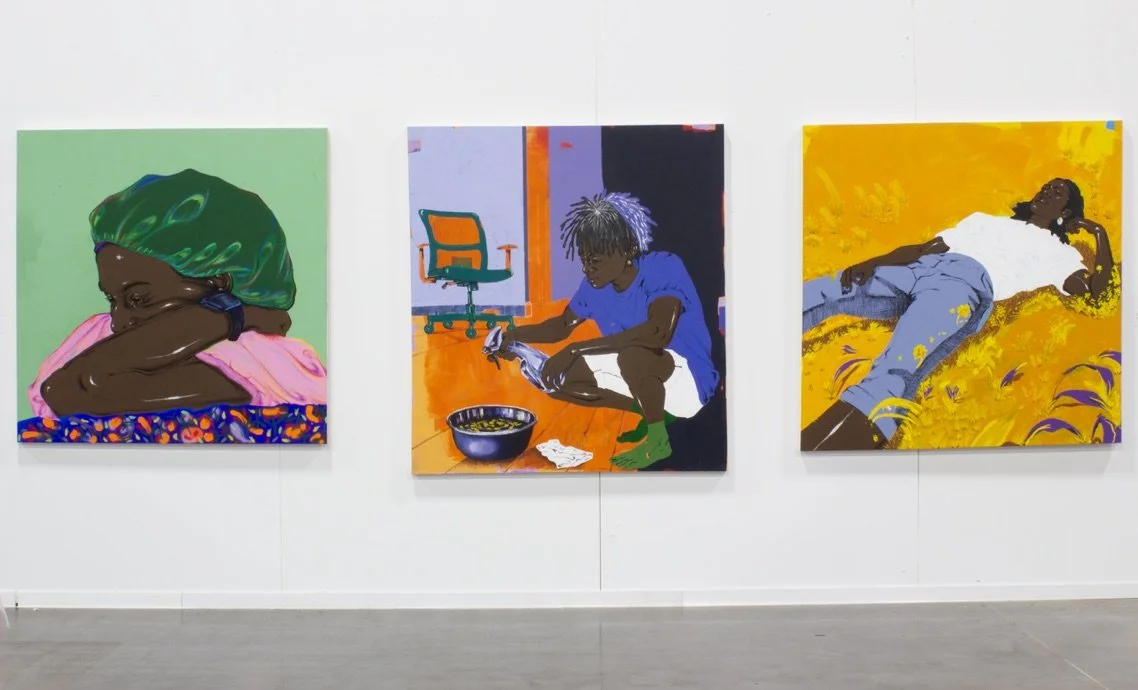
A mixture of oil, chalk, and spray paint in vibrant turquoise and yellow hues beckons viewers to rest alongside the outstretched figures in some of Haitian artist David Legrand's most recent work. Legrand is a Cornell University and RISD graduate and is currently working in New York City. Some of the main themes explored in his works are thresholds, the spaces in between places, memories, and how that all creates the self. In this interview with Ashley Davila, Legrand discusses how he navigates the translation process, oscillating between Haitian Creole, French, and English—both in his interior monologue and in how the canvas can offer a respite from those efforts by distilling meaning beyond language.
Ashley Davila: I’d love to learn about your journey. What inspired you? You’ve talked a lot about place being a huge theme across your work, and I loved your captions with the latest collection you shared on Instagram: “not absence, but suspension; not focused, but floating.” What started the journey for you?
David Legrand: What started the journey was getting that love from one of my dear uncles, who passed away recently. He was kind of the black sheep of the family. When everybody wanted to go into STEM or law, he was deeply involved in collectives and doing music. He used to work in the courtyard of my house, and I grew up around that practice. When everybody was doing something else, we were the only two people, along with some of his friends, exploring the process. Even though I didn’t know what that meant, there was something deeply fascinating about someone doing something completely different.
Courtesy of David Legrand
AD: What are some of the biggest influences in your philosophy as you create new collections? Is there an undercurrent of something that feels very distinctive to you, that feels like home for how you create pieces?
DL: That’s a good question. In terms of influence, I love Mickalene Thomas’s work. But when it comes to ideas, a lot of it comes from reading—specifically Haitian literature.
AD: Which Haitian writers have you found most engaging? Who do you feel you have a dialogue with about your work?
DL: There’s this writer called Makenzy Orcel. One of his works, Les Immortelles, is one of my favorite pieces of Haitian literature of all time. It talks about the experience of a sex worker who takes another young sex worker under her wing. The young woman was fascinated by literature—even though she was doing that work to survive, her interest was encouraged. The thing about it is confronting something that’s part of society that we don’t talk about, but some people find the courage to confront it.
AD: How do you think Haiti, Providence, Ithaca, or your time in New York City have shaped who you are as a person or artist? Do those places come through in your themes?
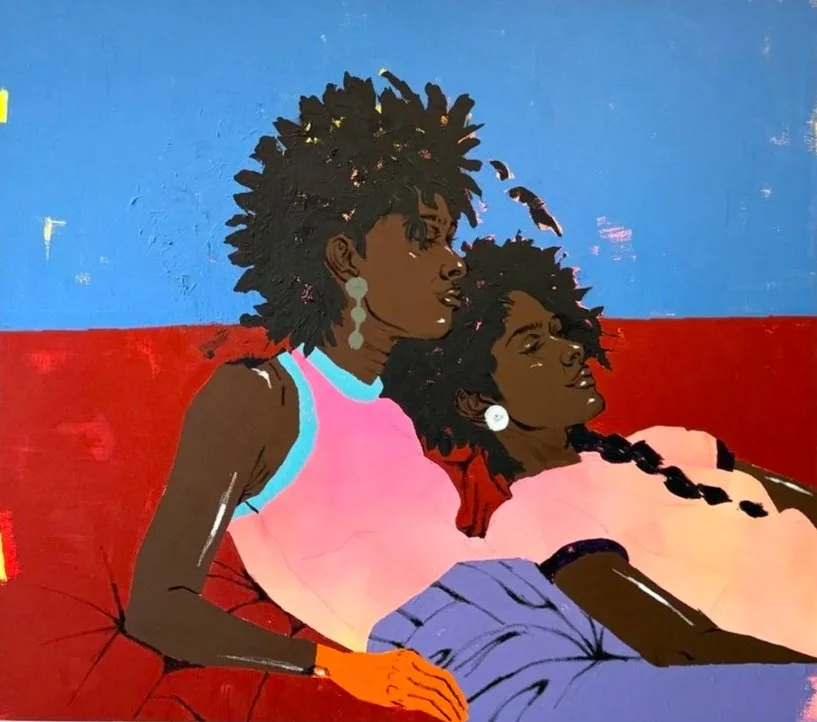
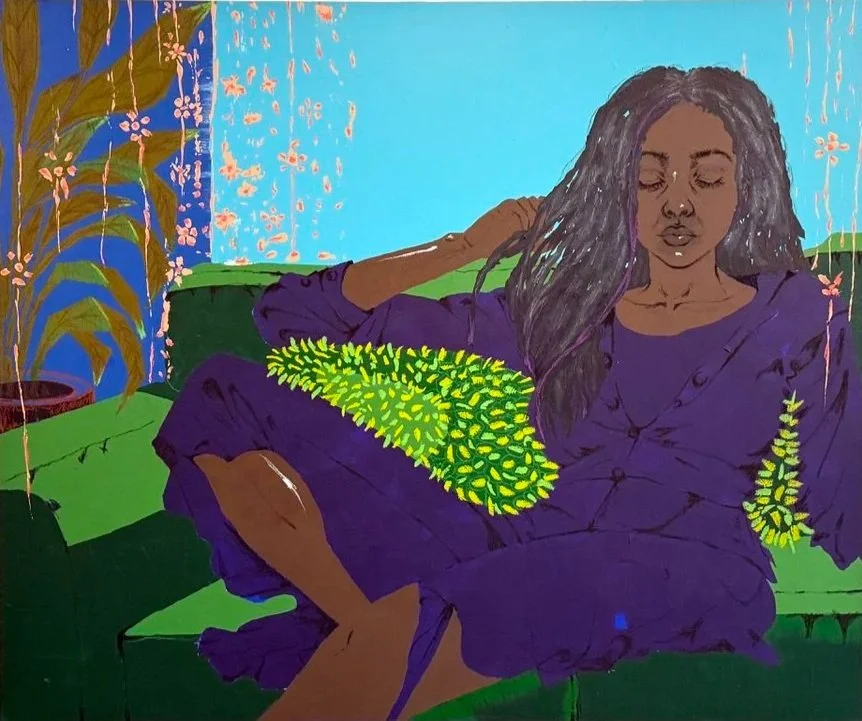
DL: I reminisce a lot about how I started my practice and the reason why I started it. A lot of the colors and places I try to construct in my work come from trying to remember what certain places looked like. It’s still there, but it’s not the same as I knew it. Part of me wanted to preserve that memory, but also confront the changes that happened. It’s similar with people—I knew them a certain way, and then they grow old. That’s not how I knew you, but I know of you. What’s in the work is my idea of those places.
Courtesy of David Legrand
AD: Do you typically work wet-on-wet, or do you allow layers to dry between sessions?
DL: It depends. When I work with oil paint, I love working wet-on-wet because there’s something that happens when you’re trying to create an image, but the paint resists the image in your head. It’s about fitting your idea into what the paint is doing and seeing what else emerges from that process.
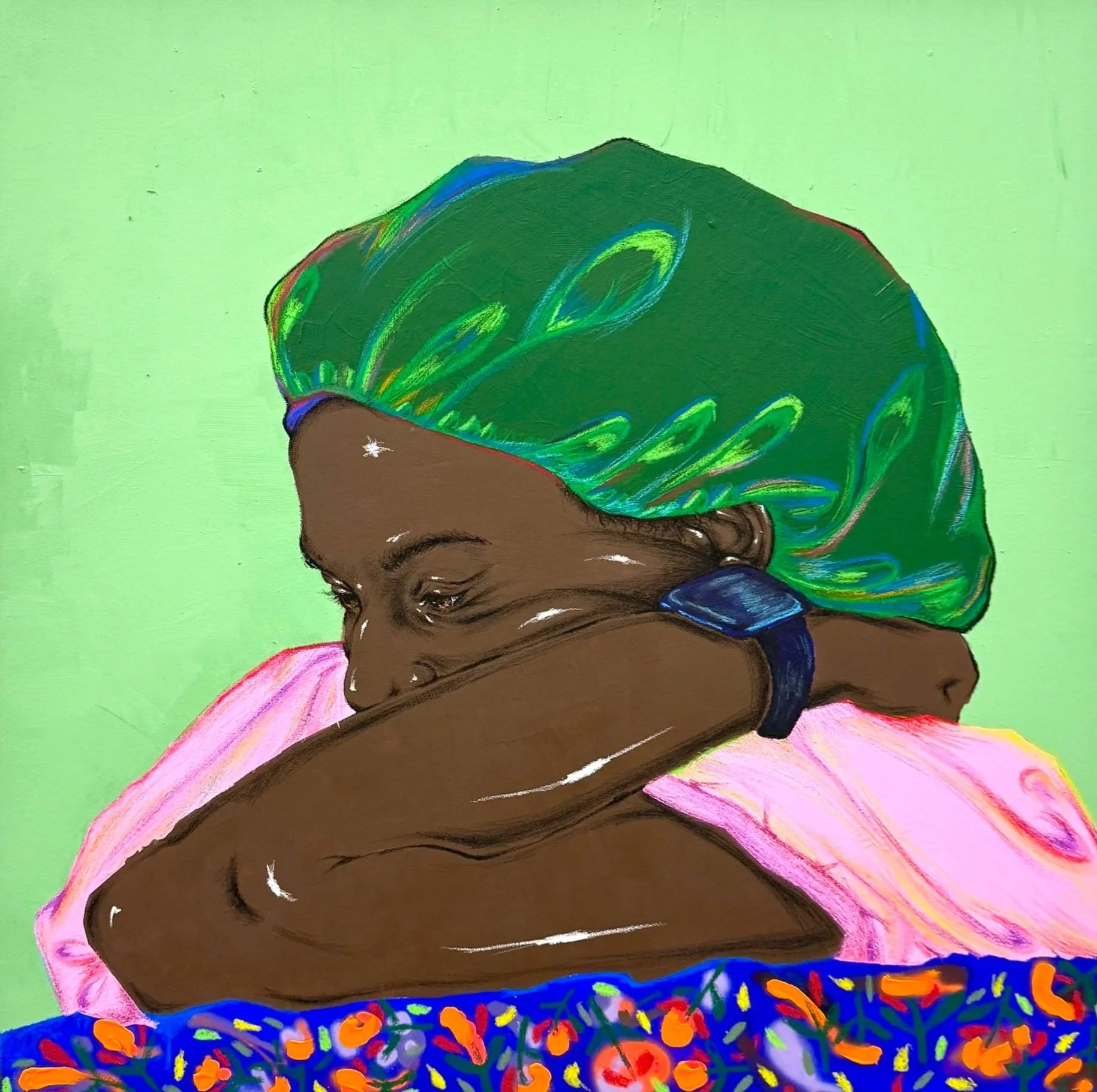
For my last body of work, I’ve been working with acrylic. One thing about it—it dries really fast, in hours. When I work with spray paint, knowing acrylic dries fast means I work really thin so the layers underneath can peek through a little, if it’s something I want to flow or integrate seamlessly with the image I’m trying to make.
AD: On that latest body of work, there’s an interesting relationship between the figures’ restful or introspective postures and the vibrant, ecstatic color palette. Do those feel like they’re in tension or harmony for you?
DL: One thing I learned through feedback is that even though in the latest body of work I’m thinking about rest and legacy, people pointed out that the colors don’t reflect that. It’s interesting because in Haiti, that’s exactly what they are. When I place my figures in a certain place or use a specific color, that’s the color palette typical of Haiti and, by extension, the Caribbean. I find that divergence interesting—how it’s understood here versus what I know of Haiti in general. Sometimes I wonder how the work would be understood if it were in the Caribbean. That transnational context is very fascinating to me, but at the same time, I’m trying to find or think of this threshold for both places.
AD: What is something you wish people would ask? Do you have an answer to a question that hasn’t been asked by anyone, specifically a journalist?
DL: I wish people would ask way dumber questions about the work.
AD: What are some good dumb questions you’d like to answer?
DL: For example, what did it feel like when you were spraying this on the canvas? Is there something you had in mind that you wanted to happen but didn’t, and how did you work around that? Not everything about it is very cerebral. Sometimes it’s emotional to me. It’s very hands-on. And that’s what I meant earlier—oftentimes people overlook the process, because the process is very physical. Were you tired while making this, since this is a big piece? How did you move it?
Sometimes, I put some of the pieces on the floor, and my professor enters my studio space and asks, “Why are you working on the floor? Is your back killing you? Put them on the wall.” And I’m like, yes, my back is killing me, but at the same time, the things I want to do on the piece, I can only do them because it’s flat on the floor. All these things are part of the process. They’re part of the work.
Courtesy of David Legrand
AD: In that spirit, do you listen to music while you work?
DL: Yes. Sometimes I do. I also listen to audiobooks or my favorite podcasts.
AD: Ok, what are the podcast recs? What’s been the background to your creation?
DL: Podcast-wise, I love Poetry Unbound. They read the work and then try to explain where the author is coming from. Sometimes they have the author talk through the pieces. I feel like I'm in conversation with the author whose piece I’m listening to, and also trying to understand the feeling they had when they were writing. Were they frustrated? Were they happy? Were they excited? All these things I’m also experiencing when I’m starting a work. It’s the same fervor in a way.
AD: Definitely. I always remember this quote that says translating work between different languages is extremely hard. Part of translation is like holding someone’s hand with a glove on. You hope you can feel the outline and the shape, but the warmth is gone. Do you feel that your work, as a form through painting and creating something on a canvas, as opposed to navigating different languages—do you feel like it’s a response to that difficulty of being straddled across different diasporas and languages? Do you feel there’s a sense of transcendence outside of that hand-holding-with-a-glove, so to speak?
DL: I feel that definitely. What I mean is, when I’m thinking in English, that’s when I feel like the translation happens. I’m holding stories for people. Sometimes when I’m explaining things in English, I feel like I’m holding my own hands with a glove to make sure certain details don't get lost. But other times, there are details that I feel like, even if they are lost, wouldn’t impede people's understanding of the story.
But when I’m thinking in French or in Haitian Creole, there’s so much more fluidity. At the same time, you won’t understand it unless you speak Haitian Creole. And sometimes even when you do speak Creole, a lot of details still get lost because stories change all the time. It’s only the core of it that is understood. So when I’m talking about those stories and thinking about time, we don’t understand it the same way. In a way, I try to translate that into symbolic elements or specific colors. But even then, it’s still hard.
For example, for my yellow painting—Basking in a Golden Light—I was thinking about rest, but people were like, well, the color yellow is very bright, so that doesn’t necessarily translate to rest. But I’m like, in Haiti, when the sun is about to set, and people are done working in their field, they just lie there to take in those things. That’s the specific point I’m thinking about. But it doesn’t get understood in the same way. And that’s fine too. That’s what I meant earlier when I said there’s a part of the work I take with me. Those are those moments. If you come from a specific background, you bring in your own details; I’m welcoming you into my world, so that’s also fine.
AD: What’s next for you? Are you creating any new collections? Do you have any shows coming up?
DL: Yeah, actually, I’m currently working on one to three new pieces. The body of work that I have is still in progress. As for shows, I actually just received this email inviting me to a show happening on Martha’s Vineyard next summer. I also have a public piece that’s in the works for the Avenue Concept in Providence. That’s going to happen sometime in May.
This interview has been edited for clarity and length.