

.webp)

“Thucydides Fever Dream” at Hill Art Foundation
Review
Artes Visuales: The Latin American Avant-Garde in Print breaks dichotomies. Tensions that rift old and new, figuration and abstraction, or independence and interdependence guide the exhibition and perplex its title. How productive is this category of the Latin American Avant-Garde, if it encompasses so many artistic styles, historical references, and sensibilities specific to each nation? This exhibition brings together various answers to that question by showing works featured in Artes Visuales, a Mexico-based art journal led by Carla Stellweg published between 1973 and 1981.
Artes Visuales cared little for art criticism. In its first issue, Stellweg scolded art critics who identified as tastemakers, knocking their subservience to the law of supply and demand: “perhaps the wisest course,” she writes “is merely to present an unprejudiced panorama of the visual arts [ . . . ] in its diverse manifestations with justifiable emphasis on the Latin American scene (not out of political or Third-World considerations but rather for reasons of historical or emotional affinity).”[1] Good art, to her, was any cultural expression that captured the essence of the present moment—no matter its medium, style, subject matter, or political messaging. Taste surely informed her editorial scope, but never clouded her horizon. Artes Visuales thus blossomed into a collaborative effort to define the Latin American Avant-Garde in all of its complexity, before it would come to be defined by outsiders. At a time of overlapping US-backed military dictatorships across South America, this was an inherently political effort, further amplified by its being published in Spanish and English—at once rejecting and addressing the English-speaking world.
The first exhibition dedicated to Artes Visuales fittingly takes place in New York, given the magazine’s bilingualism and the fact that Stellweg lived her life between here and Mexico City. Mounted at Hunter College’s Leubsdorf Gallery in the Upper East Side, the exhibition is curated by Harper Montgomery, curatorial fellows Reuben Gordon, Lisa Mason, and Grace Sanabria, and several other students from Hunter’s MA and MFA programs. It reunites reprinted issues of Artes Visuales and other Latin American art publications from the 1970s, along with artworks appearing in, or made for, the magazine as page art.
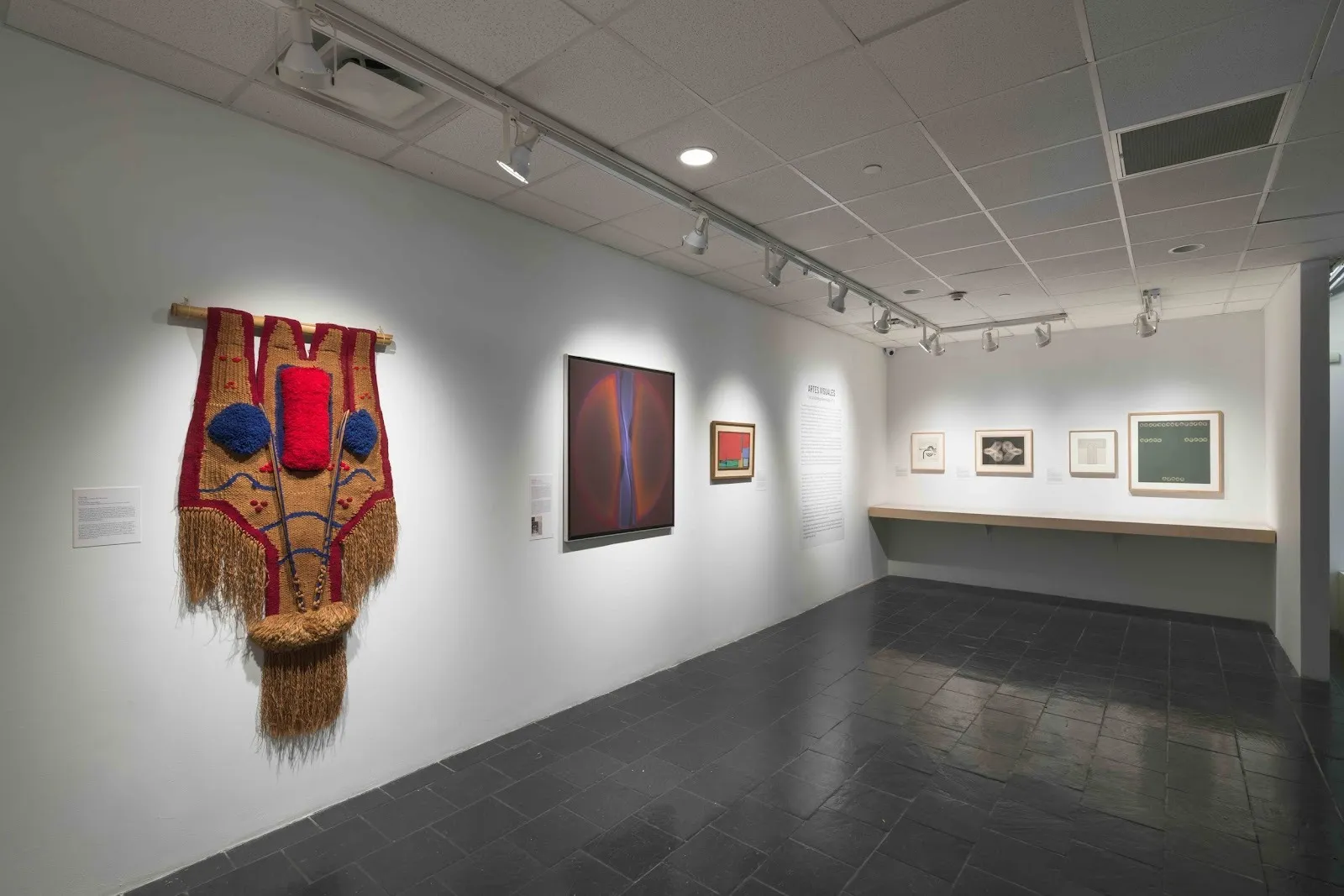
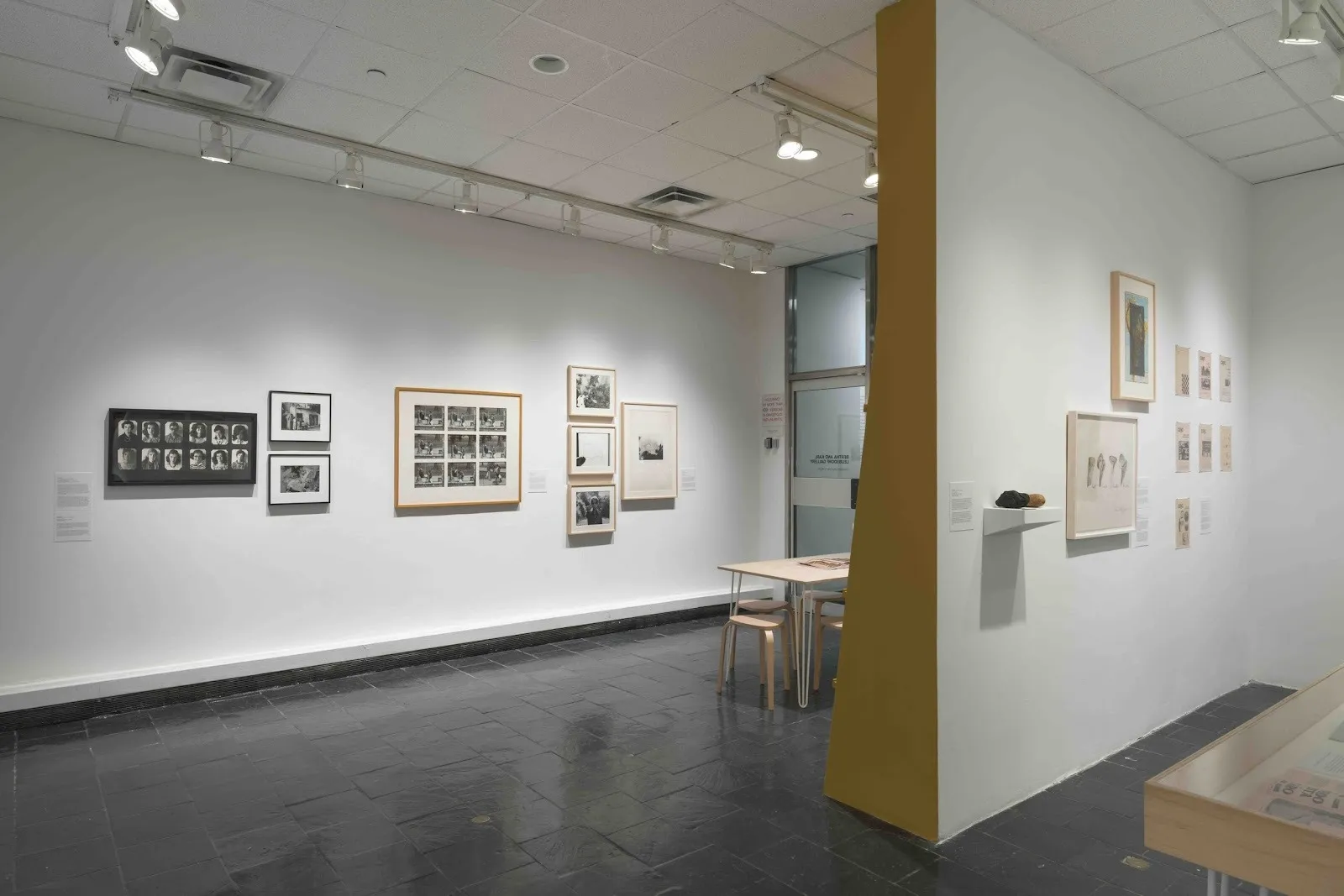
The curators embrace a non-chronological style, circumventing the potholes of having two entrances while following the magazine’s eclectic rhythm. As you traverse through the three half-connected galleries, you’ll forego borders separating nations, styles, and scenes. The exhibition aptly feels like going through an Artes Visuales issue, centering Stellweg’s role in fostering experimentation across Latin America, albeit with a slight bias for Mexico and Argentina. Beyond the magazine, what loose structure remains are clustered moments highlighting specific media, histories, or thematic concerns.
Many works take their cues from graphic design. Obviously, there are the bold, vibrant Artes Visuales covers by Vicente Rojo Almazán, but a graphic design sensibility also manifests in a cityscape of Mexico City by Mathias Goeritz, the prismatic paintings of Kazuya Sakai and Günther Gerzco, a grid-like pastel on linen by Myra Landau, or in experiments with early digital generative software by Manuel Felguérez and Eduardo Mac Entyre—all the more avant-garde in the age of AI art. Other artists fuse visuality and text to legible political aims, such as the “mail art” of Guillermo Deisler, the visual poems of Jorge Caraballo and Clemente Padín, the agitprop of Antonio Caro, the map-based works of Horacio Zabala and Anna Bella Geiger, the satirical prints of Cildo Meireles, or an artist book by Julio Plaza. Conceptual installations by Argentine artists Victor Grippo and Alfredo Portillos, two artists affiliated with the Center for Art and Communications (CAyC) in Buenos Aires, deal with notions of natural heritage and cultural syncretism. A single, striking fiber piece by Marta Palau stands in the center of the space, nodding to Sanskrit moral philosophy and Andean textiles, yet unmistakably modern. This leaves photo-based work on one wall, holding the conceptual work of Paulina Lavista and Luis Camnitzer, and the social documentary practice of Regina Vater and Martha Zarak. The magazine also promoted video art and performance, but they’re not part of this exhibition.
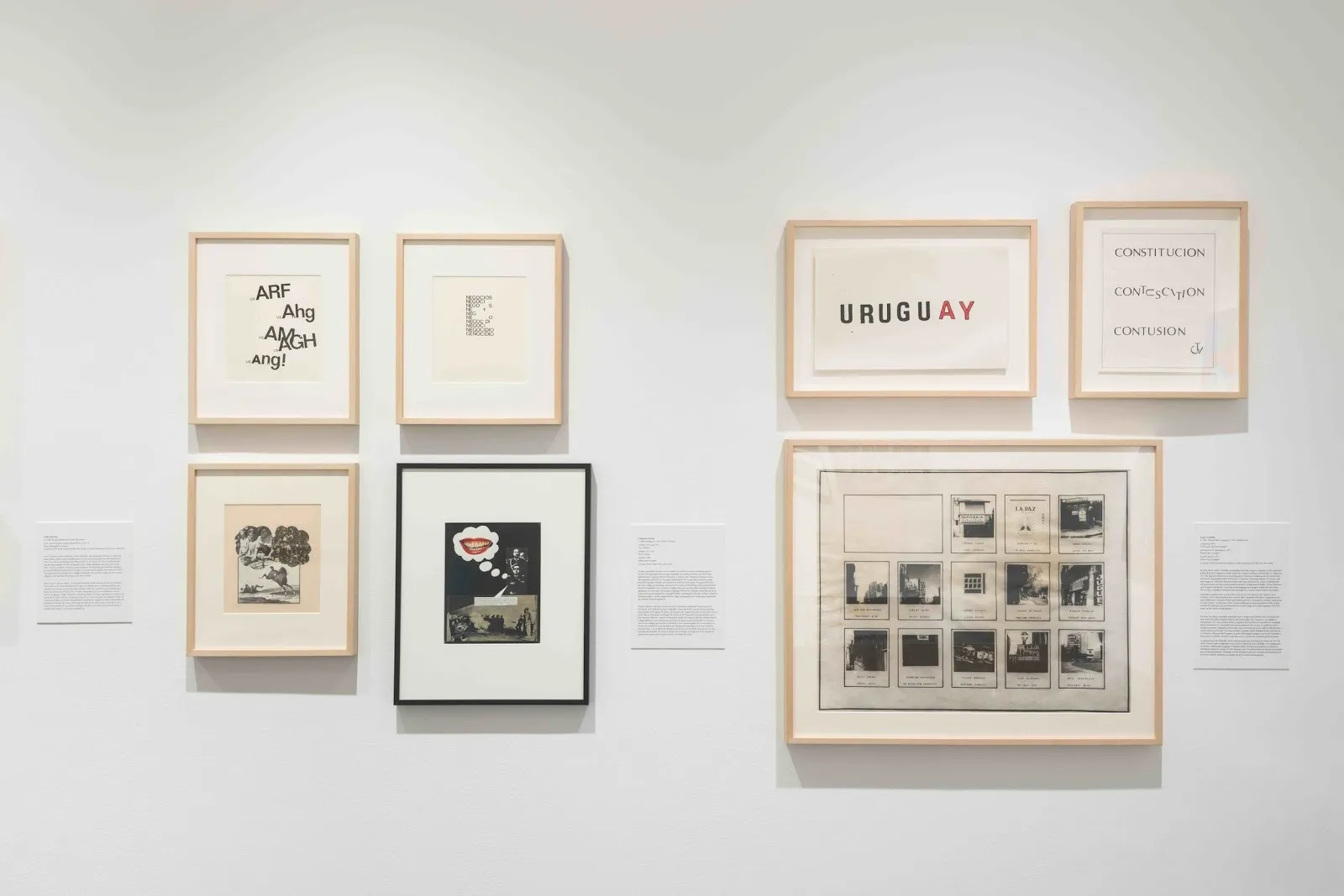
A throughline here is a cross-cultural concern for textuality as a means to negotiate questions of speech and censorship, which is conveyed through clever pairings. Deisler and Caraballo both lament their country’s military regimes by fracturing language—in Untitled (1973), negocios (business) unscrambles into genocido (genocide), whereas in Constitución (1973), constitución (constitution) decomposes into contusión (contusion). Zabala’s Rica del sura (1974) and Geiger’s Amuleto (1977) both anatomize the map of South America as an imaginative, ideological frame structured by colonial language, unveiling what Edward Said might call their “textual universe.”
Preoccupation with the ideological supremacy of text equally manifests in Caro’s En 1978 todo está muy caro (1978), Plaza’s Poemobiles (1974), or even Padín’s Penal (1979) prints, whose visual poetry positions abstraction as a gesture of resistance against speech censorship. It’s tempting to extend this reading to the experiments with generative technology by Felguérez and Mac Entyre—as if self-effacing digital abstraction would be the sole proper articulation of a world devoid of free expression. Indeed, these aesthetic concerns were not primarily artistically motivated. They were deployed as potent cultural expressions of political protest against US interventionism, hyper-consumerism, the patriarchy, and military persecution within Latin America.
It’s not clear why Artes Visuales stopped publishing in 1981, but by then, it had evidently flourished into something exceeding a mere art publication. If the experimental work fails to communicate this, multiple selected artist quotes spread out across object labels testify to the deep humanism underlying this project. For Stellweg and these artists, art writing became a mode of community-building.
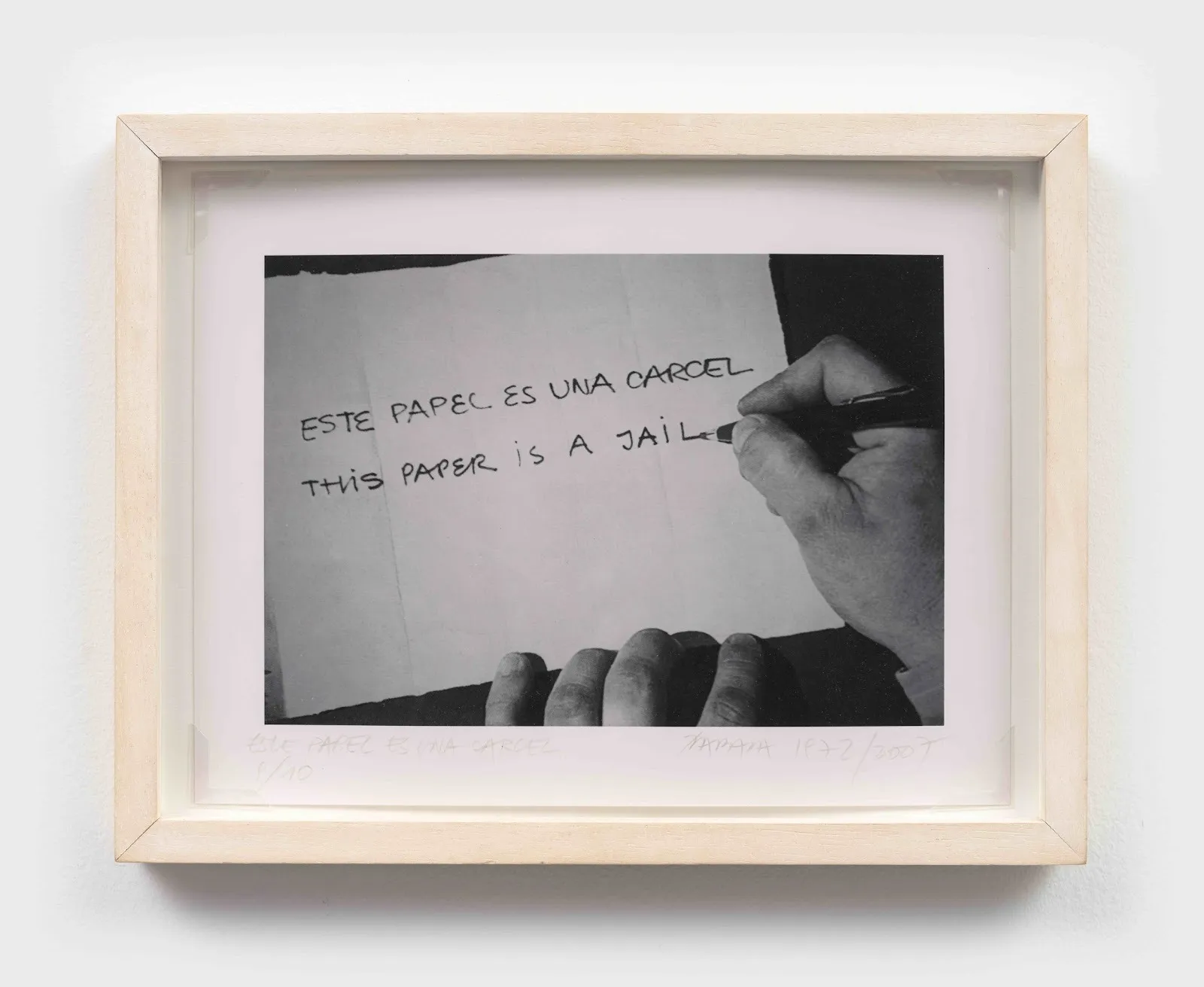
A 1972 work by Zabala, Este papel es una carcel (This Paper is a Jail), has stuck with me. It seemingly questions the value of writing and artmaking in times of turmoil. Though made during the Argentine Revolution, it shortly preceded military dictatorships in Chile, Uruguay, and Argentina. If art seeks to capture the moment, what can it produce amid incessant brutality? Is artmaking then just another form of prison, a Sisyphean exercise amounting to nothing? Este papel es una carcel shows Zabala confronting these doubts, and yet, overcoming them through artmaking. It seems a microcosm of Artes Visuales: a product of doubt and sorrow, fortified by solidarity and faith.
Artes Visuales: The Latin American Avant-Garde in Print is on view at the Bertha and Karl Leubsdorf Gallery at Hunter College from October 16 through December 13, 2025.
[1] Carla Stellweg, “Sense and Nonsense of Art Criticism in Mexico,” Artes Visuales 1, no. 1 (1973): 50.