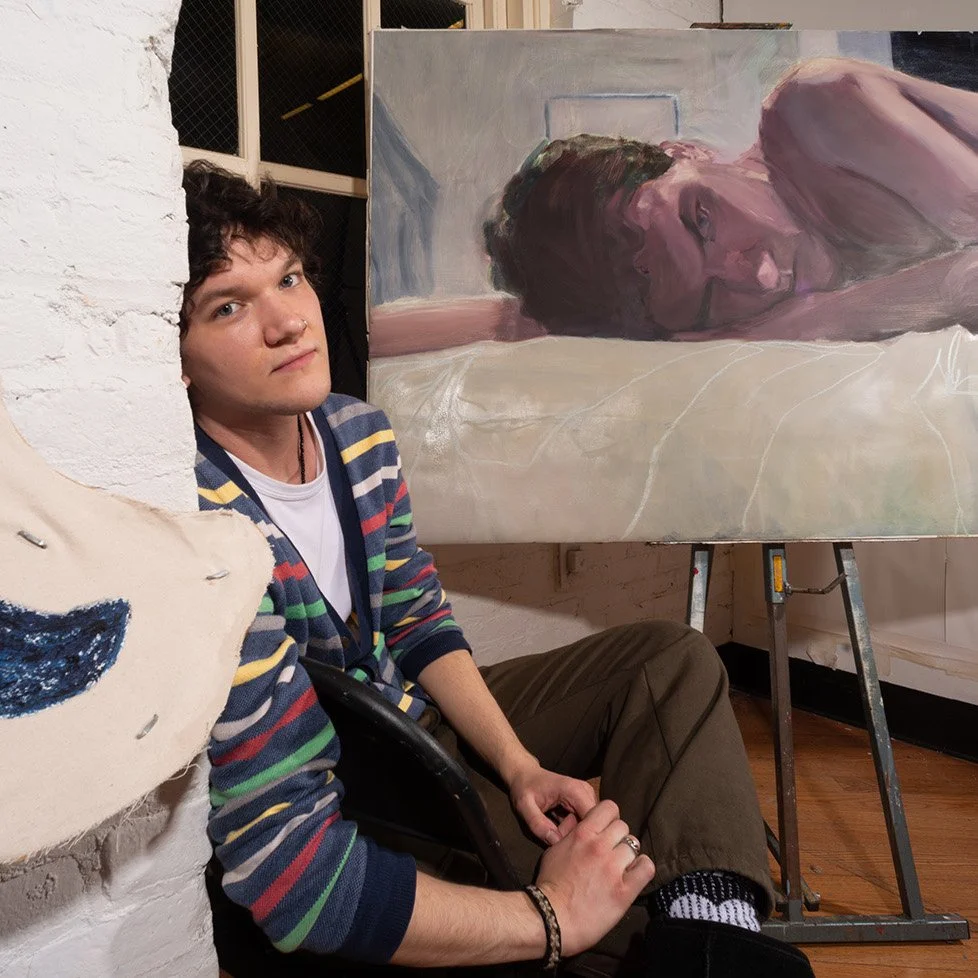
Beyond Cell Doors: Russell Craig’s Vision
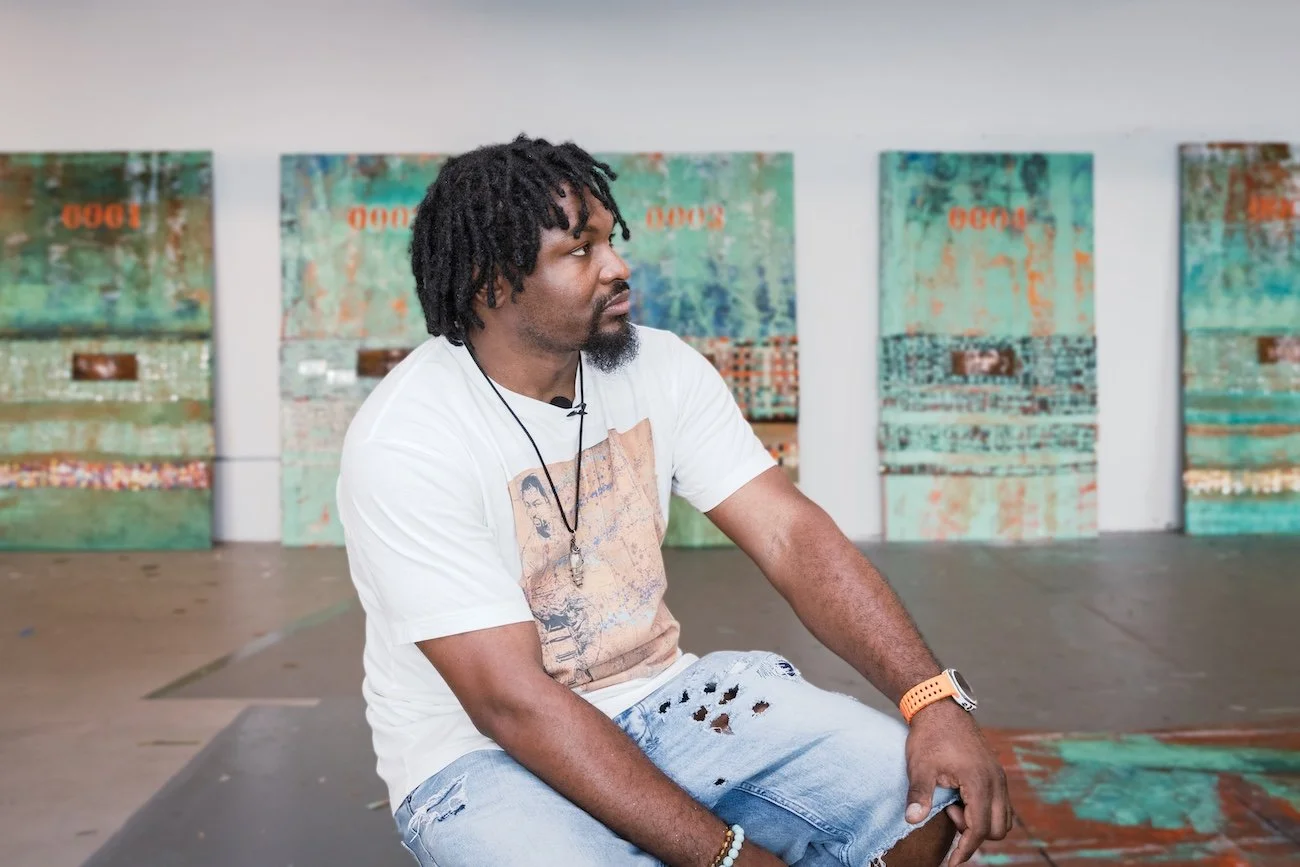
Portrait of the artist, Russell Craig. Courtesy of the artist and Clubhouse Gallery.
Inside Russell Craig’s studio, almost halfway up the gargantuan World Trade Center, the view is one of success: paint streaks are interrupted by the outlines of canvases that once hung there, now rectangular ghosts left behind after being taken down for exhibition. Outside, city lights speckle the night. As a senior fellow at the Silver Art Projects artist-in-residency program, Craig has plenty of space to sprawl out and create. His studio is filled with the classic likes of canvas and paints, but also unexpected fabrics and a large industrial sewing machine table. The room feels like an overlapping chart of his practice: part painter’s studio, part material research laboratory, part reconstruction site.
Originally from Philadelphia, Craig is a self-taught artist. While facing almost a decade of incarceration, he reconnected with art as a distraction from his situation, using it as a tool for internal moving when external moving was limited. After leaving prison, he began working with Mural Arts Philadelphia and is now represented by Clubhouse Gallery in Wellington, Florida. His work is in the permanent collections of the Brooklyn Museum, the Studio Museum in Harlem, the Bronx Museum, and the Rose Arts Museum at Brandeis University in Waltham, Massachusetts.
While incarcerated, Craig had a prophetic vision: “When I was in prison, I told people . . . I’m going to get out and be a famous artist . . . I was putting it on thick.” There was no plan B, and evidently, no reason to have one. With artistic intuition and a deep faith in manifestation, Craig worked to improve his skills, fill commissions, and make connections—he knew he was meant to join Mural Arts Philadelphia, even when their program within the prison was full. In a recent artist talk with Eileen Jung Lynch, the Director of Curatorial Programming at the Bronx Museum, Craig shared that he thought, “While I’m in prison, I’m just going to get my skills up to the point where I can be undeniable with it.” Having reached that point of undeniability, Craig’s works are now able to ask even larger questions about systems and surfaces.
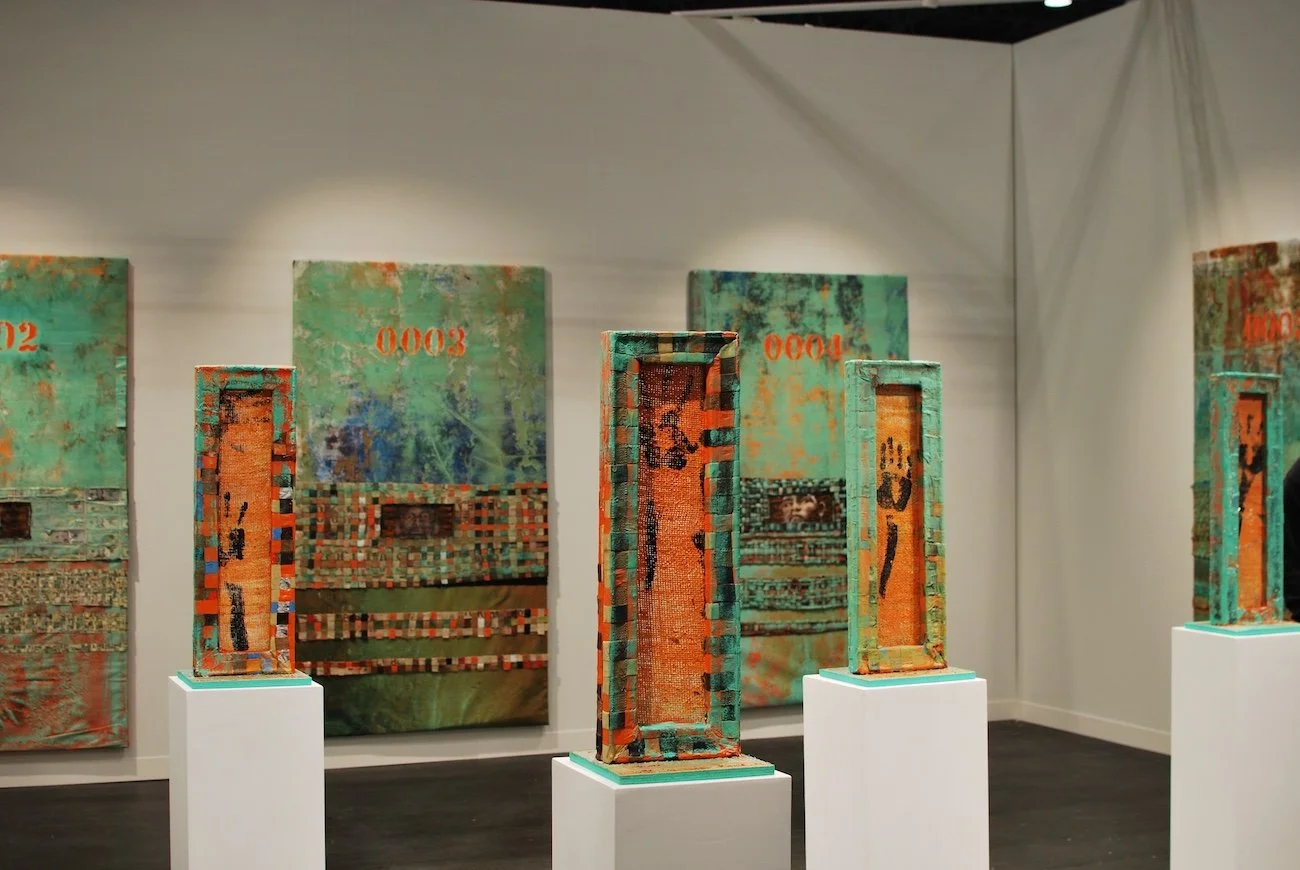
Russell Craig. Installation view of Carceral Views with Clubhouse Gallery at The Armory Show, 2025. Photo by Parker Ewen.
At last year’s Armory Show, Clubhouse Gallery’s booth featuring Carceral Views, a solo presentation of Craig’s works, felt like one of the most engaging and fresh installations in the fair, landing as a standout for many visitors. Lining the walls were life-sized prison cell doors with narrow food-slot openings, revealing portraits of the wrongfully convicted Central Park Five. Narrow prison windows, stretched with burlap and marked with handprints, dotted the middle of the booth, driving home feelings of confinement. These works speak in the high-contrast palette of many American prisons, in jumpsuit orange and institutional blues. Passersby are roped in by brightness to then encounter claustrophobic visuals of confinement. The discernment of what is being depicted as you get closer is equally captivating, even though heavy.
It is not easy to aestheticize confinement, especially through the lens of violent mass incarceration. To make something that people often willingly turn away from regularly into something that people actively seek to visualize, understand, and even applaud is a huge feat. His impact at the Armory points to why he is such a compelling artist to watch. In a sea of overly palatable art, often exploring over-churned theoretical aesthetics or concepts far detached from lived experience, Craig creates from something more immediate.
For his recent solo show, Redemption with Clubhouse Gallery, Craig chose to feature Right of Return grantees within the cell doors. In 2017, Craig co-founded the Right of Return Fellowship with the support of Agnes Gund, a renowned art collector and early backer of Craig. The initiative now operates through the Center for Art & Advocacy and supports formerly incarcerated artists through grants, mentorships, and professional development. By featuring these artists within his door motif, Craig emphasizes that these stories are not rare exceptions. People facing incarceration are not only real and complex humans; many of them are creative, compelling, and distinctive artists. Highlighting the Central Park Five at The Armory Show and then highlighting contemporary artists who have experienced incarceration at his solo show in Florida demonstrates a genuine commitment to expanding the conversation through multiple avenues, rather than simply centering on what audiences may already be familiar with.
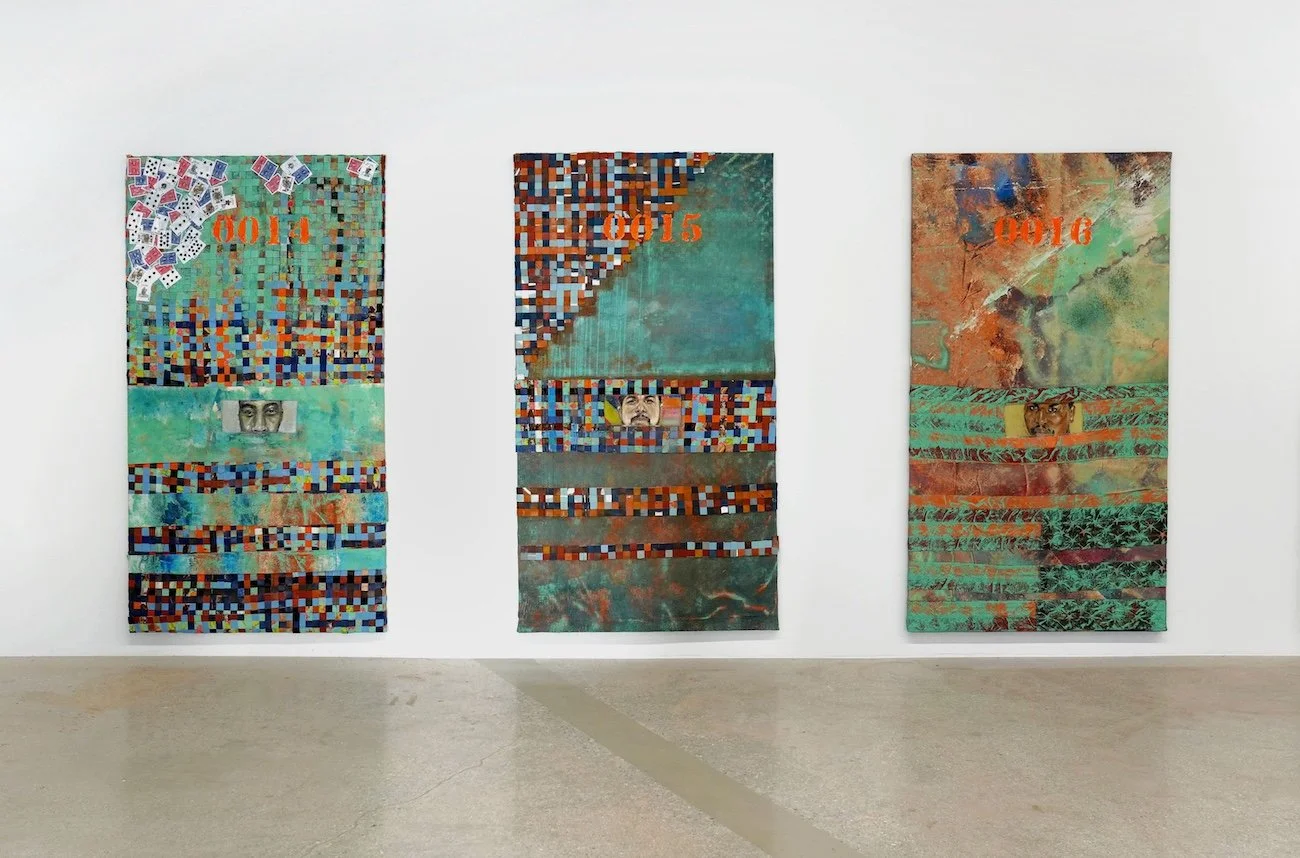
Russell Craig. Installation view of Redemption. Works shown (left to right): 0014, 0015, 0016. All three works from 2026 and approximate 89 x 48.5 in. Various materials include acrylic, horse hide, and horse pattern fabric, leather strips, ground coffee beans, burlap coffee bag, cut American flag, playing cards, heavy gel glue, and pastel on stretched canvas.
As Eddie Ellis, a former Black Panther who served twenty-three years in prison, said, “Prisons and prison populations are a reflection of what takes place outside of the prisons.” Craig’s work reflects the prison system and how our country treats incarcerated individuals: people often lost to a system that is designed for them to disappear within. He doesn’t see the door series stopping for the foreseeable future, which resonates with the unfortunate ongoingness of mass incarceration. “The doors can just go on and on and on and on . . . [because] millions of people are in prison.”
Up close, the doors reveal another layer of Craig’s practice, in a deep attention to material and surface. The doors are impressively worn—textures rarely seen on painting surfaces. Paint accumulates in such dense, fine spots jutting off the canvas that it appears like spores or sediment up close. From afar, the illusion of rusted metal is more than convincing. Craig cited Jack Whitten’s 2025 MoMA exhibition, The Messenger, as inspiring him to ask while creating, “How far can you push paint?” The tension between illusion versus material truth can stretch the question toward carceral theory—how far can the proposed surface hold the true weight of a deeper system?
Materials used for the cell doors include items found in prison commissaries: ramen, coffee grounds, chip bags, and playing cards. This does more than just highlight scarcity in available materials; it exposes the too-often closed loop of prison life through cycles of systemic recidivism—the doors themselves constructed from what is available within that environment. Similar to his surface building, the materials are not hidden purposefully, but peek in and out of recognition.
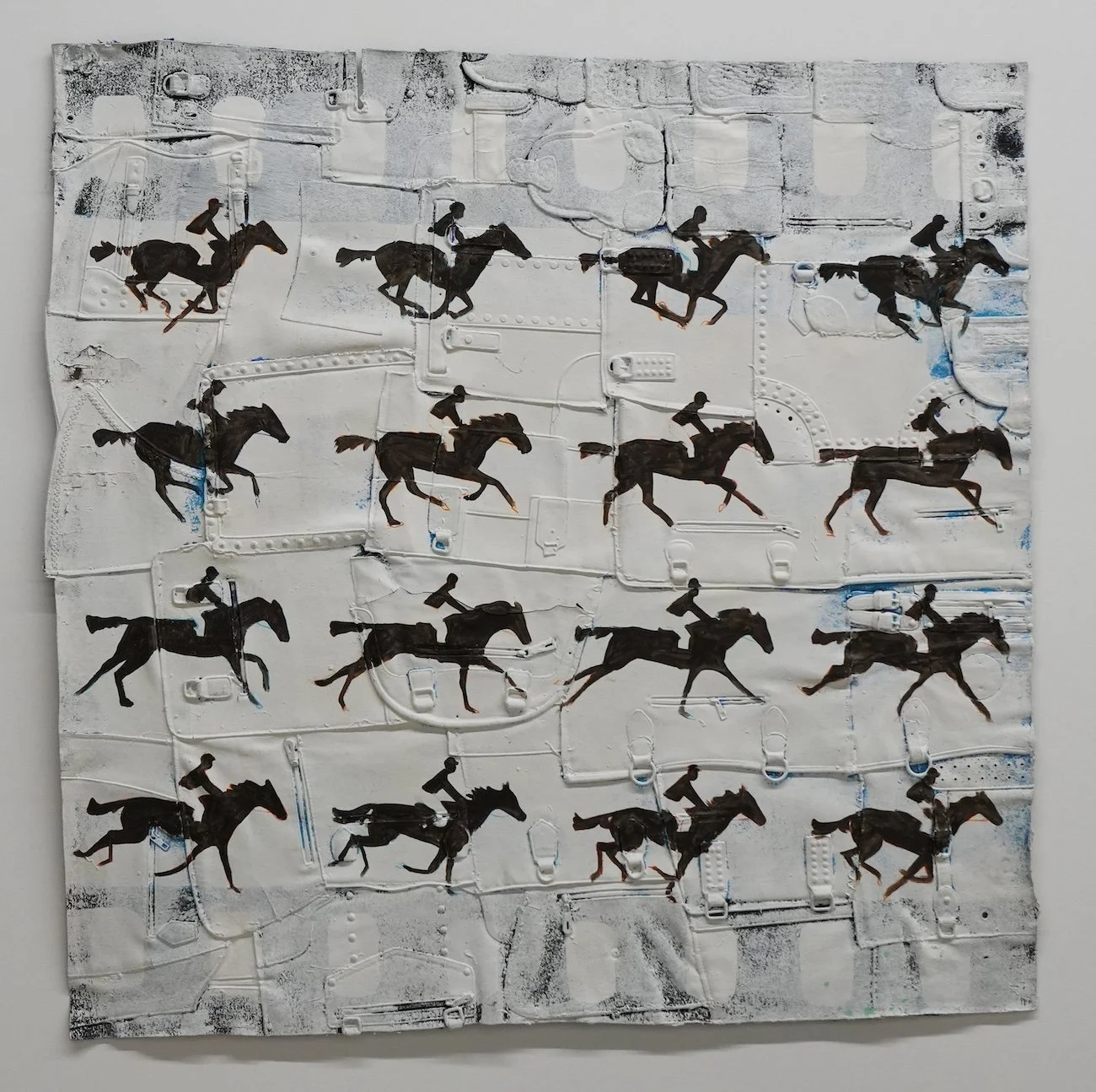
Russell Craig, Identity, 2026. Acrylic, heavy gel glue, stitched leather bags. 60.75 x 60.25 in. Courtesy of the artist and Clubhouse Gallery.
Horse hide and horse-patterned fabric appear throughout his works as well, along with stitched leather bags and recurring horse imagery. Leather carries the historical weight of prison labor, and Craig subverts the dynamic by disassembling and reconstructing. In this, the material becomes a tool for expression rather than exploitation. With horses as a symbol, Craig takes the associations of control, labor, and freedom by the reins, making it possible to highlight a reclaimed autonomy. Here, Craig forms a vocabulary of agency and resistance built from materials of former constraint.
Beyond material, the installation scale is confrontational. Life-sized cell doors with life-sized portraits glimpsing through small food slots confront the reality of people brutally locked away. Similar to Craig’s use of colors, the scale of these works presents an interesting desire to close distance, but uncover a new narrative once you do. Standing near the doors gives a sense of helplessness—a body behind an untouchable surface, one that still begs you to reach out with its perplexing and enticing textures. A tarnished metal door conveys a forgotten portal, and thus a reminder of a forgotten person.
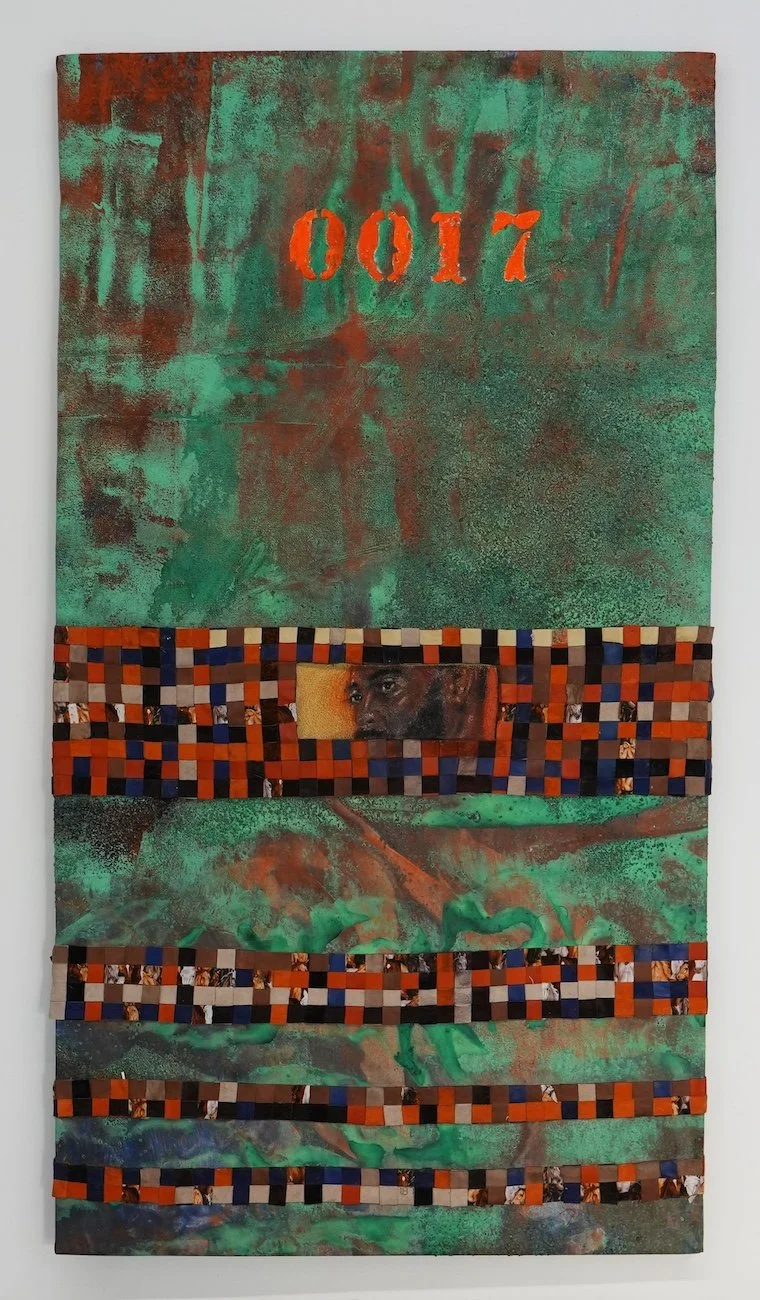
Russell Craig, 0017, 2026. Acrylic, paint primer build up, ground coffee beans, heavy gel glue, horse hide and horse pattern fabric, leather strips, and pastel on stretched canvas. 89.5 x 49 in. Courtesy of the artist and Clubhouse Gallery.
Craig’s newer works merge realism and abstraction. In his conversation with Lynch, Craig described how he initially focused on realism to remove any doubt in his technical abilities. Eventually, however, something shifted—“The voice told me: it’s time to go abstract.” Craig credits much of his artistic direction to spirituality as a guiding force in his practice, oftentimes finding himself “not making decisions,” but doing what he feels he is told. This shift towards welcoming abstraction reflects a merging of his own experiences with a willingness to act as a vessel for the work that comes through him—less of a stylistic pivot, and more of an expansion of what can be held in the surface of a work.
“The work is an extension of yourself. Some work . . . there’s no spirit in it, there's no movement, there’s no nothing in it, no soul.” Craig’s trust in the intuitive process allows him to produce work that is deeply personal while still speaking to the larger, all-encompassing issues of mass incarceration. Abstraction opens the space where the personal and the at-large can coexist without literalism.
Even during our interview, Craig was firing off ideas and imagining potential installations with intense clarity. The immediacy and confidence of his thinkies carries a prophetic quality, reminding me of Hilma af Klint’s famous plans for a future Guggenheim installation long before its construction.
Russell Craig is impressive for many reasons—his story is undeniably one of perseverance, passion, and strength. But what may be most impressive is his ability to make difficult conversations engaging in his work rather than distancing. Addressing important issues to viewers, such as mass incarceration, sometimes feels like a tightrope between urgency and comfort, but Craig does no such gymnastics: instead, he approaches it with an ingenuity that manages to avoid both sensationalism and simplification. His thirst for the next move and his willingness to be a vessel for the art he must make are unmistakable both in conversation and in the work itself. Craig approaches his subject with tact, tenacity, honesty, and experience. His vision is expansive, his practice serious, and his commitment unmistakable. He is, above all, “undeniable with it.”