


.webp)
Marc Kokopeli: “M.Kokopeli CURSED/01” at Gladstone
Review
Baroque Apocalypse features two components: a large-scale neon light sculpture, the ninth in Norwegian interdisciplinary artist Anne Katrine Senstad’s spatial neon series ELEMENTS (2018–); and a four-channel sound environment created for this installation by the renowned composer and longtime collaborator JG Thirlwell. Together, they operate as interdependent forces that guide the viewer’s sensory and temporal experience. The installation’s neon elements radiate a subtle, nearly imperceptible stirring to form a structured but intimate luminosity that seems to hover between physicality and illusion. The accompanying soundscape amplifies this effect, with its low tones resonating with the viewer’s bodily rhythm and echoing the gentle pulsations of the neon gases themselves.
At first glance, the work appears restrained. Delicate neon tubes are arranged in vertical columns, tracing lines of color through the space. This initial sense of stasis and the synthetic register of neon light are deceptive. Only when you move through and around the structure do you slowly notice the elemental nature of neon’s noble gases, softly colliding and releasing energy that emerges as a faint, rhythmic pulsing of light so subtle that it nearly slips beyond recognition. As the eye adjusts and the body begins to synchronize with this nuanced modulation, the colors seem to breathe along with you. This shared rhythm produces a curious intimacy between the viewer and the work, collapsing the distance typically maintained in a gallery setting. This sense of intimacy is deepened by the installation’s sonic environment, an immersive envelopment of sound that feels as though it is meant to be internalized by a continuous field of resonance.
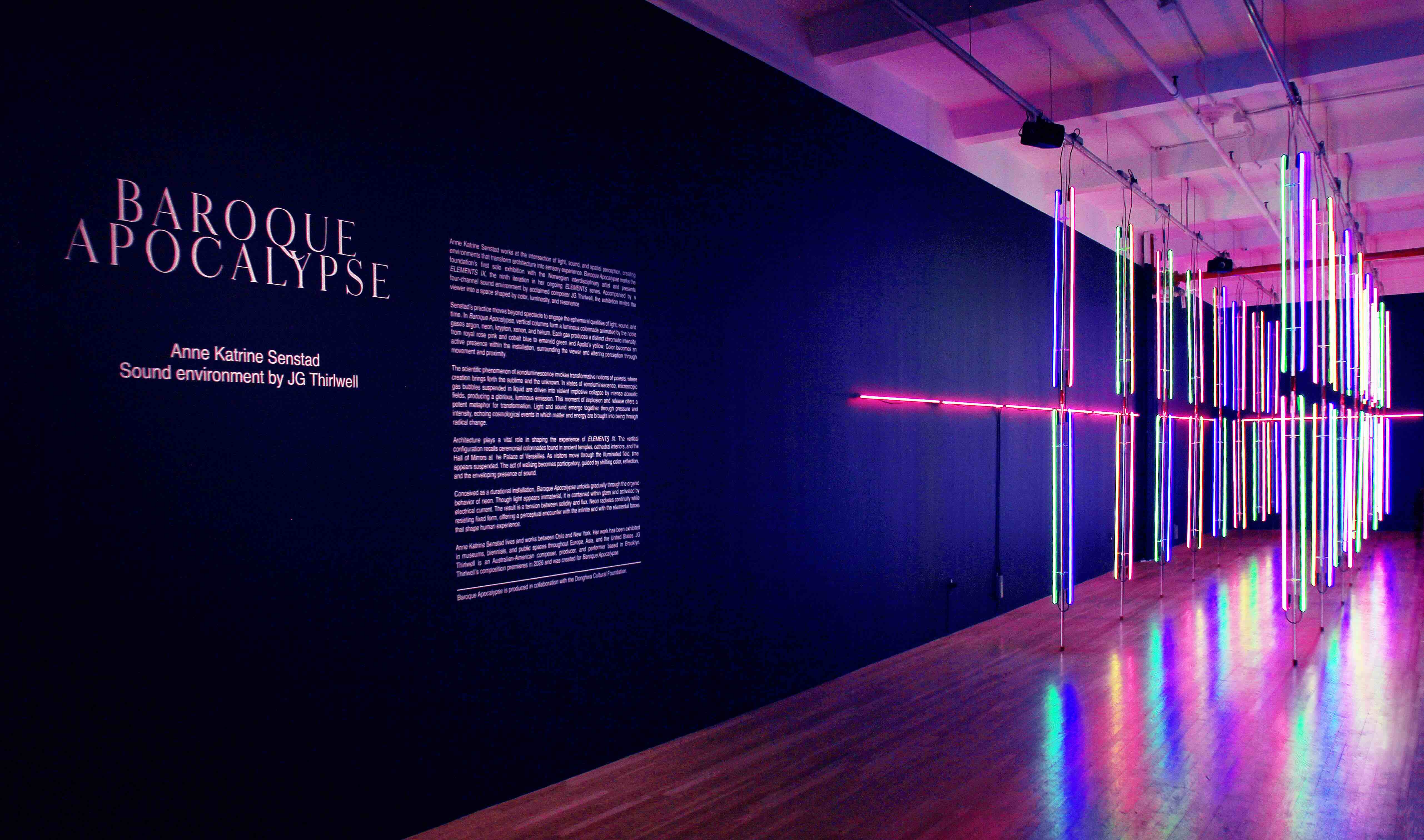
The interplay of pulsing light and ambient sound results in a feedback loop of sensation. The combination nudges the body into a meditative state that oscillates between calm and heightened awareness. I became acutely conscious of my own presence, sensitive to my breathing and movements alongside a creeping feeling of submission, signalling my absorption into the work’s experiential flow. Along with sound, the spatial design reinforces this immersive effect. The gallery walls are painted a deep, saturated blue, evoking ambiguous associations, such as the ocean floor, where light is scarce and diffused, or the final moments of a crepuscular sky, when day dissolves into night. This surrounding darkness actively shapes the experience of the neon, calling attention to its clean lines, chromatic intensities, wireframe structure, and branches of luminous pink neon that drift into the surrounding walls. The boundary between object and atmosphere seems to blur.
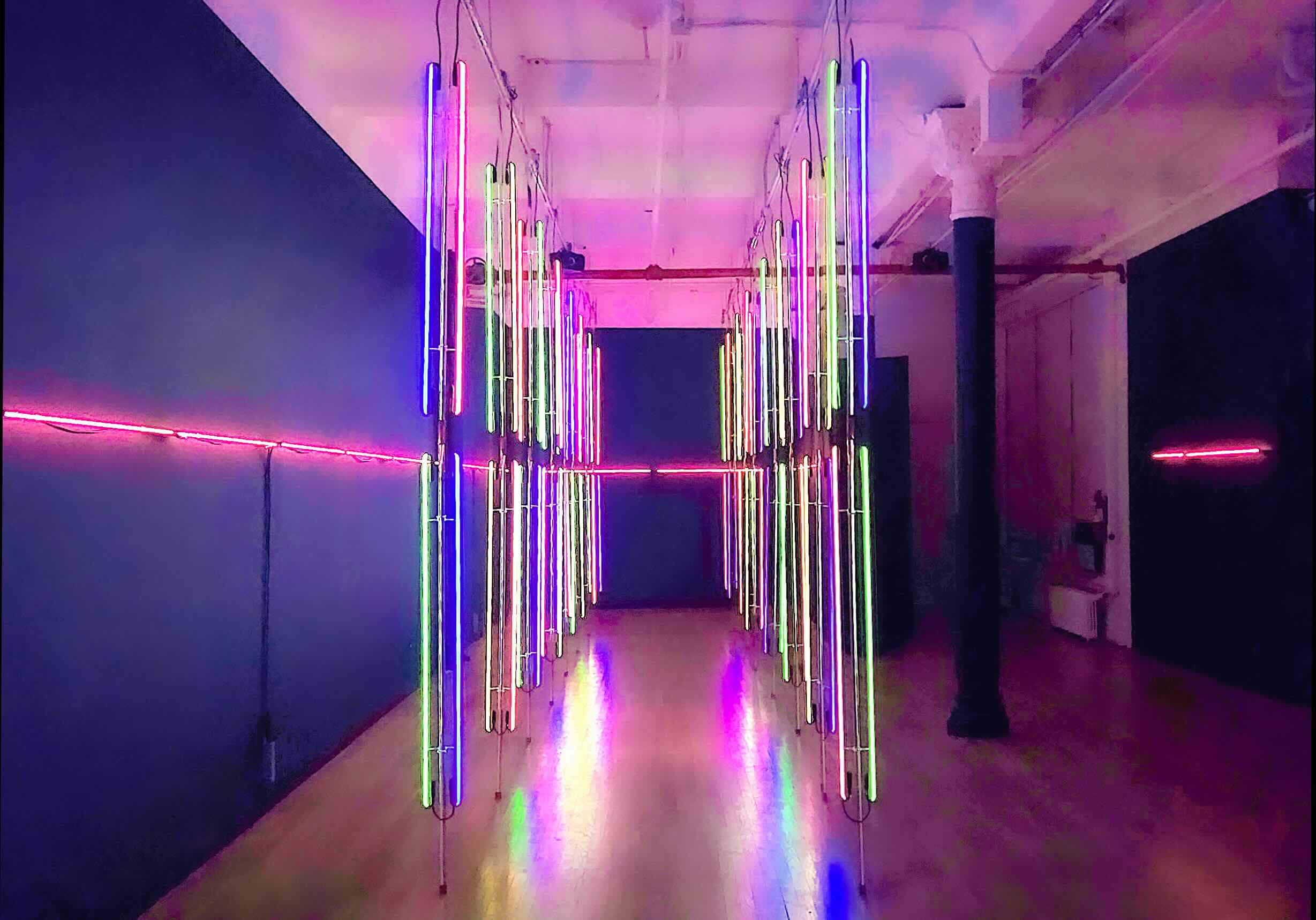
Also active is a metaphoric resonance in the scientific phenomenon of sonoluminescence that underlies the work’s conceptual framework. The idea that light can emerge from the implosion of microscopic gas through collision and release echoes the installation’s own logic. Light and sound here are not stable givens, but emergent events shaped by forces we were not aware were present. This lends the work a cosmological dimension, as if it were simulating the conditions through which matter and energy come into being. In this sense, Baroque Apocalypse operates as a kind of neon-fueled poesis, a structure of becoming held together with light and encouraged by sound, where time and materiality feel like they are being held in suspension.
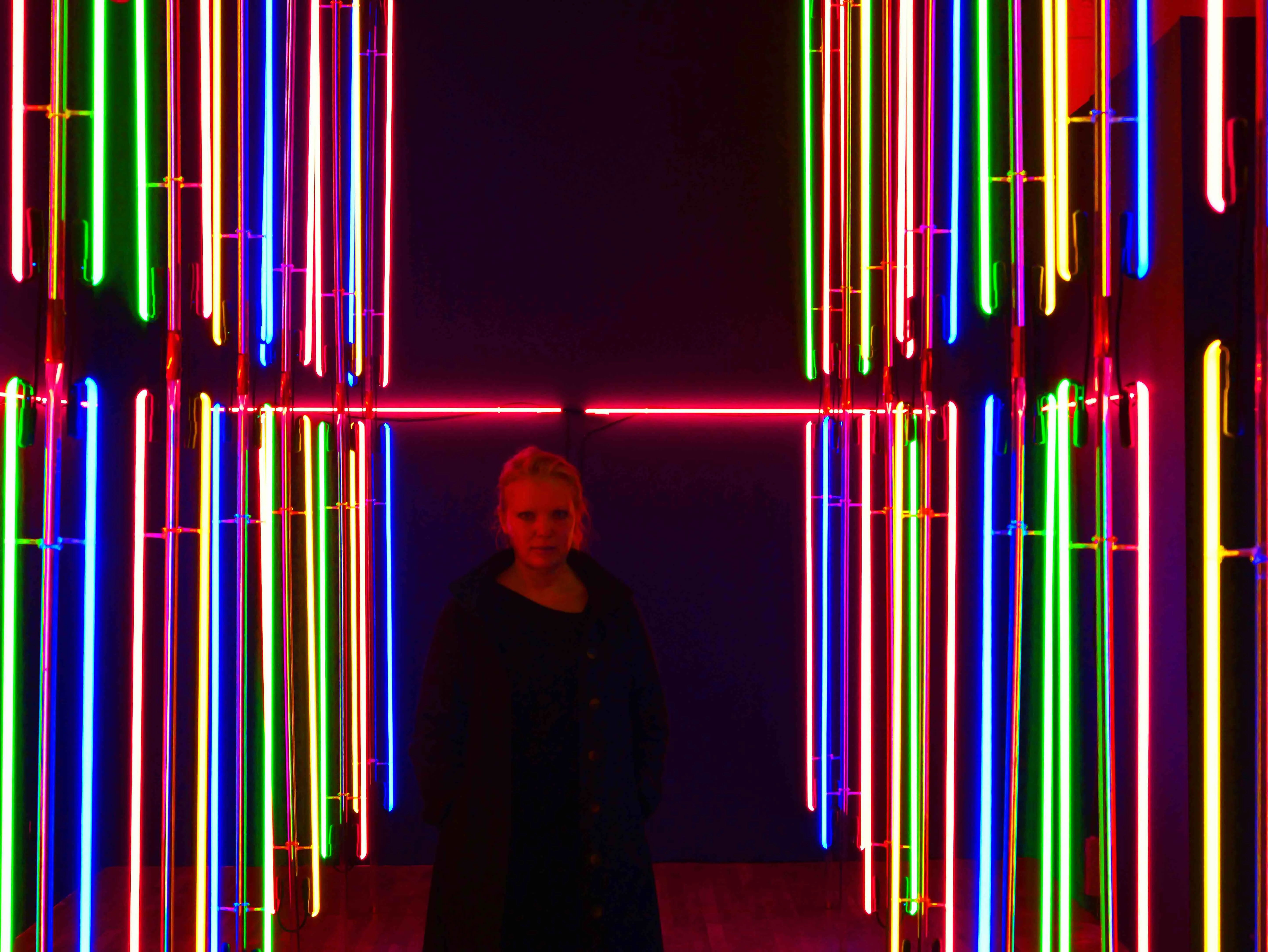
ELEMENTS IX (2026) continues the compositional grammar established in ELEMENTS I, mobilizing the convergence of perspectival lines and the colonnade as both formal device and historical residue. In this Baroque Apocalypse inflection, these gestures resonate with the affective intensities of sites such as the theatrical excess of mirrored halls and structures that invite experiential density, like the ritual architectures of antiquity and the cathedral. ELEMENTS IX similarly captures the way time feels durational and oriented toward a dimension that never fully arrives. In this way, it stages a spatial-temporal relation in which light and sound operate as conditions that traverse the body, reaching the threshold where the perceptual activates the primordial, and where the subject finds itself momentarily reconfigured within a more elemental state of experience.
The banality of neon light in the modern world is intriguingly transformed here into both building material and a site of corporeal awareness and introspection. As you work your way through the structure, there is a sense of spiritual receptivity, of energy circulating in a space that invites contemplation and interaction that, at the same time, feels undemanding. The “baroque” of the title might be understood as a complexity of perception rather than ornamentation and excess, while “apocalypse” suggests a revelation or gradual unveiling of how we might see, sense, and orient ourselves in unfamiliar territory. The work recalls a photographer’s concern with the so-called writing of light, and the way photography shapes perception and meaning. Working as a multidisciplinary artist across photography, video, neon sculpture, and site specificity, Senstad extends her photographic sensibility into the architectural realm, transforming light itself into a medium of guided presence and perception. Translated to the three-dimensional space, light shifts from mere capture to construction, toward an embodied experience that lingers long after leaving the space.
Anne Katrine Senstad: Baroque Apocalypse is on view at The Sylvia Wald and Po Kim Gallery from February 11 to April 18, 2026.