
.webp)
Wenfei Quan: “Contemporary Hominin” at TaThaTa
Review
In February of this year, the United States and Israel launched a joint attack on Iran targeting key military sites and leadership. Though the conflict is meant to remain localized, neighboring states in the Persian Gulf are already implicated, with drone strikes flying toward US-backed allies. In Iran, UNESCO has already confirmed damage to significant cultural sites, including the Qajar-era Golestan Palace in Tehran, the Chehel Sotoun pavilion, and the country’s oldest mosque, the Masjed-e Jāme’, both in Isfahan. Meanwhile, the escalating violence has disrupted the petroleum supply chains, rattling global markets and driving oil prices upward with no return to normalcy in sight.
If recent events have reminded us of anything, it is that neither we as humans nor the world we built were designed for isolation. What affects some of us–as the global pandemic and now intensifying wars demonstrate–inevitably affects all of us. It is in this light that Iranian artist Roksana Pirouzmand’s double exhibition, everything was once something else (the land was the sea, the sea was the land) at JOAN, curated by Suzy Halajian, and everything was once something else at OXY ARTS, curated by Meldia Yesayan, emerges as a compelling meditation on the subtleties of our interconnectedness.
Spanning two sites, the energy of the dual exhibition is quite literally transferred from one place to another. As visitors move through OXY ARTS at Occidental College in northeastern Los Angeles, the sculptural works are embedded with a vibrational surface, which captures motions and transfers them as sound waves at JOAN in downtown LA, leaving traces on both the art objects and other visitors. In effect, exhibition-goers are not passive spectators and consumers of the aesthetic objects before them, but participants whose very presence, like our choices elsewhere in the world, leaves its own imprint. The show is a careful arrangement of multi-media installations comprising a range of materials and techniques. From wood to metal to clay and water, Pirouzmand, who is no stranger to clay and handwork, also employs processes such as corrosion, oxidation, and erosion as part of this interactive work.
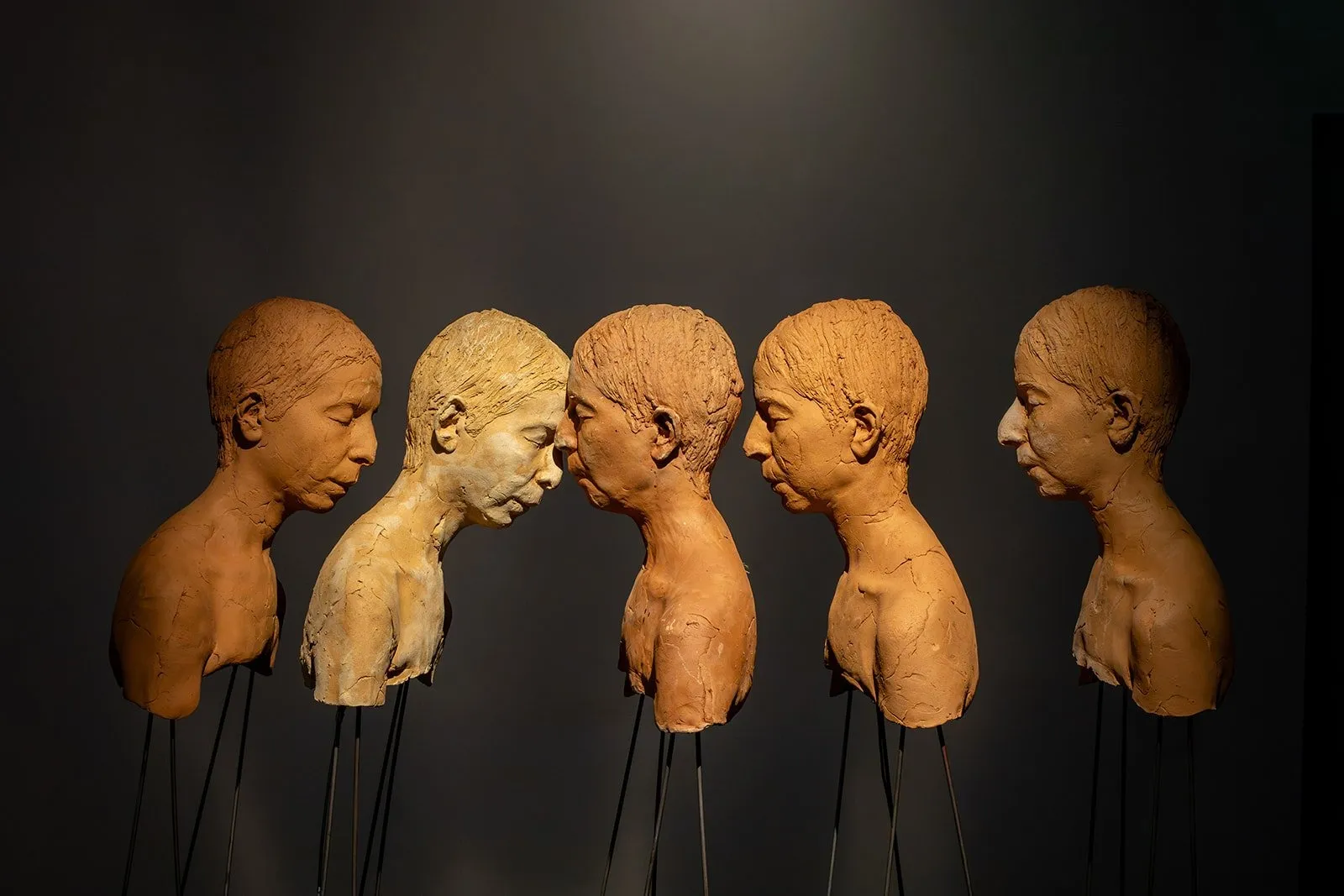
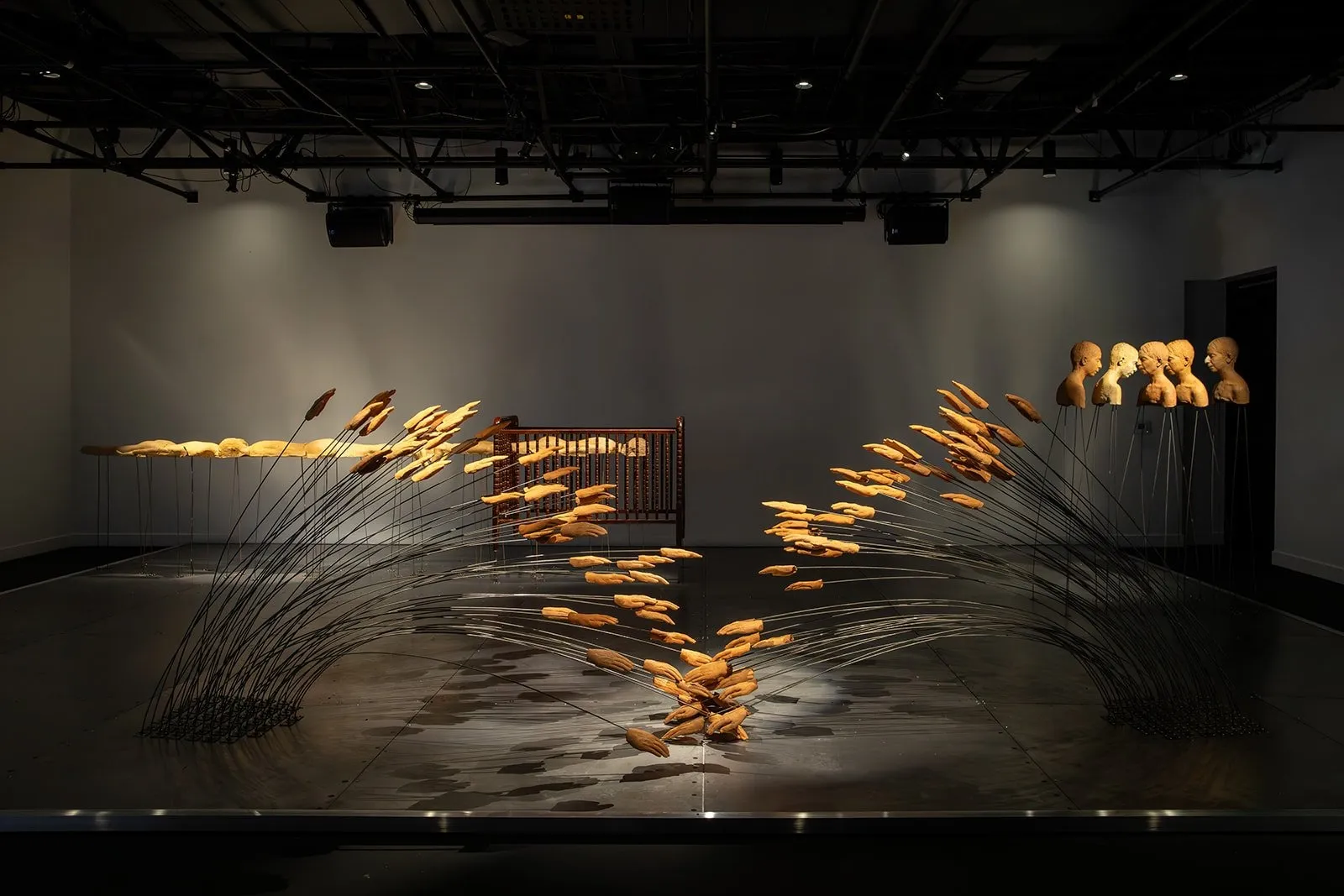
Starting at OXY ARTS, Land (2026) presents a series of ceramic busts of the artist herself mounted on steel rods, each with closed eyes. The figures face inward, as if on the verge of collapsing into one another. Their skin is left unsmoothed with small cracks, rough edges, slight imperfections, and variations in coloration, suggesting difference and sameness. Their gaze remains inaccessible, as though sleepwalking in single file, almost mechanical in their intimacy.
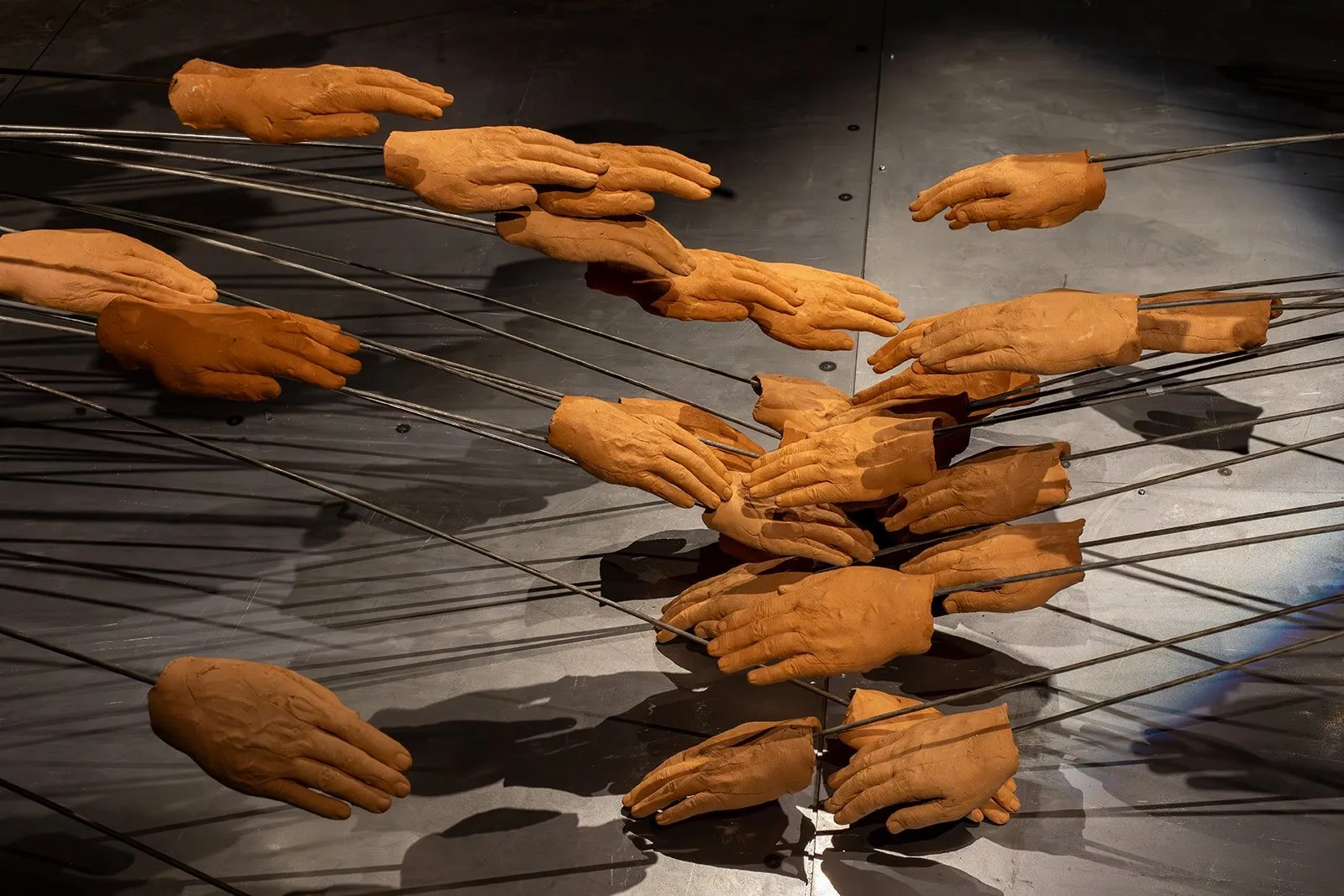
In Wave (2026), as the title suggests, dozens of ceramic hands tethered to steel rods overlap in a wave-like formation. Rising from the seabed like our genetic progenitors, the hands—fingers slightly separated in a swimmer’s gesture—draw attention less to the individual digits than to the larger form they collectively create. Depending on the angle, the assemblage evokes motion, at times appearing to clash against itself in opposing tides.
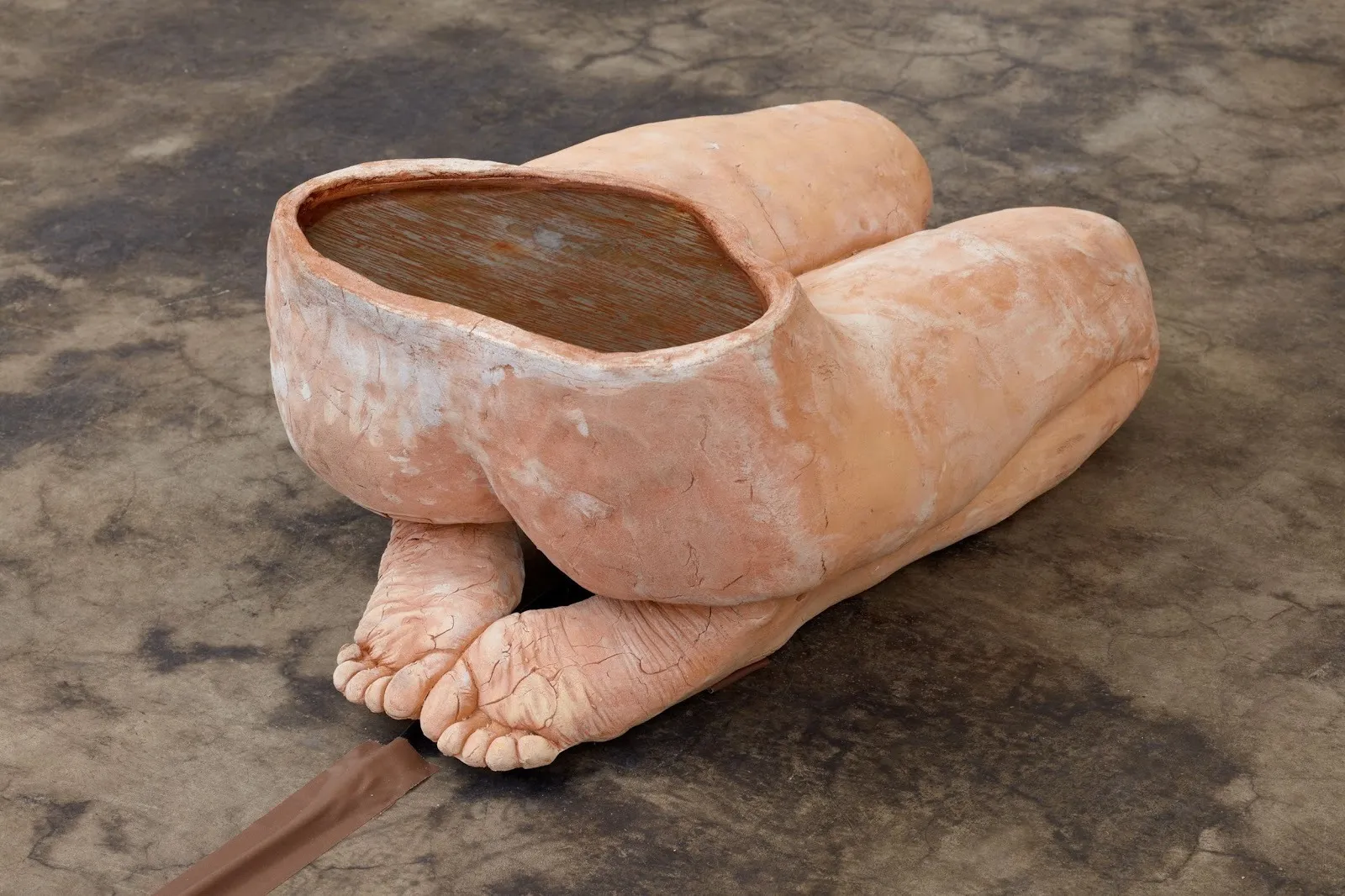
At JOAN, where the exhibition title expands to include the subtitle the land was the sea, the sea was the land, the theme of earthly cycles and reverberations becomes more explicit. With kneeling, sinking (2025), a model of the artist's lower body rests with pleated knees while her interior is exposed. Sound vibrations generated by visitors at OXY reverberate through the installation, creating ripples in the small, shallow pool. It becomes, in many ways, a sculptural take on the butterfly effect—or perhaps more aptly, the ripple effect—where small movements and irregularities are transmuted into unexpected and sometimes outsized consequences.
In spring (2025–26), a human body lies on a steel platform as water flows from its crevices. The face is hollowed out and filled with water, which pools underneath the still form. Residue from the erosion and corrosion collects and evaporates, leaving behind a faint image of a past landscape carved by time and processes. Similarly, in dreaming, sifting, settling (2025–26), the cross-sectioned body hangs above a steel bed frame, its interiors exposed as dust gradually falls and accumulates below. The sensation gestures toward our own residue, as bodies of matter returning to matter, from dust to dust.
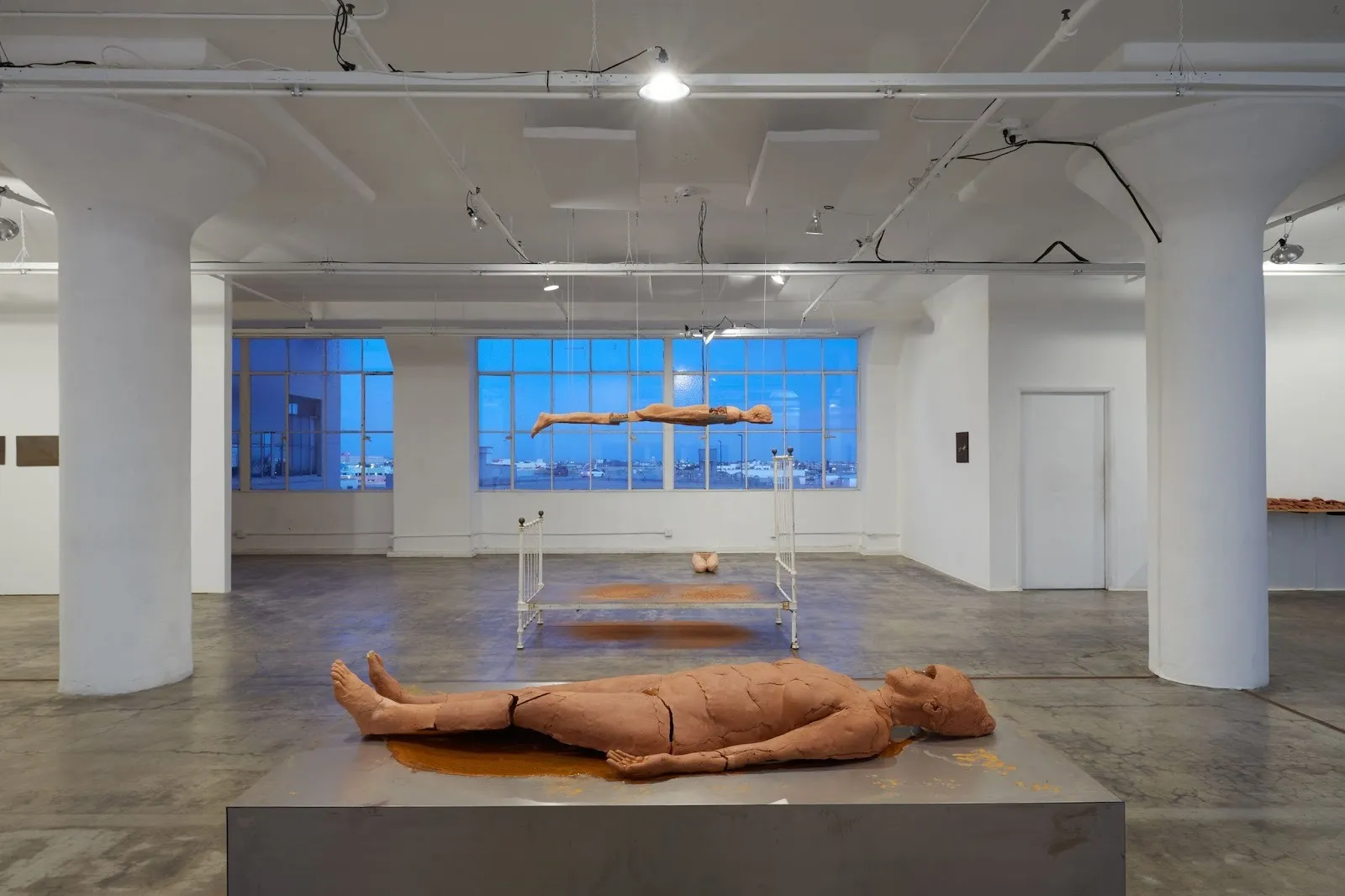
Here, the body no longer functions as a singular entity but as a collection of appendages and sections participating in larger cycles of movement and exchange. Bodies here do not simply occupy space but function as conduits through which forces circulate. In this sense, it recalls Gilles Deleuze and Félix Guattari’s notion of the Body without Organs: not a body freed of structure altogether, but one configured as a field of circulating intensities where meaning emerges through flows of matter, connections, and distribution of energy. As much about coordination and connection as about the transference of energy, Pirouzmand’s installations introduce rhythm to these fragmented forms, situating them somewhere between bodily presence and geological process. In their thoughtful arrangement, the works confront the limits of our anthropocentrism. Our devastating conflicts, monuments, and jewel-laden walls of golden temples appear fleeting when measured against geological time. What greater irony than our obsessions and wars over the bio-waste of former-life-turned-energy, consuming the dead simply to remain alive?
Regardless of where one begins, Pirouzmand’s exhibition remains cohesive and contemplative. In its treatment of the body across time, the work thinks less in terms of individual identity than of bodies as sites of transformation. If global conflicts reveal the fragility of the systems we inhabit, Pirouzmand’s installations reveal how those systems are already embedded within the smallest gestures of the body.
Roksana Pirouzmand: everything was once something else (the land was the sea, the sea was the land) is on view at JOAN from February 21 through May 2, 2026. everything was once something else is on view at OXY ARTS from February 12 through April 11, 2026.