.jpg)

.webp)

“Wetware” at RAINRAIN Gallery, Curated by Spine
Review
Now closed, Once Within a Time signaled a decisive rupture in curatorial thinking, grounded in ritual, circulation, and storytelling. This essay moves through its afterglow, tracing how value is reimagined, as resonance, care, and shared meaning, in defiance of exploitative models of accumulation and spectacle.
Curated by Cecilia Alemani with the assistance of Marina Caron, the exhibition was conceived for SITE Santa Fe’s newly renamed biennial, The International. It offers a fertile counterpoint to the systems of value that have historically prevailed in a global art world molded by Western institutional canons and market dynamics. Through curatorial strategies that unsettle these conventions, the exhibition summons us to reconsider how value is constituted, through proximity, relationality, and the inclusion of plural genealogies.
Once Within a Time unfolds as a distributed, site-sensitive ecology of artworks, narratives, and interventions woven across Santa Fe. Spanning fourteen venues, museums, landmarks, storefronts, and even a cannabis shop, the exhibition allows place to become both subject and medium. New Mexico emerges as setting and protagonist, its histories and spiritual economies offering a lens on global conditions: ecological crisis, migration, technologization, militarization, and colonial afterlives. The exhibition is structured through “figures of interest”: semi-fictional and historical personae, Indigenous leaders, artists, mystics, scientists, and local legends, whose stories anchor thematic threads across geography and time. The curatorial strategy mirrors the nonlinearity of Godfrey Reggio’s 2023 film Once Within a Time, which lends the exhibition its title and its spiraling temporality.
Overall, the exhibition weaves a porous fabric that calls upon memory, myth, dissent, and reverie. Context is favored over spectacle, slowness over immediacy, and the ritual of encounter over passive spectatorship. This is where questions of visibility and circulation, central to understanding value, are disrupted. Rather than following the entrenched economy of cultural capital, where value is tethered to scarcity, exclusivity, and controlled access, Once Within a Time disperses meaning through time, space, and context. Artworks are not treated as singular rarities to be consumed, but as elements within a living, relational field. Cultural, historical, symbolic, and even financial value is reconfigured through the distribution of attention, narratives, and sites.
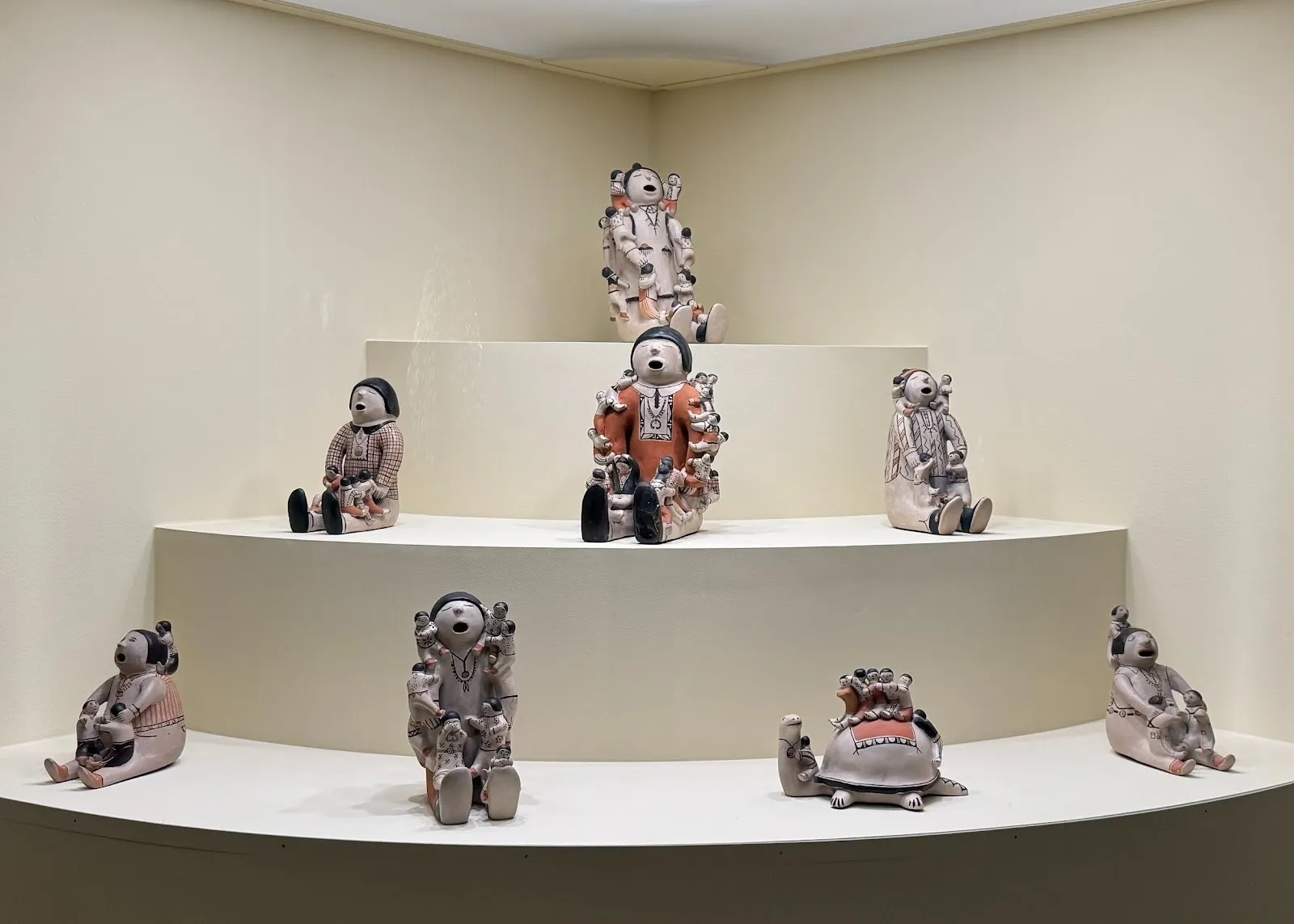
Helen Cordero’s Storyteller figurines capture the spirit of the relational and intergenerational values that Once Within a Time brings to the fore. Rooted in personal memory and Pueblo tradition, her clay sculptures enact transmission as ceremonial rites of care and continuity. The grandfather figure surrounded by children becomes a living conduit of knowledge, personifying value as a shared resource. In a purposeful curatorial gesture, Cordero’s work, long associated with the Museum of International Folk Art, is relocated to SITE Santa Fe’s contemporary venue, the Railyard. Exhibited in a room adjacent to Reggio’s film, Storytellers are folded into the exhibition’s conceptual core, dissolving boundaries between folk and contemporary, and foregrounding Indigenous knowledge within a forward-looking syntax. Cordero’s work anchors a section titled The Wheel of Telling inspired by Kiowa writer N. Scott Momaday. His idea that “there is only one story in the world,” spinning endlessly on a wheel of shared telling, reflects the show’s non-linear structure.
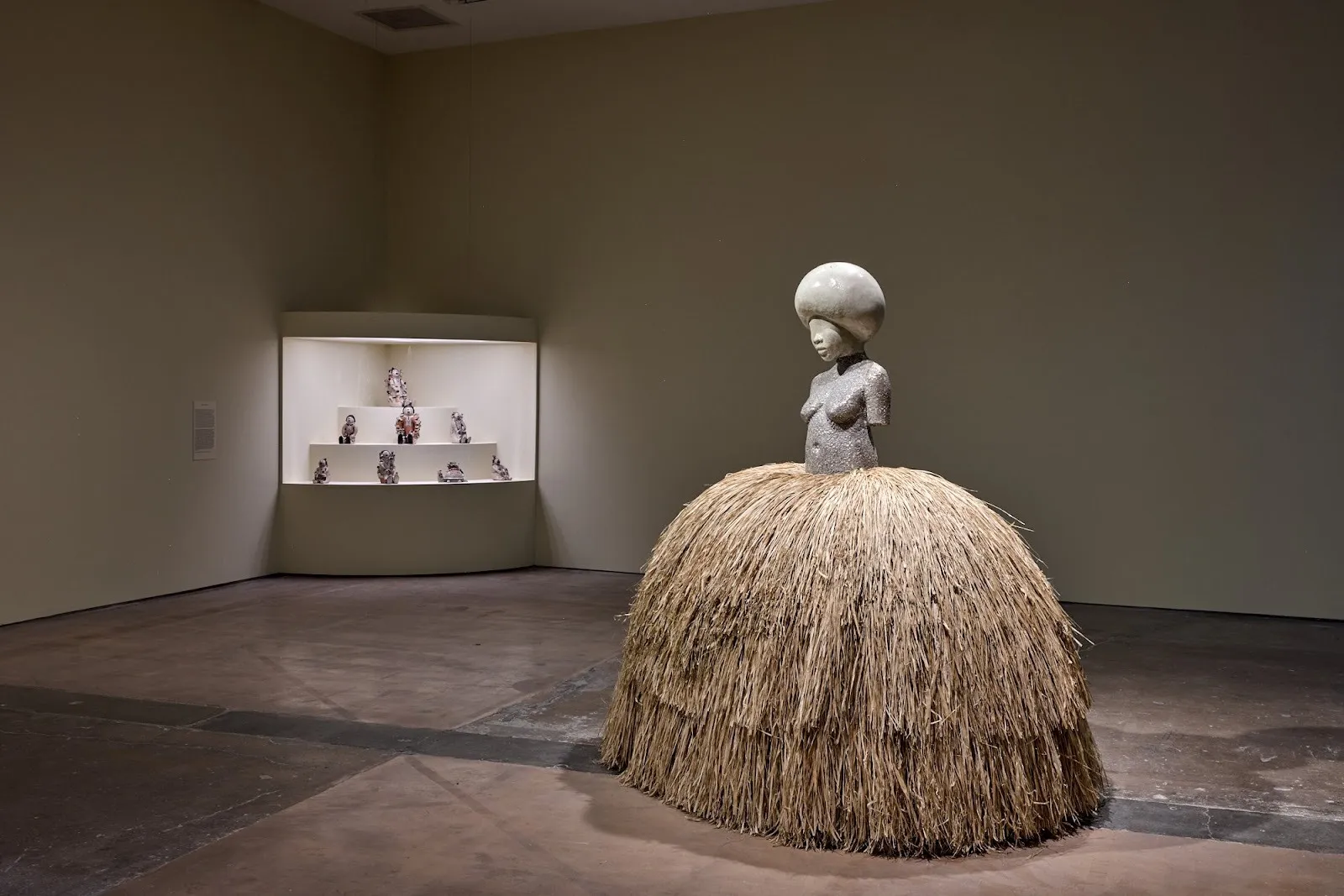
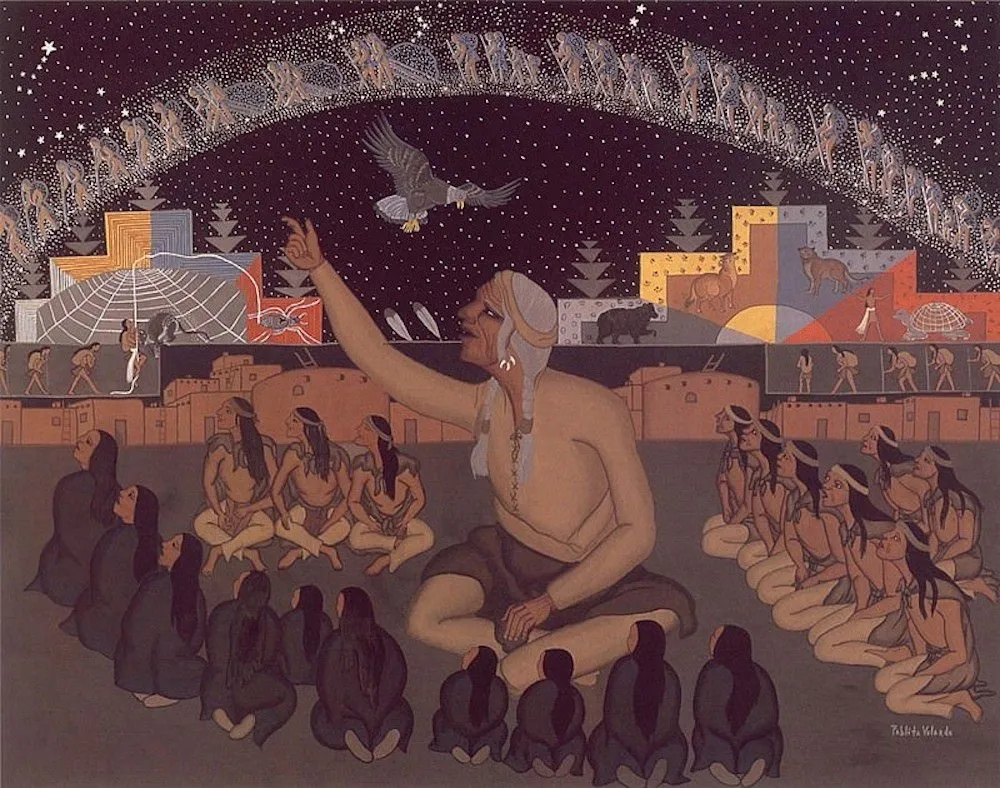
Cordero’s works dialogue with another Pueblo artist, Pablita Velarde (Tse Tsan), and with contemporary artists Simone Leigh and Dominique Knowles, each exploring storytelling as a generative force. Leigh’s raffia-skirted figure echoes Cordero’s work, invoking protection and transmission. Velarde’s Tewa legends and Knowles’s immersive canvas expand this field of cyclical narration, dissolving boundaries between myth and lived experience. This grouping reveals the exhibition’s core strategy: artworks and figures of interest are interlaced into a dispersed web of meaning, where stories circulate and regenerate, and value emerges through shared rather than individual authorship.
The decision to relocate Cordero’s work and to center Indigenous artists raises questions about the ethics of cultural representation. As a European curator in a North American context, Alemani navigated the challenge of engaging cultures not her own. The exhibition acknowledges this tension through collaborative approaches and careful attribution. Still, such strategies merit scrutiny, as curatorial authority remains entangled in broader negotiations of power, representation, and the limits of mediation.
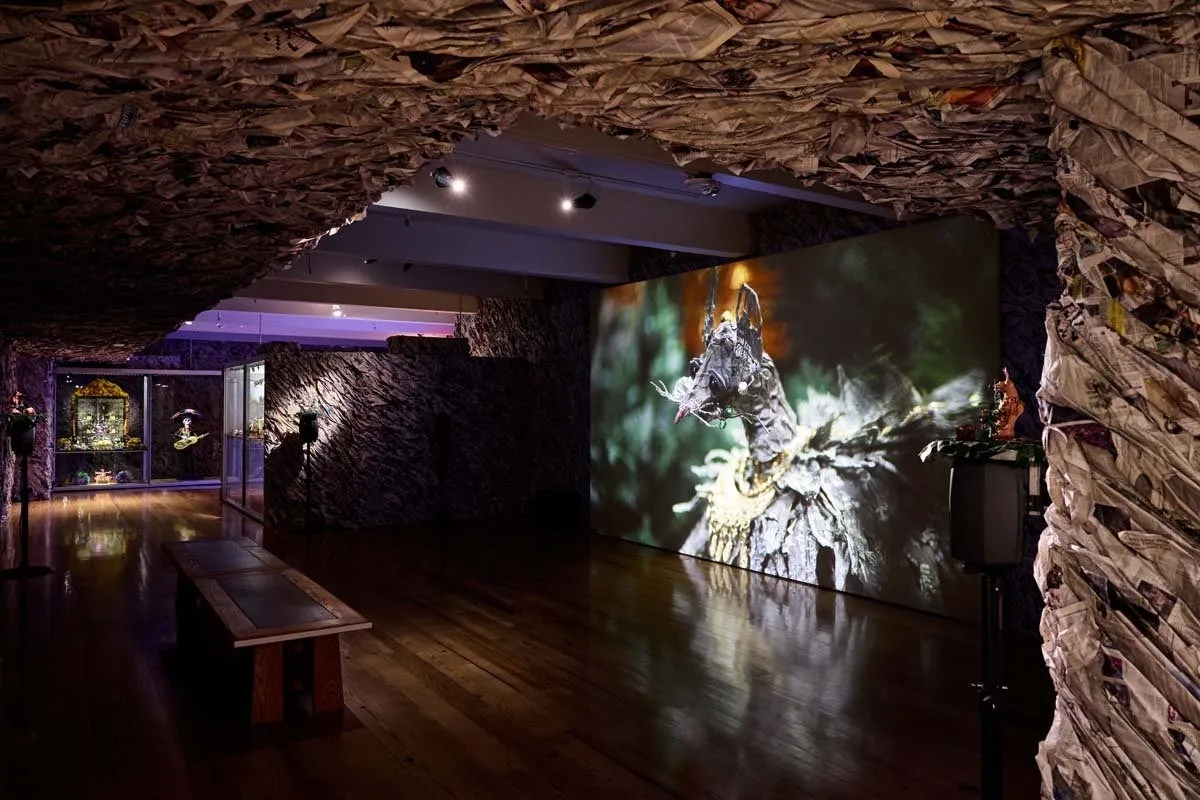
While Helen Cordero’s Storytellers are repositioned within a contemporary art context, collapsing hierarchies between “folk” and “fine,” Zhang Xu Zhan’s Compound Eyes of Tropical (2022) reverses the proposition, bringing contemporary moving image into the Museum of International Folk Art. Installed in the museum's basement and surrounded by ritualistic objects, the work owes to the Taoist funerary tradition of zhizha, which has been passed down through his Taiwanese family. The stop-motion animation translates ritual into cinematic language. Shapeshifting into animal forms, its protagonists move in a choreography at once mythic and vernacular. Amidst objects long sidelined by art history, Compound Eyes of Tropical resists separations between past and present, art and craft, story and substance. It affirms that value can be constituted through continuity, adaptation, and the resonance of cultural memory.
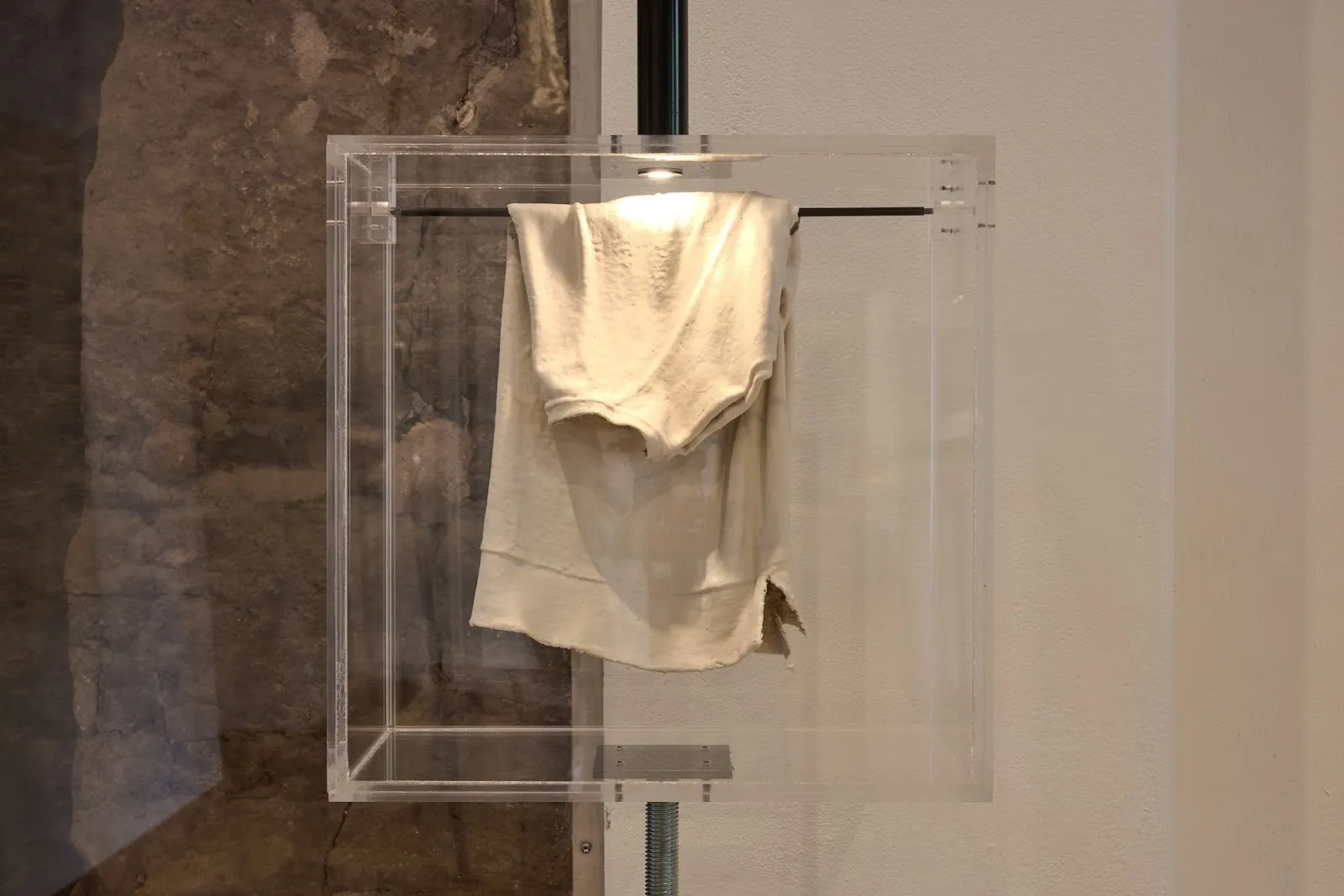
At the Palace of the Governors, Daisy Quezada Ureña’s installation likewise challenges inherited modes of value and visibility. Her porcelain-cast garments, fragile impressions of bodies, labor, and displacement, speak to a cultural memory that resists preservation through monumentality. Value emerges with erosion and the interplay between vulnerability and structure. Plexiglass boxes suspended between shoring posts, tools of temporary support, create a space of provisional stability, where excavation, care, and repair coexist. Soil, archival fragments, and sculptural elements activate dialogue between personal and institutional histories, between the notion of site and the forces that have shaped it. Circulation becomes a way of making visible the effort of reckoning with legacy. Like Zhang’s installation, Quezada Ureña’s work reframes value as contingent, relational, and rooted in memory, care, and place. Both projects reorient us toward practices of continuity and persistence.
Six miles outside Santa Fe in Tesuque, Finquita joins the biennial for the first time. Formerly a gallery, sculpture garden, and bronze foundry, it has recently been reimagined as a farm integrating art, agriculture, and community. This layered site offers a fitting context for works exploring spiritual renewal, ritual, erosion, and the speculative reimagining of value. Among them, Guillermo Galindo’s single-channel video If It Was Ever to Be Used: On the Possibilities of “Undo” (2025) transforms a decommissioned missile silo near Roswell into a resonant chamber of unmaking. Drawing on Alvin Lucier’s I Am Sitting in a Room (1969), Galindo begins with a conversation with a nuclear engineer, which is played and re-recorded inside the silo, again and again. With each iteration, sound and image deteriorate, words dissolve into frequencies, meaning collapses into echo, and image becomes visual noise. Only resonance remains, tuned to the site’s haunting frequency. This metaphorical erosion rejects dominant metrics of value and stages unmaking as an ethical response to systems of control, secrecy, and violence. Undo becomes a case for resonance, decay, and disappearance as counter-values.
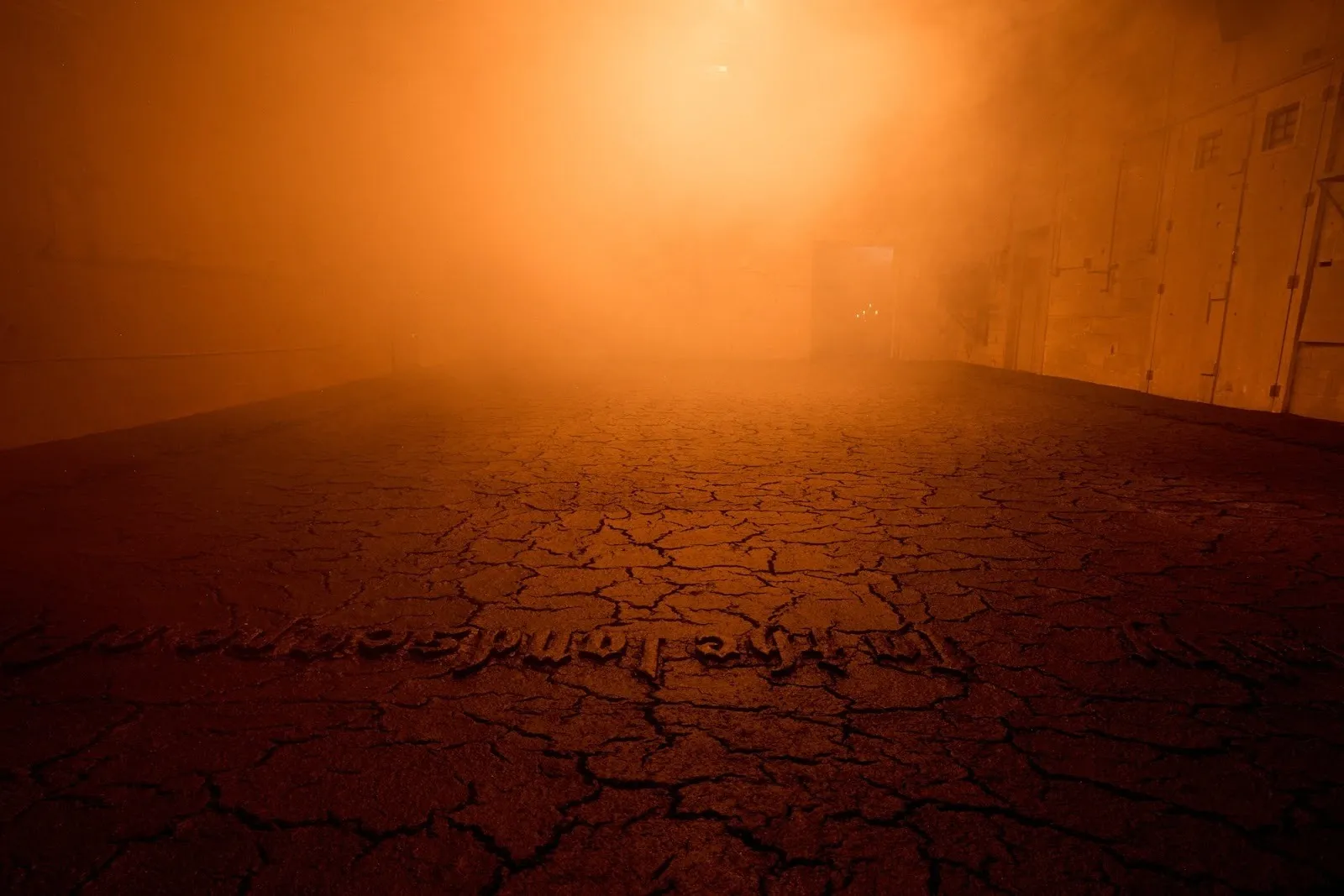
Installed nearby, Korakrit Arunanondchai’s Nostalgia for Unity (2024) offers mythic and atmospheric intensity. Ash from Santa Fe's Zozobra ritual, an annual burning that exorcises gloom, is embedded into a cracked floor, enveloped in smoke and flickering light. Layered sound echoes across cosmological planes: underworld, earth, sky. Arunanondchai’s work conjures the cycles of destruction and rebirth and the ways in which memory is metabolized through bodies and landscapes. His cosmology, suspended between history and hallucination, treats value as something to be transfigured through collective reckoning. Galindo and Arunanondchai activate a process of transformation central to Once Within a Time. They transfigure spaces marked by violence and loss into sensory fields of sound, light, and atmosphere. Here, value emerges through ritual and the symbolic work of unmaking.
Once Within a Time has closed, but its questions persist. In an art world dominated by exclusivity, scarcity, institutional gatekeeping, and market logic, it proposed an alternative: value as something dispersed rather than concentrated, circulated rather than hoarded, motivated by care rather than by possession. From Cordero’s clay figures to Galindo’s dissolving frequencies, the works resisted the terms by which art is typically made legible to capital. They offered acts of resonance, erosion, and collective memory, values that evade extraction and refuse commodification. Yet the exhibition’s aspirations revealed tensions. The centering of Indigenous knowledge and plural genealogies, however thoughtfully framed, still unfolded within institutions marked by histories of exclusion. The biennial format itself remains entangled in the systems it aims to critique. These contradictions are not failings but reminders: reimagining value is an ongoing practice that requires humility and a willingness to sit with discomfort. The curatorial team at SITE built a structure spacious enough to hold these contradictions. The exhibition unfolds like an ecosystem, where artists, ideas, and figures of interest ricochet, collide, and transform. It invites us to stay with complexity, to follow meaning as it spirals, disperses, and resists resolution.
The 12th SITE Santa Fe International Biennial: Once Within a Time was on view from June 27, 2025 to January 12, 2026.