

.webp)

Face to Face: February 2026
Interview
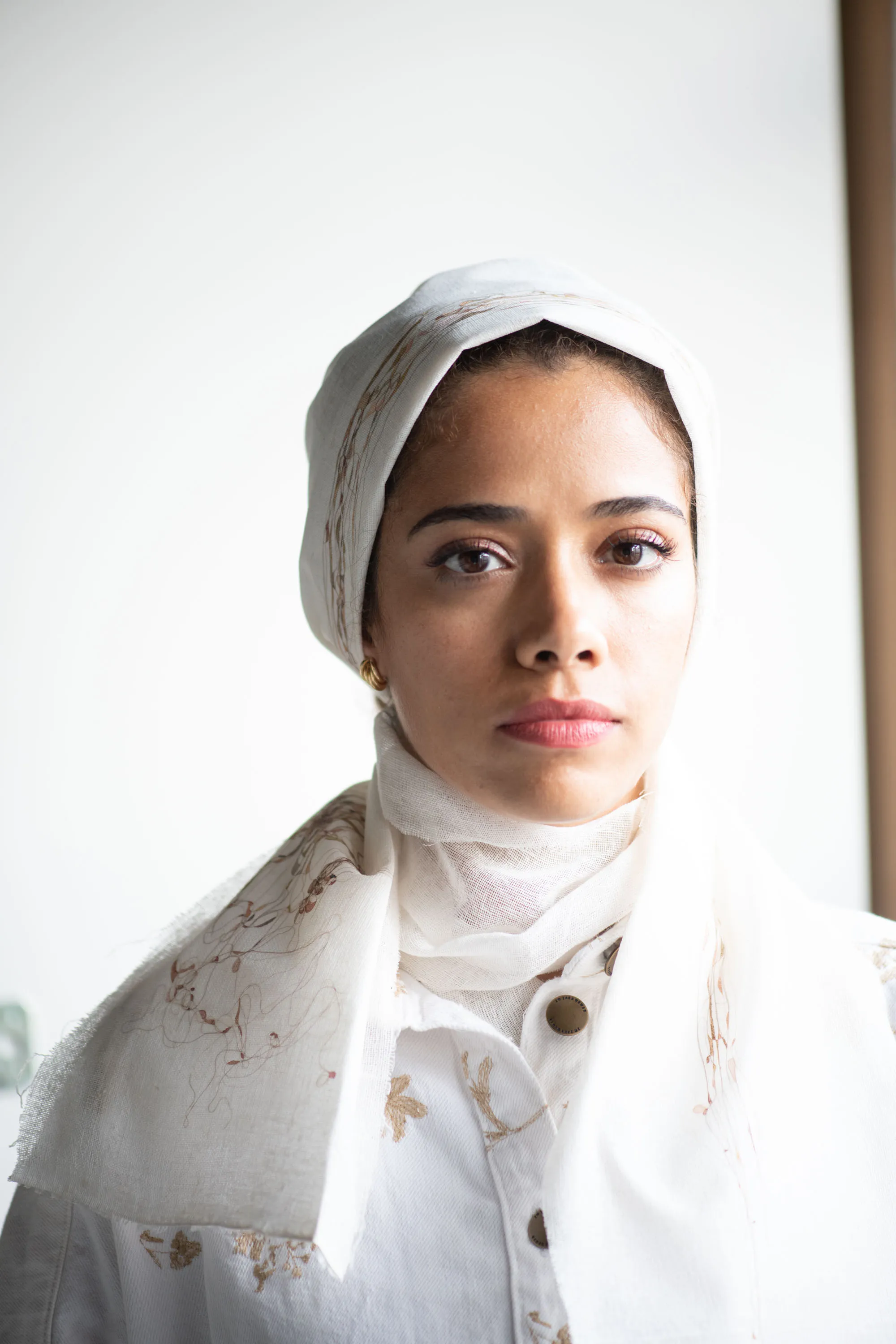
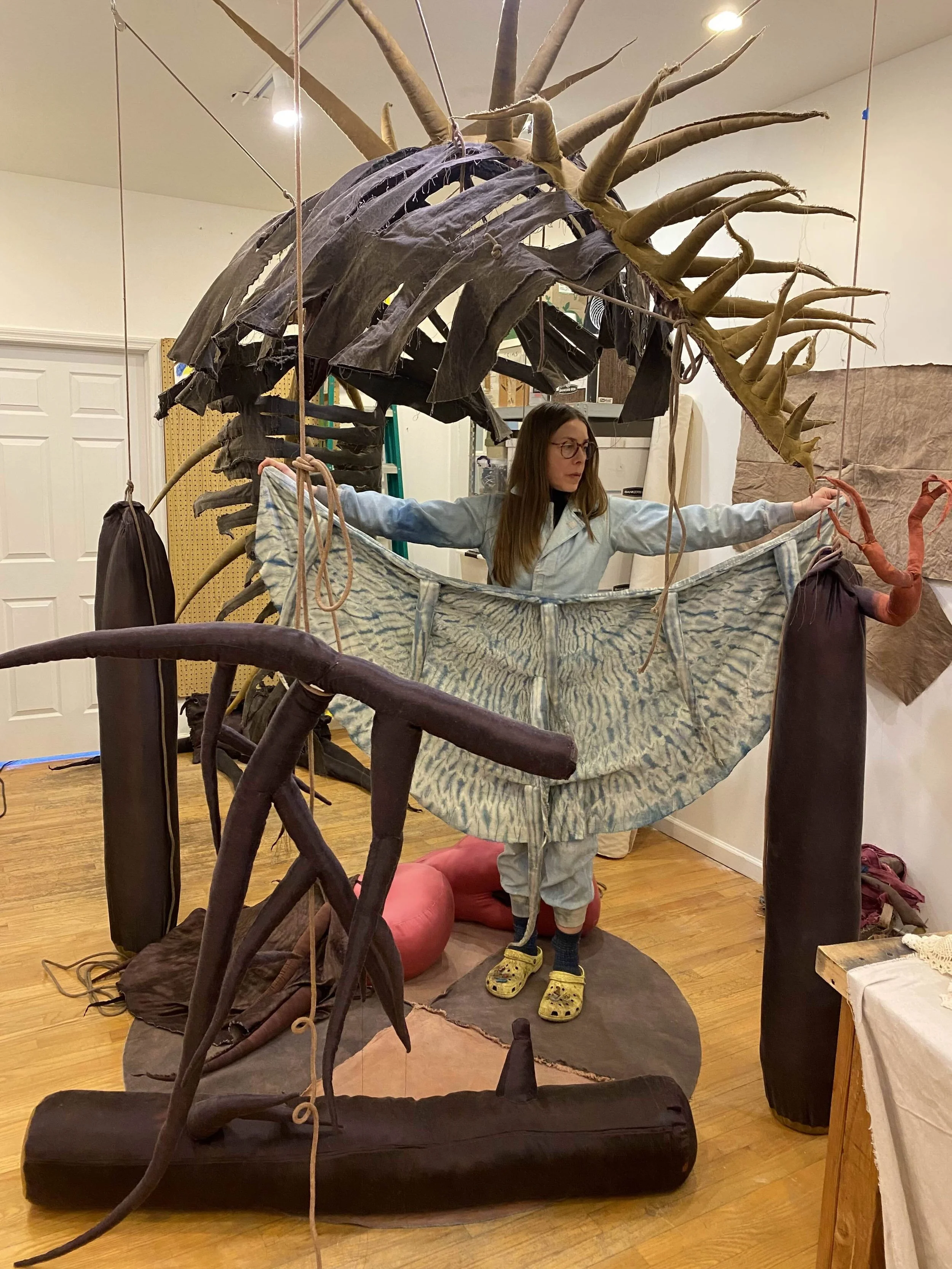
Artistic vocabularies defined by process and materiality are not a novelty. Emirati artist Afra Al Dhaheri’s vocabulary is irrevocably tied to her use of rope, cement, steel, hair, and wood—and the novelty lies in the labour that centres her process, materials, and outcome. In her video work Conditioning the Knot (2022), a hand with a tool scrapes away inconspicuous knots that connects cotton threads to the strings of a musical instrument. The sound of the scraping with the off-tune instrument demands the viewer’s sensory labour, depicting the simple process of detangling a piece of fabric and the materiality of each element. This sensory labour is coupled with the invisible intellectual and manual labour that defines Al Dhaheri’s large-scale sculptural installations made of rope, thread, knots, and hair.
In her exhibitions Give Your Weight to the Ground (2023) at the Green Art Gallery in Dubai and Restless Circle (2025) at the Sharjah Art Foundation, Al Dhaheri refers to a quip by her mother: “Take your fallen hair and bury it in the soil of your house plant. They will nourish it.” Scientifically, hair falls out when it has died and no longer has a connection to the human nervous system. Al Dhaheri, based on the above quip, imagines fallen hair to be worthy of a nourished afterlife, especially in more recent works like Don’t pull my hair (set of two) (2023), made of cotton rope on stained wood and concrete cinderblock. Two pieces of wood have cotton rope hanging down from the edges and reaching the floor. The entanglements become more complicated as the rope reaches the floor. Each abstract sculptural piece is reminiscent of a female body burdened by the fast-paced world and women’s role within it. The two pieces of wood rest on each other at the top at a risky angle, almost falling onto each other. For the artist, this burden is held by the earth within the intangibility of time. Grounding amidst the restlessness of the world is a necessity for survival, according to Al Dhaheri, who believes that the closer we are to the earth, the more nurtured by it we will be.

Closely connected to Al Dhaheri’s focus on labour are her explorations of memory and heritage, as present in her installation Dining East or West (2016–), which uses glass, ceramic, cement, and cinderblocks and is currently on view at In Interludes and Transitions, the third edition of the Diriyah Contemporary Art Biennale. (Re)presented ten years after its original development, the work attempts to record the burden and labour of holding memory at a dining table, a space of gathering and communal existence. The glass is transparent, distorted, and fragile, similar to how we experience memory. The vessel that is the body struggles to hold truth even in its subjectivity. In this attempt to immortalize a dining table in progress using glass, Al Dhaheri portrays the opposite: that memory is not concrete nor definitive.

Artist Corinne Botz recalls encountering ghosts at two points in her life. She describes the first visitation in the foreword to her 2010 book, Haunted Houses, telling of a spell between the ages of five and eight when she saw colorfully clothed phantoms “who glided around in clusters” in her attic bedroom. Botz’s spectral perceptions ceased for several decades thereafter, only returning—albeit more subtly—when she gave birth to her daughter, Echo. “I would fall asleep between every contraction, wake up, and have the strongest sense of another person by my side,” she told me in her upstate New York studio as we looked through her photobooks.
That Botz stopped believing in ghosts during the years in between is a little ironic, as it was during this interim that she embarked on a 10-year project on the very subject, trekking across the US to photograph supposedly haunted houses and transcribe the accounts of their inhabitants. “I was thinking academically, interested in seeing inside how people live,” she explained. As with most of her photographic series, these pictures are without people, foregrounding spaces themselves as containers of anthropological data. Botz’s masterfully composed long exposures on color film show weathered interiors and mannered old dwellings that are charged with a paranormal expectancy, especially when contextualized by the anecdotes of those who believe themselves to be living among the dead.

“I enlisted the camera to explore invisible territories,” Botz writes in the foreword. “By collecting extensive evidence of the surface, one becomes aware of what is missing, and a space is provided for the viewer to imagine the invisible.” This may well articulate her approach to meaning-making throughout her life’s work. Since her first long-form project out of graduate school, Botz has developed bodies of photography, video, writing, and research around places that are generally avoided at all costs—hospital rooms, crime scenes, haunted houses—assembling her findings in books, films, and exhibitions that reflect the most universal human experiences: life, death, motherhood, fear, faith, loss, and belonging.
Around the time she became a mother, Botz began investigating the “invisible territory” of lactation rooms, an endeavor that has since materialized as a 2021 documentary short as well as a 2025 book of photographs, oral histories, essays, and a poem Botz composed using fragments from her interviews with mothers. She didn’t set out to make work of political significance; the series started when she photographed the “oddly sparse” room where she pumped at work, gradually evolving into a record of the “invisible labor” undertaken by lactating parents in America. By posting to mom-blogs and distributing flyers, Botz met subjects who allowed her to photograph their pumps in the spaces made available to them for lactation. Botz’s pictures indicate that institutions generally do not offer adequate accommodations (the exception proves the rule). That said, I came away from Milk Factory thinking less about institutional shortcomings than the ways in which mothers create their own sense of comfort, dignity, and connection—to their children and to one another—even in less-than-ideal circumstances.
How many people can say
I make food with my body
asks the chorus of mothers in Botz’s poem.
Pulling milk out of thin air
I am a motherfucking machine

Tiantian Lou described her sculptural process as “really fun” more than once during my morning visit to her light-drenched Gowanus studio. Surprises are inevitable as she translates two-dimensional plans into three-dimensional forms, merging textile and architectural logics by folding and sewing together painted canvas panels. Interspersed among her similarly vibrant paintings, these densely patterned sculptures range from her earlier vessel-like objects to her more recent scaled-up forms, which seem vaguely infrastructural in their geometric modularity.
Standing next to a columnar form roughly her height, Lou described her ongoing interest in liminal systems engineered to go unnoticed within the built environment. For her upcoming solo exhibition in China this spring, she envisions installing wall-based sculptures in unconventional configurations reminiscent of HVAC systems. At the same time, though, Lou complicates such utilitarian associations through the softness of these canvas constructions, which subtly sag and warp over time. As she puts it, the sculptures “develop character,” with their visible seams recalling her hands-on process.
Lou’s architectural sensibility reflects her formal training as an architect. During graduate school amid the pandemic, she shifted her focus toward painting as a site of spatial inquiry. Her paintings dovetail with her sculptures in seeking to soften the linear austerity of geometric forms, while evoking infrastructural motifs—grids, scaffolds, partitions—without resolving into stable architectures. In these characteristically colorful compositions, Lou enacts tension between crisp, tape-defined edges and more fluid, biomorphic shapes, which seem to spill from rectilinear containers. Elements subtly protrude and recede without adhering to a consistent spatial logic, complicating any stable sense of depth or orientation. Appearing at once resolutely flat and curiously dimensional, these works, animated by visible brushstrokes, recall familiar perceptual metaphors—painting as window, portal, or screen—while destabilizing such frameworks. Lou routinely paints onto the edges of the canvas, pushing beyond the conventional boundaries of the picture plane.
On a table in the corner, a three-dimensional model of the gallery for her upcoming exhibition crystallizes her spatial attunement, exceeding any particular work. Lou routinely moves between the familiar architectural formats of the sketch, the plan, and the model, considering how each piece operates within space in relation to the body. Her painting process typically begins with simple line drawings during her subway commute to and from her day job in Lower Manhattan, where she works in a printmaking studio, often preparing color studies for other artists. This routine, she notes, inevitably shapes the energetic palettes of her own paintings, which intensify the dimensional interplay among forms, reinforcing her prevailing interest in how rigid architectures might be softened and otherwise reimagined as more open-ended, perhaps provisional systems.
— Aidan Chisholm
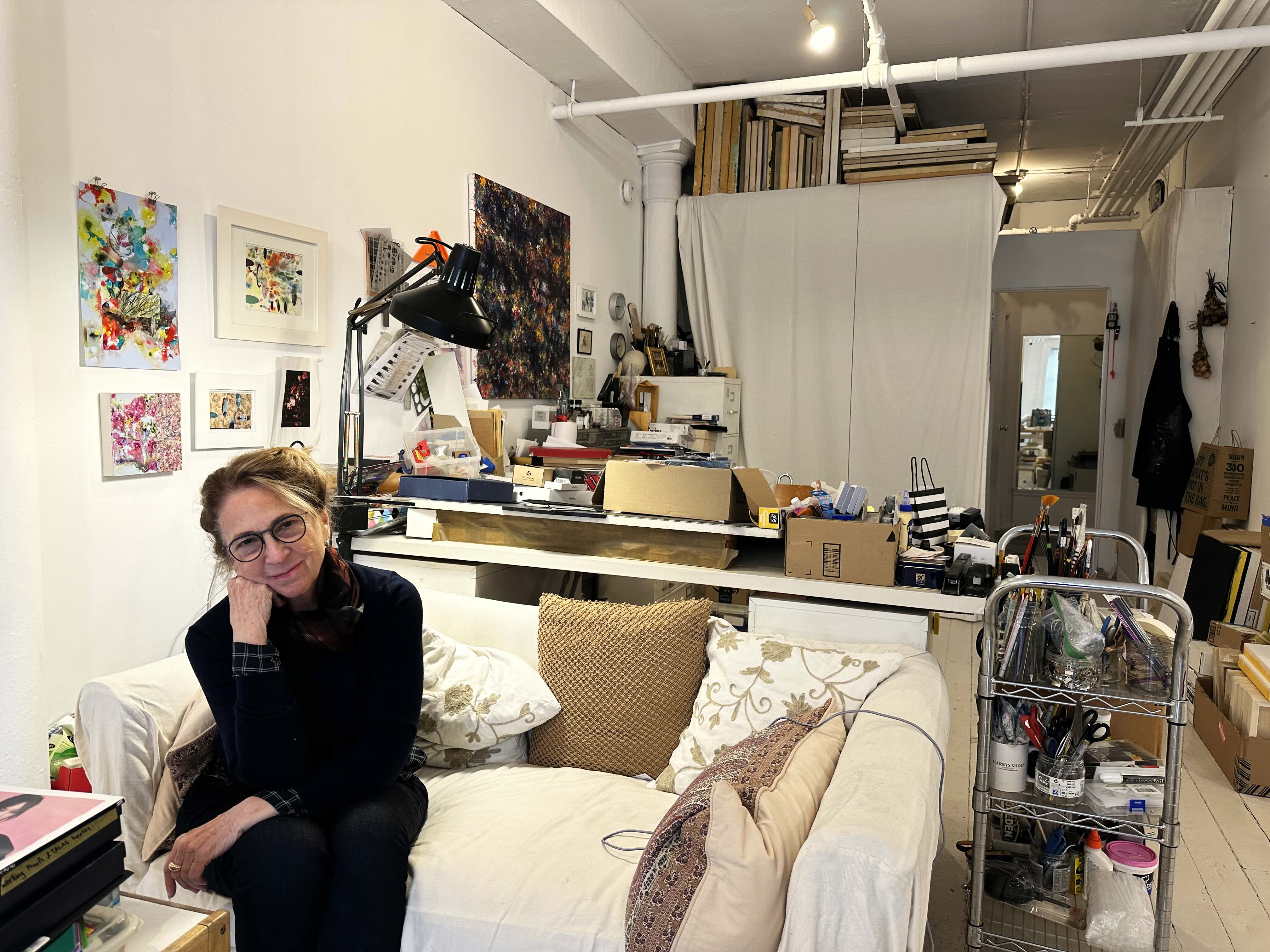
In the entryway to Joan Snitzer’s 4th-floor walk-up, neatly stacked boxes had returned from her recent exhibition at A.I.R. Gallery, Carefully Constructed, containing ninety 8-by-8-inch paintings on panel, which formed one of two bodies of work in the exhibition, Graphic Genomes (2026). Snitzer’s studio looks out over the Bowery; she’s been there since 1981 and has witnessed the neighborhood morph from a low-rent haven for artists to luxury real estate listings like Rihanna’s $50k per month apartment in the 2010s. Snitzer’s loft is a constant in her otherwise fast-paced lifestyle. She had just returned from Berlin on a trip she organized for her visual arts senior thesis class at Barnard College, a combined major with art history that she began in 1992 and has retained close relationships with decades of students and alumni that she has mentored over the years.
An essential part of Joan’s practice is music. She was classically trained in piano as a child, and later on, she found tango dancing to be an escape from a hectic life as an artist, mother, and professor: “I feel the music in my body, and I wake up,” she says. When working on a painting, Snitzer listens to a single song on repeat until the painting is finished. “It’s not a rule, but the painting is structured around the architecture of the song. If I change the song, I change the painting.” The music is an activation, painting is physical. “I often stretch and dance around before I start a painting,” she adds.
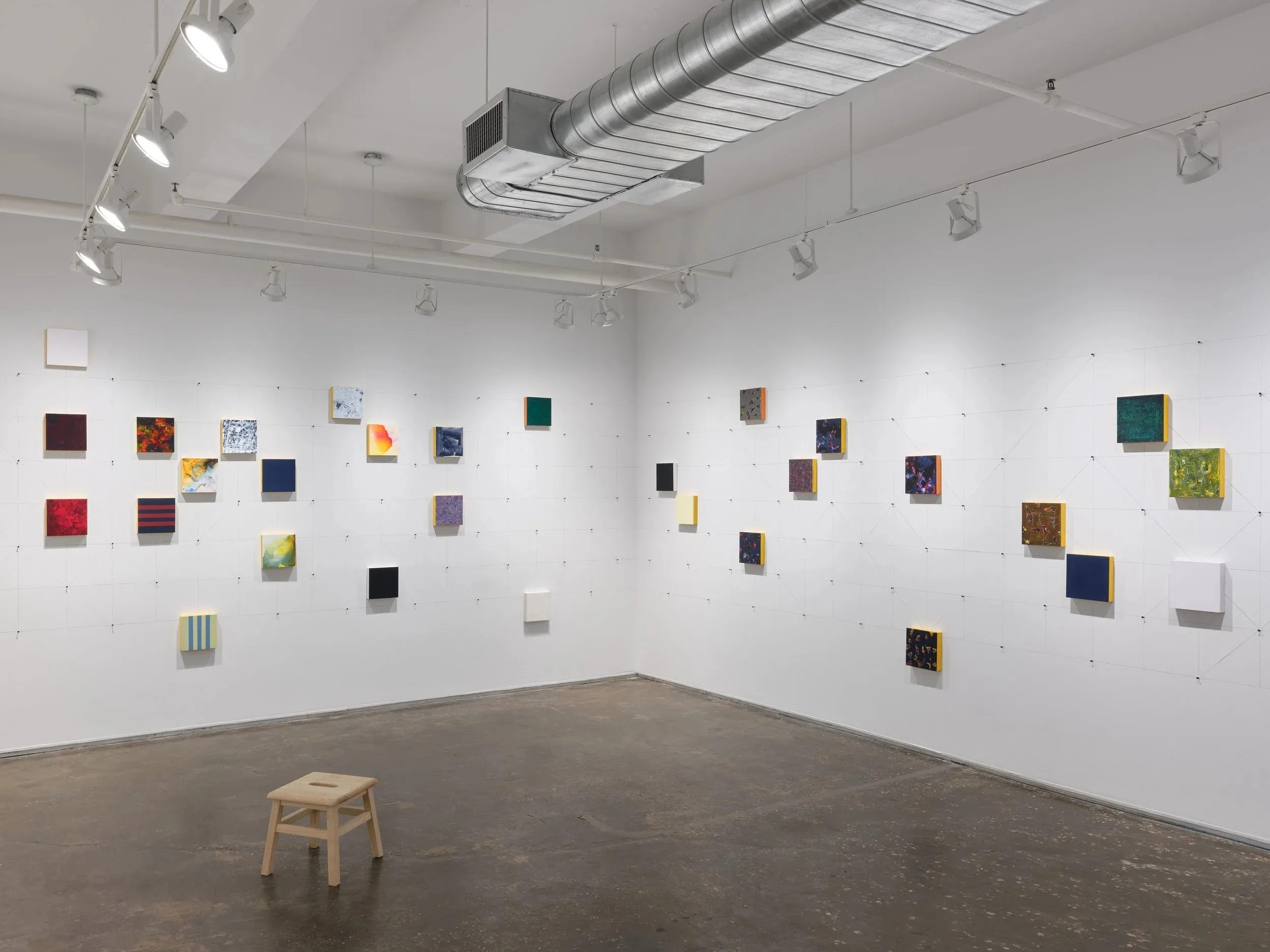
Music is also where the interests of Snitzer and Landon Wilson, the curator of Carefully Constructed, intersect. The small panels were originally intended to be studies for larger paintings, but they eventually became the basis for the exhibition. Wilson, a current graduate candidate at the Center for Curatorial Studies at Bard College with a degree in classical piano and composition from Manhattan School of Music, saw the musicality in Joan’s work when he first visited her studio. During the activation of Graphic Phenomes, student volunteers moved the paintings in different arrangements across the gridded walls of the gallery to the backdrop of the 1987–89 composition Rebonds by Greek-French composer and architect Iannis Xenakis. The composition of the show was in constant flux. The key was to not question—just to move the paintings on impulse as randomly as possible.
That sentiment gets at a core tenet of Snitzer’s practice. Thinking and analyzing might be inevitable, which Snitzer does employ much of in her work, but painting comes out of the body, not the head. It’s about separating these two modalities, and it’s also about not having rules. The paint is the collaborator, just as the volunteers became collaborators in the expressions of Graphic Genomes.
— Meinzer
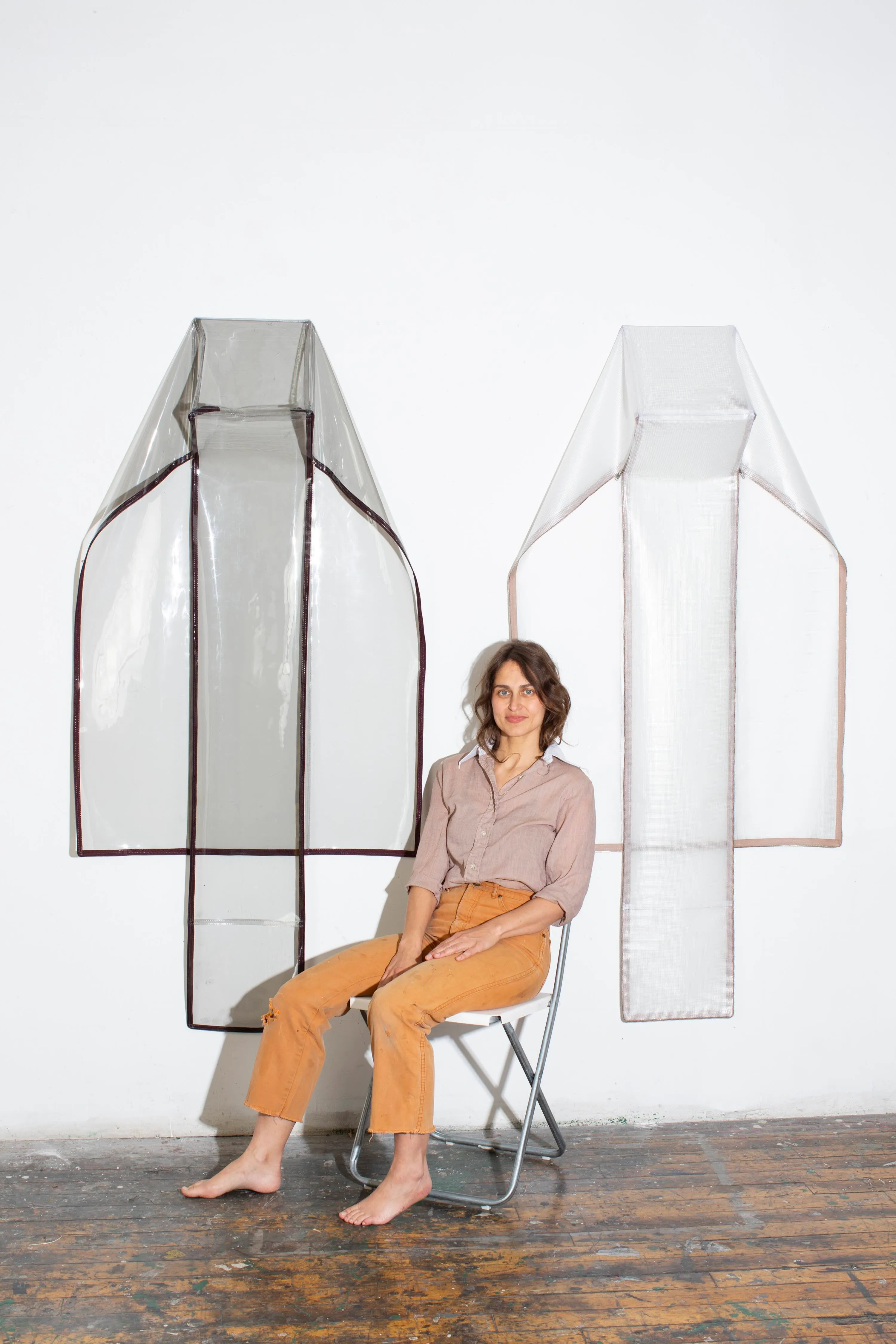
Plastic is the first thing we talk about in Alina Tenser’s Maspeth studio. She tells me that the aquamarine blue and umber vinyl constituting her collapsible packing cube-like sculptures is marine-grade—a 30- and 40-gauge plastic that she needs to use an industrial sewing machine to serge—as I zip and unzip the toaster-sized cubes. The action is immediately nostalgic, partially because there’s an inherent sense of play to these cubes, and partially because the strong scent of the vinyl reminds me of childhood experiences of plastic, like chewing on the flexible rubber of Polly Pocket clothes.
Tenser started to make these cubes a few years ago as cases for her concrete sculptures of letters of the alphabet. Ukrainian-born, she imagined them as containers that replicate the experience of compartmentalization inherent to speaking a second language, and she rendered them in a transparent vinyl associated with packing and the physical movement of immigration. Over time, they evolved into sleeves for her concrete sculptures of a single line that rotates at sharp angles, like a spiraling doodle made three-dimensional. This pattern, which repeats throughout her work, mimics Greek meanders—the running ancient Greek ornament that wraps around vases, jewelry, and the tops of buildings, symbolizing continuity, unity, and infinity. Tenser shows me pages of drawn meanders in her sketchbook and describes her interest in static objects that appear dynamic.
.webp)
In the small courtyard behind her studio, which we reach through a dark hallway that suddenly becomes a bathroom and then a hallway again, we look at her latest meander, Circuit Meander (2026), a circle of steel mesh on casters held together with neon green zip ties. Currently on view at September Gallery in Kinderhook, New York, it stands in the center of the gallery, where visitors circulate the sculpture while it remains unmoved. A projection of her 2023 video Walking in Circles with Sharp Corners plays on the wall above. Holding the camera at hip height, Tenser films herself walking in a circle in the shallow metal pan of a large, welded square filled with water that continues to run.
Repetition is the central unit of Tenser’s work, and her interest in the deceptively simple tension between rectilinear and circular forms appears again and again. Describing the relationship between Circuit Meander and Walking in Circles in a recent email, she emphasized repetition and rotation, and how “it is precisely the act of repeating a square path (in the video) and square shapes (in the sculpture) that creates a circle or circulation.” In the video, she crops each shot so as to never reveal the whole of the form beneath her, our focus centering instead on her movement, the continuous loop of circling.
— Caitlin Anklam
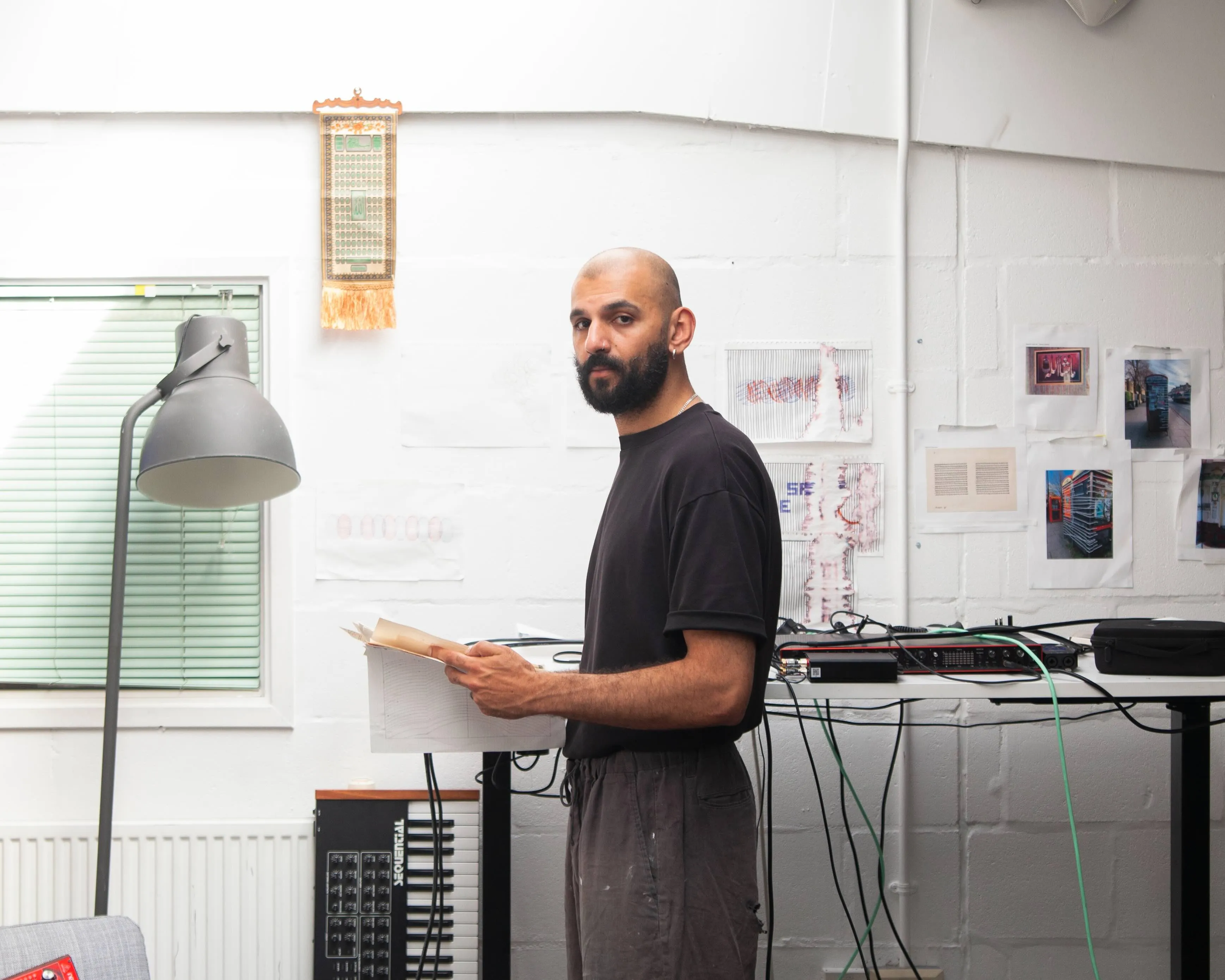
When Raheel Khan speaks of composition, he speaks of the movements between systems: the passage from stage A to B in history, the migrations of technical objects, and the crossing of bodies across borders. What arrests his fascination across these passages, however, is the contemporary residue that’s left in limbo, both sonic and material—warm, tired, on its last leg, yet holding a wayward feeling.
Born in Nottingham to a Kashmiri family displaced by the construction of Mangla Dam in 1966, Khan spent his early career in banking before becoming a full-time artist, carrying with him a personal understanding of the systems he now interrogates. Working across text, sculpture, performance, and sound, his practice becomes a volatile site where lived experience seeps into larger questions of global capitalistic circulation, migration, and governance.
Across his studio wall at Somerset House, London, is a print of German composer Hanne Darboven’s grids of choreographed lines (Untitled [c.1972]), bird’s-eye view and close-up photographs of tessellations in Mughal Architecture, sketches of crescent-moon-inspired semicircles arranged as graphical notations, iPhone images of municipal infrastructure, exhausted shop interiors, and taped-up telephone booths, a hand-torn corner of old invoice stating the terms and conditions of sale. What draws these references together is an obsession with loops, grids, and repetitions— conceptual apparatuses that undergird systems of control, their false promises and failures.
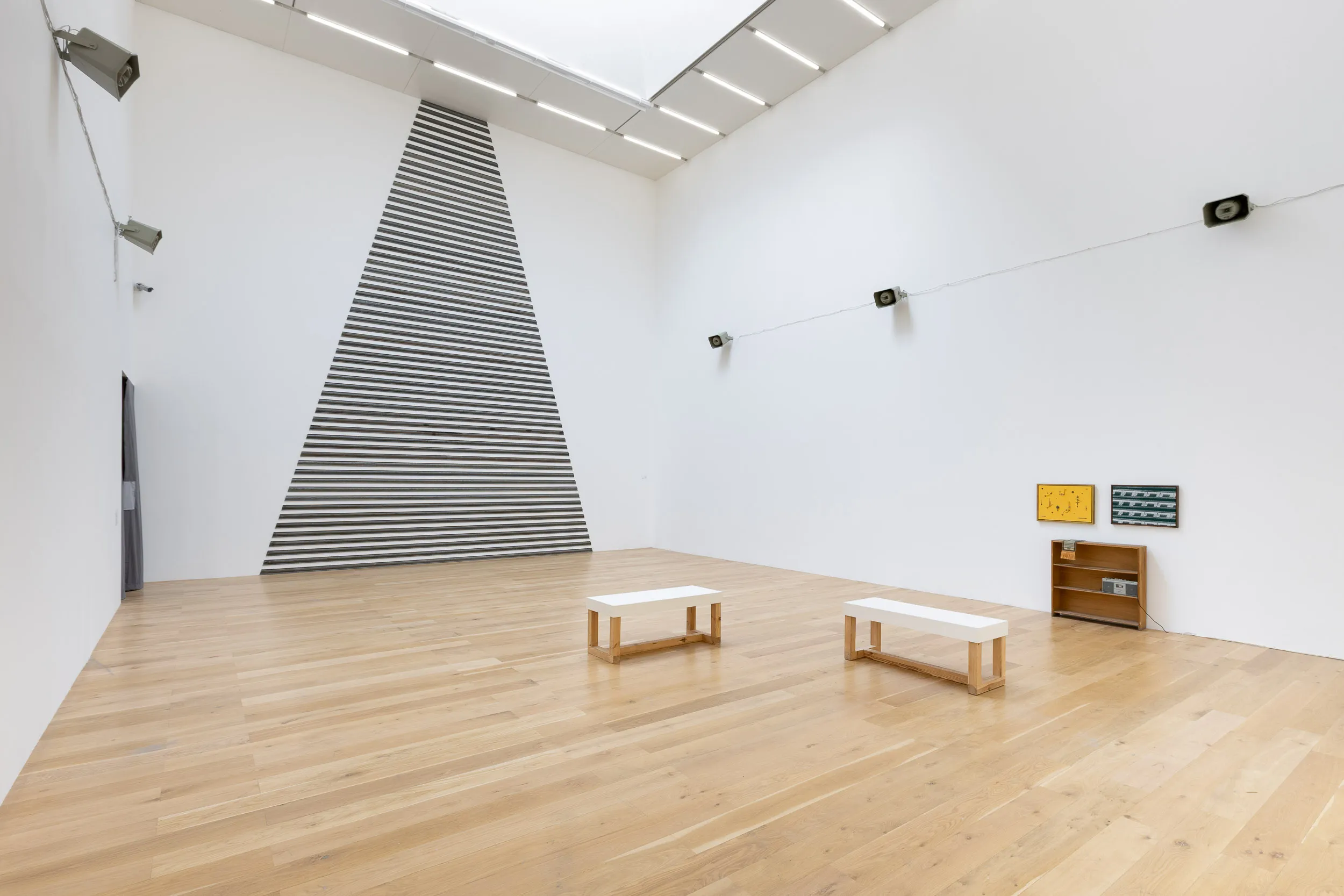
This attunement to site—arriving at a place with an impulse, a curiosity, a humility, and from there, ideas abstracted into language and brought to life by sound—evokes Khan’s site-specific methodology. In past projects, the artist has often worked from within the exhibition space, dynamically repurposing mass-produced civic infrastructures, such as shop shutter laths, discarded doors, gondola shelving, and Islamic prayer mats. This ongoing exploration of found material animated his commission, Flood (2025), for a group show at Nottingham Contemporary, in which Khan constructs a merging of the temporalities of the Mangla Dam and the British high street. Six tannoy speakers, typically used for civic announcements, are installed high toward the ceiling, playing a composition in which two soprano voices move in and out of a heavenly, elegiac synchrony.
“Sound is atmospheric—it brings things to life,” the artist said to me during our studio visit. Working with loops, as both material and subject of his sonic composition, the artist draws our attention not just to the soundscape, but its surrounding architecture and absence: the discordance between a breath, a tongue, a whisper, and a withholding of play.
Against the oppressive state and corporate surveillance listening, Khan’s practice reminds us that sonic borders, akin to our desires, are more permeable than ever. Currently, his renewed research interest in sirens as a civic infrastructure continues to formulate sonic relations with written scores and spoken words.
If catastrophe has a momentum—recall Walter Benjamin’s storm from paradise, the wind of “progress” that swept the Angel of History away from the past ruins into the future, Khan is someone who drags time, attuning to the disjunctions, leakages, and asynchronicities from modernity’s triumph. For him, a siren is not merely a warning of a certain ending, but a compelling signal of yet another passage: the forming of an inchoate world.
— Fiona Ye
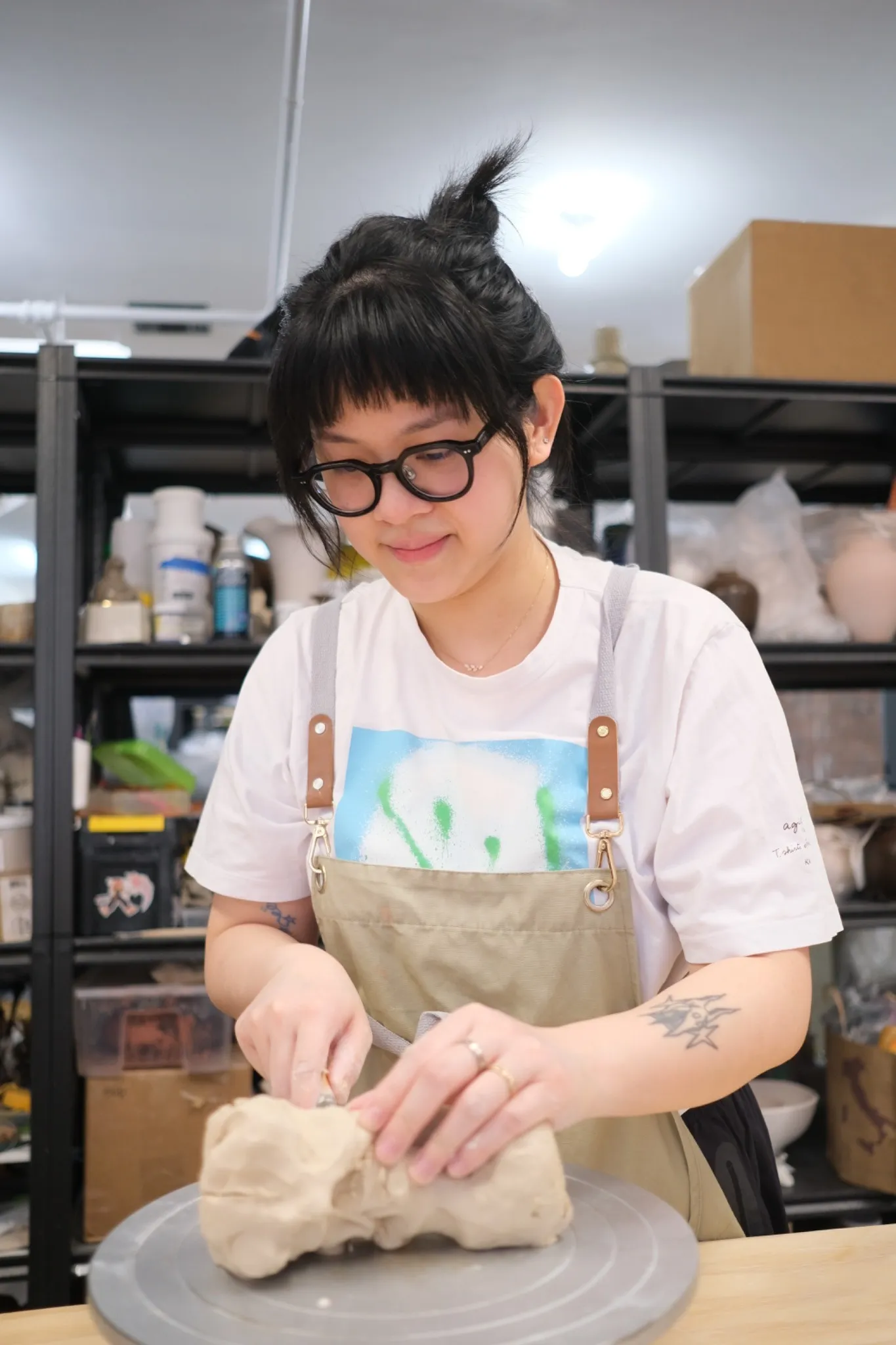
For Devon Chen, who is currently in residence at All Bout Clay, ceramics carry a sense of nostalgia, evoking memories of home. When Chen was younger, her mother spent years making ceramics in a neighborhood studio, a place where other moms of different ages gathered, drinking wine and working side by side. At the time, Chen saw the medium as overly traditional. But being far from home now, she has started to see it as a point of connection, where human interaction and memories live.
This idea of home extends into the thematic core of her work. Chen’s upcoming solo exhibition, The Dog Is Busy Having Hotel Breakfast, highlights the fine line between a desire for a better life and a desire for things.
Chen traces part of the exhibition’s impulse to a simple longing: hotel breakfast. Since starting and finishing grad school, she hasn’t had the financial freedom to travel much. Meanwhile, images of leisure—of people moving through hotels, buffets, transient luxuries—circulate online all the time. The dog becomes a stand-in, a figure that can inhabit and perform this “good life” in her place.
On one end of the table sits a large, hand-built dog head. Nearby, another sculpture takes shape: the lower half of a body in jeans, with bare feet planted firmly on the ground. In a smaller piece, a dog bends down to sniff and eat a mushroom. It’s a simple gesture, drawn from Chen’s own dog in Taiwan, and she finds herself infusing these small movements, such as sniffing, eating, wandering, into her work to bring a sense of warmth to her work.
What does it mean to feel at home, and how easily does that feeling become tied to consumption? Chen’s work doesn’t resolve this contradiction. Instead, it lingers in it, where longing attaches itself both to lived experience and to the objects that seem to promise it.
Her path to ceramics wasn’t direct. Chen originally worked in animation during her years at the Pratt Institute, drawn to movement and constant visual change. Over time, especially after beginning a yoga practice, she became more interested in stillness. Ceramics offered a pathway to reflect that shift.
Some of the works for the show remain unglazed, suspended in a state of indecision. Chen gravitates toward what she calls “cute colors”: pinks, light greens, a palette shaped by the anime culture she grew up being drawn to, yet she mentions being aware of the risk of such colors trivializing the work. The question of whether to lean into sweetness or resist it lingers at the edge of the exhibition. For now, the surfaces remain open, holding that uncertainty as part of the process.
— Peiyue Wu