

.webp)

Marc Kokopeli: “M.Kokopeli CURSED/01” at Gladstone
Review
Mickalene Thomas: All About Love
Grand Palais | 17 Avenue du Général Eisenhower, 75008 Paris
December 17, 2025 – April 5, 2026
All About Love, a solo exhibition by Mickalene Thomas at the Grand Palais in Paris, belongs to a multidimensional legacy: intellectual, emotional, and spiritual. It marks a notable moment: Thomas is the first Black woman to mount a solo show at the institution, following presentations across the States and Europe. Referencing bell hooks, the title acknowledges the practice of citation and return through which Black women artists sustain one another. In a moment saturated with images of suffering and exhaustion, this exhibition offers something rarer: an atmosphere grounded in feminine interiority and radical softness.
In All About Love, collage functions as both technique and organizing principle. Thomas’s rhinestoned paintings combine photographic sources, patterned surfaces, and fragments of art historical documents. The exhibition itself operates the same way, layering painting, photography, film, textiles, and staged interiors into a single environment. The reconstructed living rooms in each gallery form spaces that feel adorned and inhabited. In hooks's terms, the home becomes the ground where love and self-definition develop.
A portrait of artist Carrie Mae Weems appears in the first gallery, connecting Thomas to a lineage of Black feminist artists who have treated domestic spaces as sites of inquiry. Seeing decades of work gathered together is both inspiring and overwhelming, revealing the depth and persistence of an artist’s concerns over a lifetime. It brings to mind filmmaker Cauleen Smith’s reflection on utopia and creative labor: striving for something better with intention, even if the ideal is never fully realized.
There is a strong sense of comfort in the galleries: sofas and chairs appear throughout the installations, inviting visitors to pause and remain within the rooms. Books lie across tables as though recently handled: multiple copies of Native Son by Richard Wright sit alongside Song of Solomon by Toni Morrison. Objects accumulate with precision, constructing environments that reflect attention to everyday life—the careful curation of reading, decoration, rest. The work enacts a practice of attentiveness: noticing what is around, tending to relationships, and shaping spaces in which connection can occur. Each arrangement asks viewers to look closely and find themselves in the work.
All About Love is an exhibition that lingers in the mind. It reframes the mythology of romance so often associated with a city like Paris, and proposes something steadier. Love here is collective; it is studious. It is present in the accumulation of images and references, in the domestic spaces treated with the gravity they deserve, in the grounding of rest, and in the arrangement of objects that register the textures of everyday life. Love as method, love as structure, love as the thing you keep coming back to. Thomas makes a world where you come to feel close.
— Pola Pucheta
Cathleen Clarke: Episodes
Margot Samel | 295 Church St, New York
February 20 – March 28, 2026
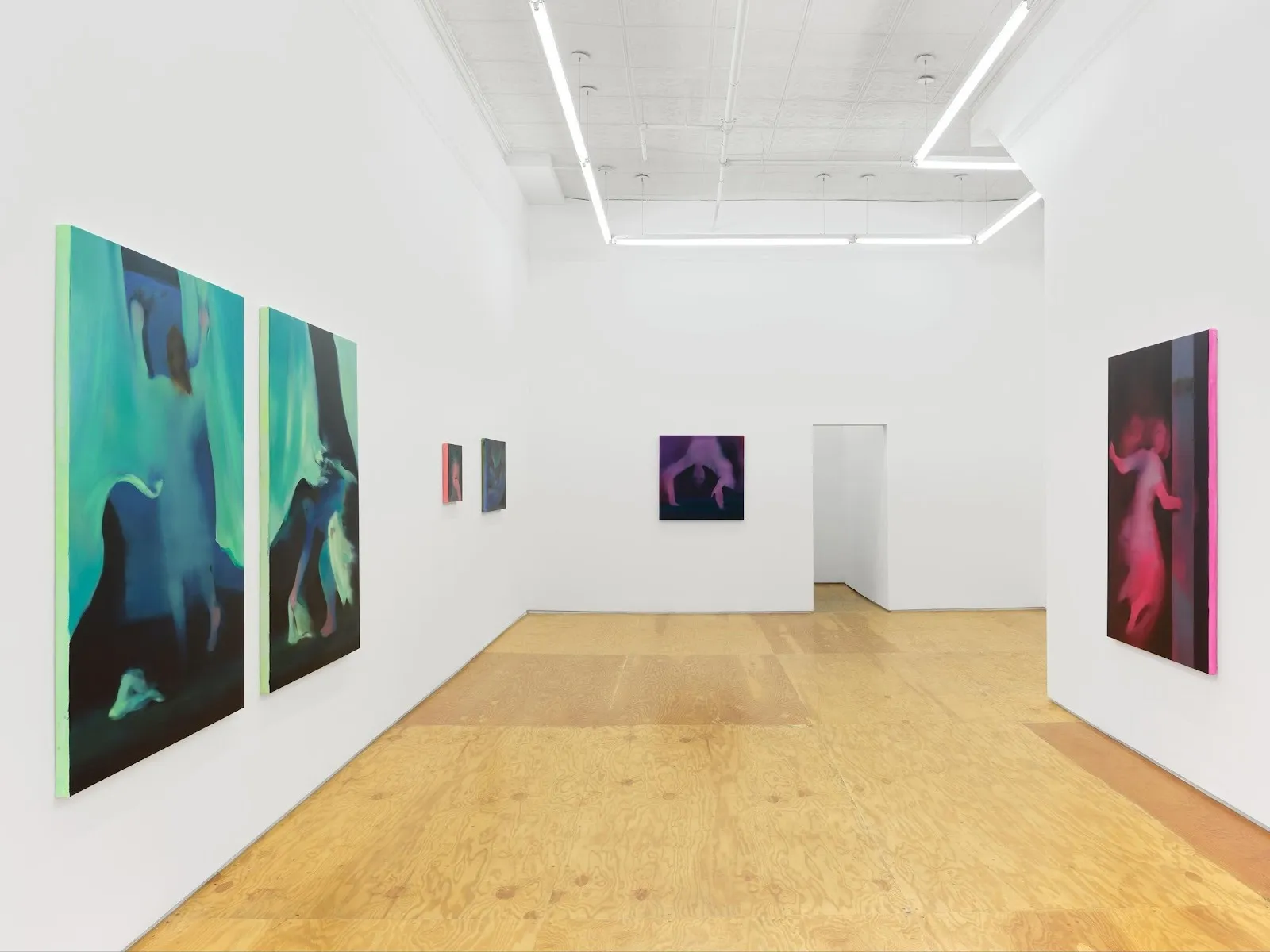
The figures in Cathleen Clarke’s paintings drift eerily between wakefulness and dreaming. They are constantly in motion, caught in blurry transformations, illuminated in iridescent light. Her exhibition, Episodes at Margot Samel, presents a self-contained body of work which gently weaves its characters through night and day. She imagines her scenes with a luminescent touch, shifting from soft to heavy paint, from deep darkness to delicate light. Like half-remembered dreams, her paintings brush up against familiarity with a feeling that’s still distinctly fresh.
As the viewer enters the space, the large diptych of The Dance I and The Dance II (both 2025) might first catch their eye. The diptych shows two frames of a figure attempting to close the curtains of a room, then stooping over to pick something up from the floor. Rendered in hazy greens, dark blue, and black, the domestic scene is given an unearthly atmosphere. Like a ghost, the figure appears to float and become enmeshed with the curtain, disappearing into ethereal green. Clarke begins each of these works with a bright layer of acrylic that remains visible beneath the layers of oil paint and along the edges of the canvases, creating an unmistakable glow.
The progression of paintings seems to reach its climax with Ebb Tide (2025), which shows a collection of figures on a mattress hovering before a darkened horizon. The figures are not distinct but are folded into one another, entangled. Here, the dreamer is lucidly imagined in a plane between earth and heaven. The sky sheds radiant light, drawing the viewer in with a soft magnetism. Episodes takes place in a world where astrological events, the movements of the sun and stars, are in intimate contact with the lives of dreamers. A world where the transcendence of sleep, the fantasy of nightmares, and the trauma of waking are indistinguishable; knotted.
In lieu of a standard press release, the exhibition text for Episodes by Alja Zoë Freier describes three fragmented, dreamlike scenes or episodes. Initially arising out of conversations between the artist and the writer, the text sought to illustrate some of Clarke’s dreams and memories that she was working off of in her paintings. As the text emerged, Clarke began to interpret and respond to it in new paintings, intertwining the narrative text with the exhibition’s content. Freier’s text is full of colorful descriptions, references to the sky, weather, and astrological events, processes of waking, dressing, and urgent rising—linked by an unnamed female character—which emphasize the visual motifs present in Episodes.
— Jonah James Romm
Hans Haacke and Louise Lawler
Maxwell Graham | 55 Hester Street, New York
March 5 – April 18, 2026
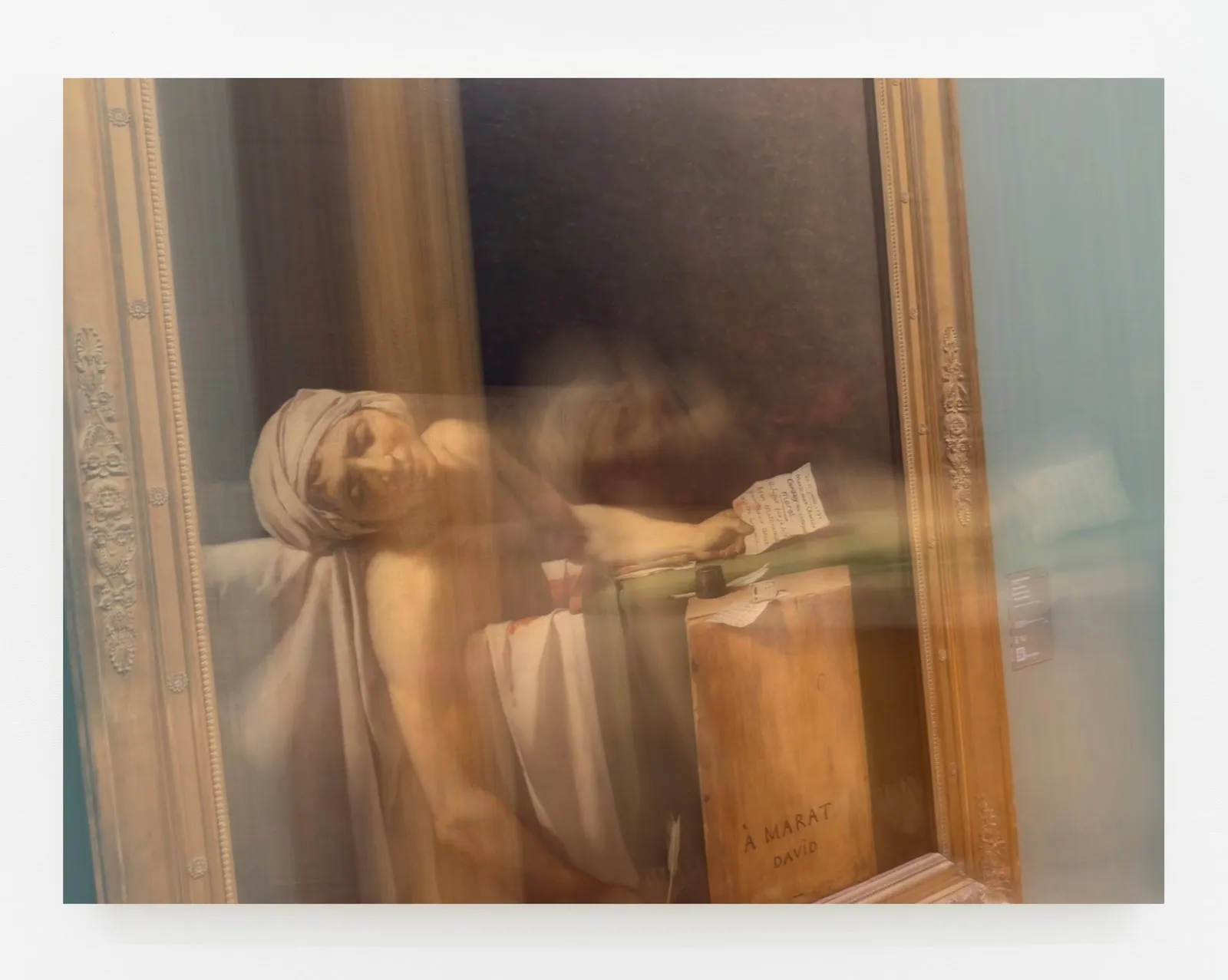
“Hans Haacke and Louise Lawler are artists of our times,” asserts the press release for their duo exhibition at Maxwell Graham. But what does it mean to be an artist of our time? The show’s subject matter is clearly political violence. Lawler sets the tone with Alizarin (Terrorists are made, not born) (2023), a series of red arrows printed on small white panels distributed across the gallery walls.
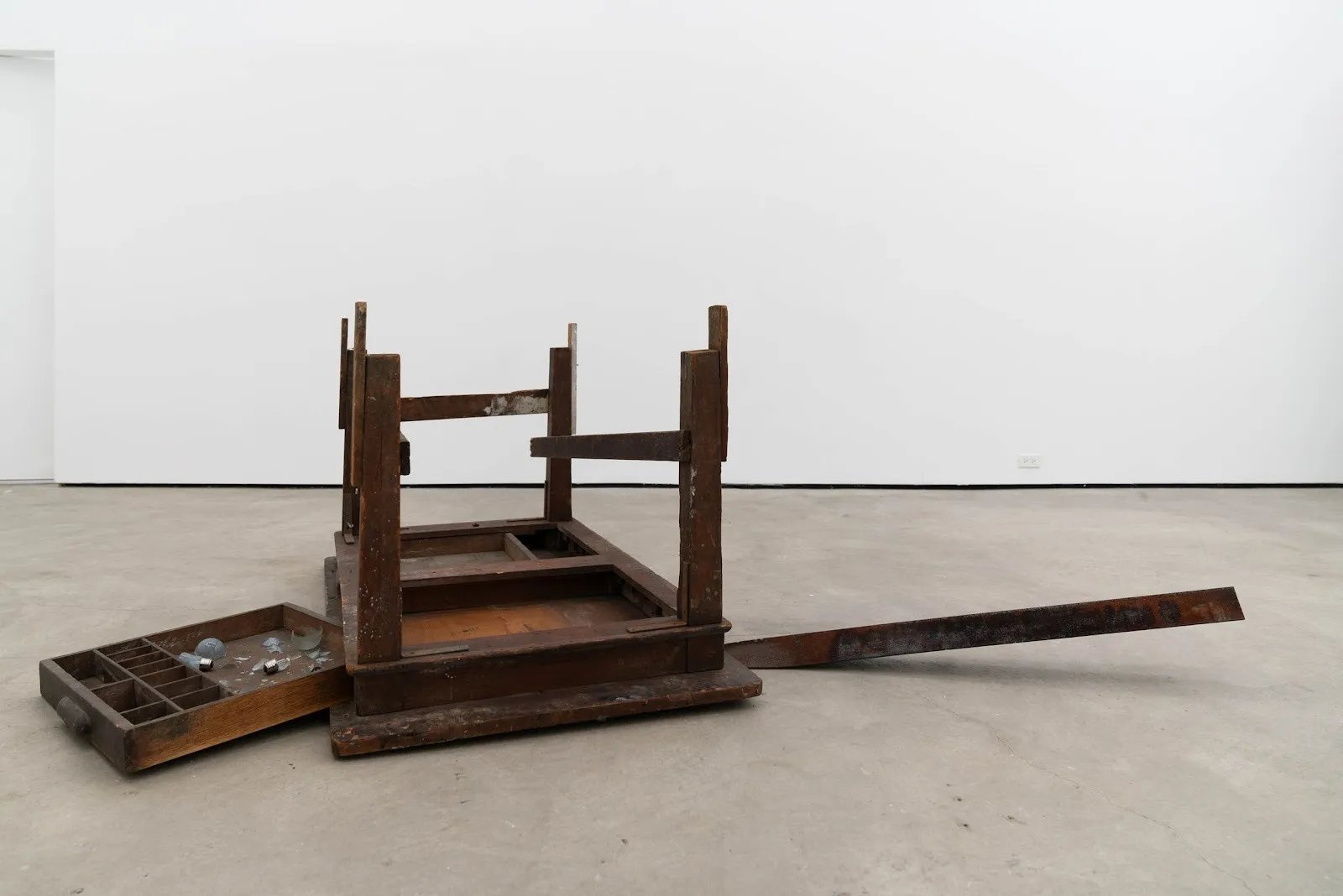
In dialogue with Lawler’s series and her new photograph, Before/During/After (Green) (2024/2025), is Haacke’s Untitled #1 (2005). This installation features an upside-down table covering a long metal piece with the welded text “LAST NAME FIRST NAME,” alongside a cabinet drawer containing broken lightbulbs and an American flag pin. Haacke previously showed this work in a 2005 exhibition, State of the Union. As the press release notes, the show reflected “on the aftermath of Sept. 11: this country’s wounds, the US government’s actions, and a conflicted and divided nation.” Haacke’s second contribution is We (all) are the people (2017/2026), a postcard featuring the titular text in multiple languages that visitors are welcome to take as a souvenir.
The press release makes a second assertion: “The times when an artwork is made and the times when it is exhibited is important.” While certainly true, the text’s decisive tone ignores the nuance lost when constructing these links between past and present. The danger lies in the fact that re-presenting older works, created in response to a highly specific context, often proves insufficient for unpacking our current historical moment. Take the term “terrorist”: in recent years, it has become increasingly evident that terrorism is a label deployed by those in power to define any agent who threatens that power—an elasticity recently exemplified by the attempt to brand Luigi Mangione as a domestic terrorist. Lawler’s title demonstrates an awareness of this dynamic. Furthermore, her work gestures toward the constant potential for anyone, perhaps those at whom her arrows point, to be driven to “terrorism” after being subjected to state, and often colonial, violence.
Because of this context, Haacke’s Untitled #1 feels somewhat anachronistic within the exhibition. Although it interestingly blends the figure of the fallen soldier (evoked by the dog tag metal bar) with that of the fallen citizen/worker (represented by the upside-down, broken office desk), the installation registers almost as a patriotic piece. It centers the American consciousness as the victim of violence, obscuring how the United States functions as a primary exporter of violence—whether through direct imperial interventions in places like Venezuela and Iran, or through proxy actions involving Israel. Revisiting the tragedy of 9/11 during our current conjuncture of unnecessary, manufactured wars, genocides, and ethnic cleansing could be a potent maneuver. However, the mere gesture of re-presenting an old piece in a new era, without any additional intervention, risks pretending that nothing has changed—or, at the very least, that nothing has happened to justify a reevaluation of the work.
— Yonatan Eshban-Laderman
Studio Visit
Performance Space New York, Hauser & Wirth | 134 Wooster St, New York
February 27 – April 11, 2026
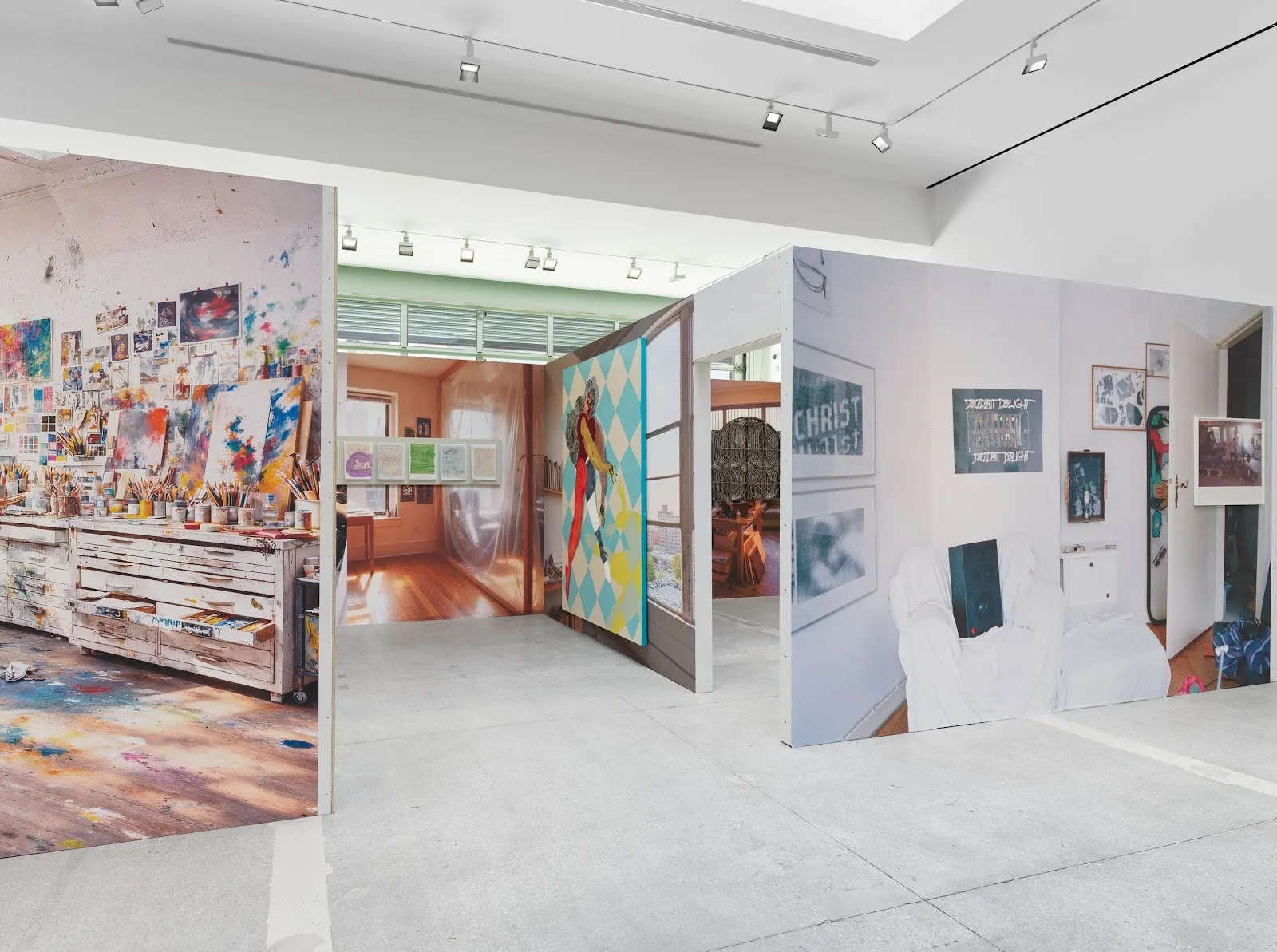
Partnering with Performance Space New York, artists Anicka Yi and Josh Kline collaborated to curate Studio Visit at Hauser & Wirth’s Wooster Street location. The exhibition unites twenty-seven of the most prominent figures in contemporary art, from Wolfgang Tillmans and Cecily Brown to Paul McCarthy and Huma Bhabha. Studio Visit’s curatorial conceit centers on the “studio” as a microcosm of inspiration, labor, and community—a ubiquitous point of artistic identity. While the artists embody a diversity of practices, generations, and nationalities, each artist submitted a written description of their first studio. Yi and Kline then translated the artists’ descriptions into AI-generated backgrounds for their respective recent artworks.
As such, Studio Visit does not merely show the studio’s impact and range; it embodies them through its immersive structure. Upon entering, visitors encounter the artists’ recollections printed and mounted against a green-screen backdrop. The staging wryly invokes the logic of the film studio, echoing the exhibition’s title while subtly blurring the boundary between production and representation. The documents themselves—some partially redacted with thick Sharpie lines—feel informal and unfinished, as though viewers were glimpsing notes pinned to a studio wall. Even the gallery layout reinforces this atmosphere: a sequence of compact rooms that echo the cramped scale of many artists’ early working spaces.
Many of their accounts recount modest beginnings in minuscule studios with little light or heat, improvising ways to both work and survive. For instance, Brown recollects constructing a bed frame that doubled as storage for paintings, while Jason Fox remembers first encountering a studio environment through university. These anecdotes underscore how creative practices often emerge from the simplest means.
Nevertheless, the AI-generated studio visualizations are the exhibition’s most contentious element. The renderings drift toward the idealized: paint dripping romantically down every surface produces an almost cinematic sense of productive squalor—a mythologization of the past’s grimy reality. Moreover, in dialogue with each artist’s current work, the AI backgrounds make it difficult to ignore the irony of using AI to memorialize spaces defined by human creativity, labor, and struggle.
Another notable exception to the exhibition’s coherence is the inclusion of Jean-Michel Basquiat’s The Sheriff (1981), the only work by a deceased artist presented as it might have appeared at Club 57. While the accompanying text connects it to Performance Space New York’s history, the artwork’s inclusion feels like an archival footnote in the show’s living exigence. Overall, through its exploration of the studio, Studio Visit reminds viewers of the beauty that emerges from humble beginnings, leaving one inspired to create.
— Tara Parsons
Stefan Sagmeister: I Look Like This
Thomas Erben | 526 W 26th St. 4th floor
March 5 – April 11, 2026
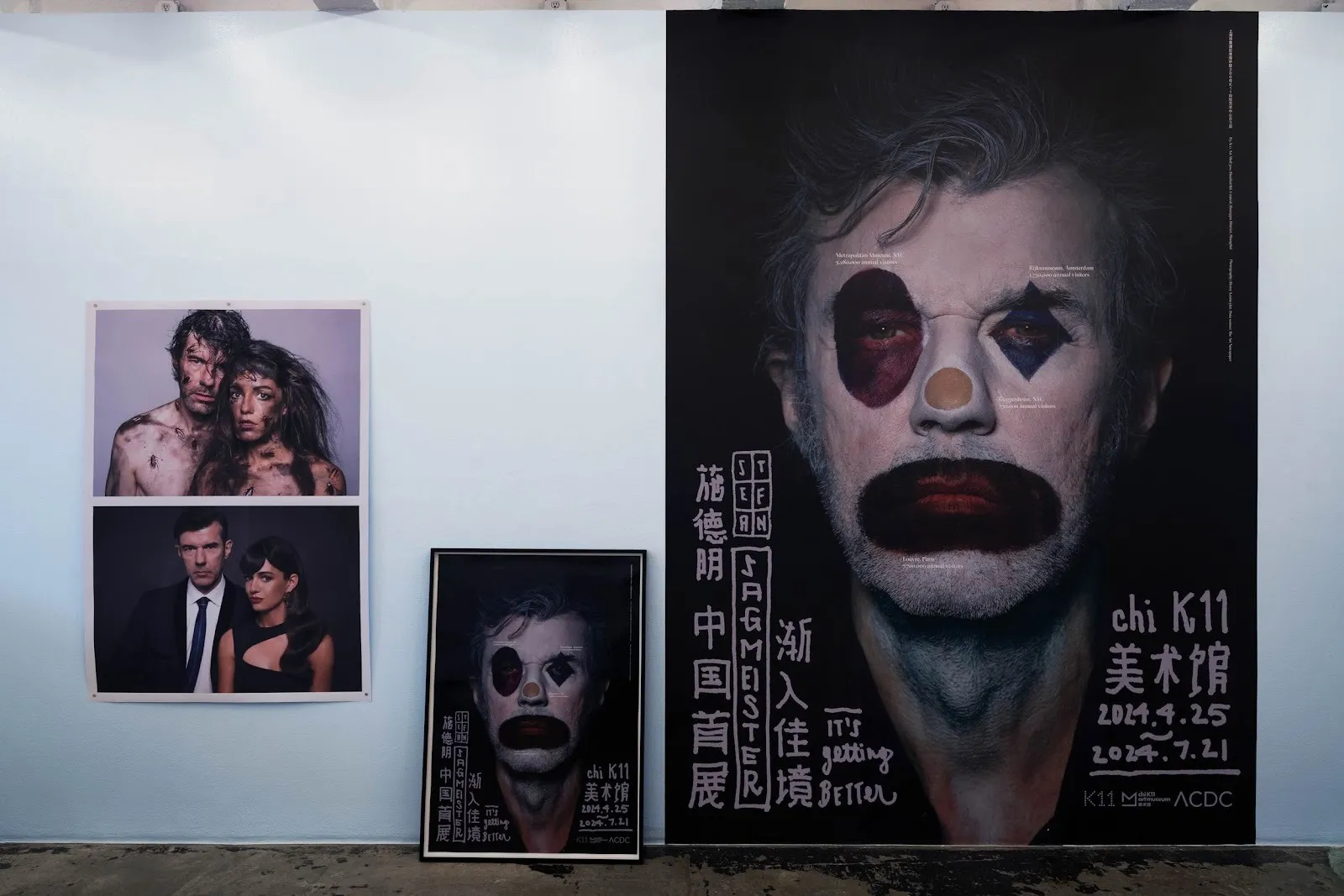
In the incessant visibility of advertisement and marketing material, it’s unusual to be confronted with images of startling or grotesque subject matter. The veiled authorship that sales strategies demand is upended in the design work of Stefan Sagmeister, whose exhibition I Look Like This on view at Thomas Erben presents a selection of self portrait posters. Although almost oxymoronic to attach “self portrait” with “poster”, Sagmeister finds a way to use the body itself as the tool for communication, playing with the very notion of authorship in design. I Look Like This is the first exhibition of its kind devoted to Sagmeister’s promotional materials, which demand the same formal considerations as photography or painting.
The field of design is still primarily shaped by the objective concerns of modernism, which has been co-opted to streamline corporate communication styles. What Sagmeister asserts with his signature approach to design is instead, a renewed subjectivity in the art of visual communication. When we look at a poster like AIGA Detroit, 1999 for example, we see the text scratched into the designer’s torso. It announces his lecture at the American Institute of Graphic Arts in Detroit with all of the associated dates, location, sponsors and ticket fees. Not only does the image communicate a specific event, it records a series of actions on Sagmeister’s body; an impression made by the gesture of communication. We see the author with voyeuristic clarity reaching for a box of bandaids on the edge of the frame, caught in the painful moment between articulation and reception.
In this collection of posters, Sagmeister displays his body with an almost exhibitionistic drive. From a McLuhanist perspective, his body is the medium which the promotional message acts and speaks through. The message frequently takes the form of expulsions from the body; blood (in AIGA Detroit), piss (in Everybody Thinks They are Right, 2005), hair (in Paris, 2011) or even fat (in GGG Tokyo, 2011). For the latter, Sagmeister gained thirty pounds in a week, showing before and after pictures of himself on a couch surrounded by the packaging of all of the sugary products he consumed. The text reads “Sagmeister Inc. on a binge”. If design language is built to appeal to the desire of the viewer, these images function as acknowledgements of the designer’s own desire, flipping the usual script, or at least, creating reciprocity out of a formerly one sided relationship.
— Jonah James Romm
Pello Irazu: Matter
Yancey Richardson | 525 W 22 St, New York
March 5 – April 11, 2026
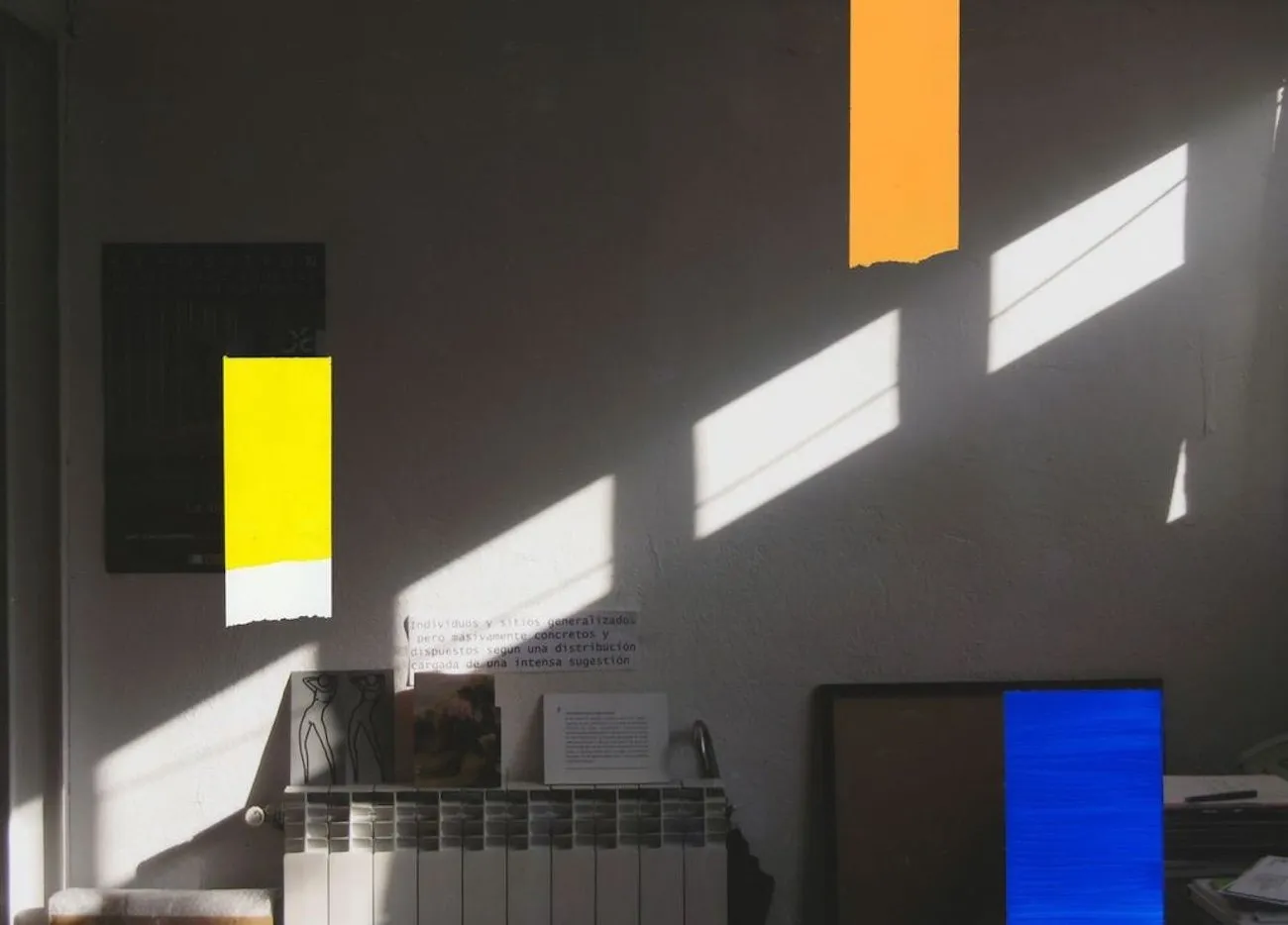
At Yancey Richardson Gallery, Pello Irazu’s solo exhibition Matter presents a collection of sculptural works and photographs interrupted with solid colored shapes—results of the artist’s ongoing experiments with the surface of images. The work Waves of Particularity (2025) starts from the artist photographing temporary sculptural structures built and arranged into simple spatial setups within his studio. But Irazu does not treat his photographic images as records of the sculptures—he painted bands mimicking wood, metal, and plastic finishes on the surface of the photos. These interferences act like a structural frame, partly covering and cutting the studio scene like painter’s tape. At the same time, the scene appears again inside an abstract network of color. Here, photography is no longer just a representation of objects; it becomes a surface that can be covered, reorganized, and rebuilt.
This intervention on the image surface becomes stronger in Demolition Strategies 1 (2025) and Ostensive Signals 2 (2025). Bands of color and flat blocks form a new visual order on the image. Irazu's photographs of the studio space thus lose a stable sense of perspective as space becomes flattened into many overlapping layers. Viewing also changes: the eye moves from recognizing objects to sensing the relations between structures. In these works, photography is not a window to reality—it is a material that can be changed, covered, and rearranged again and again.
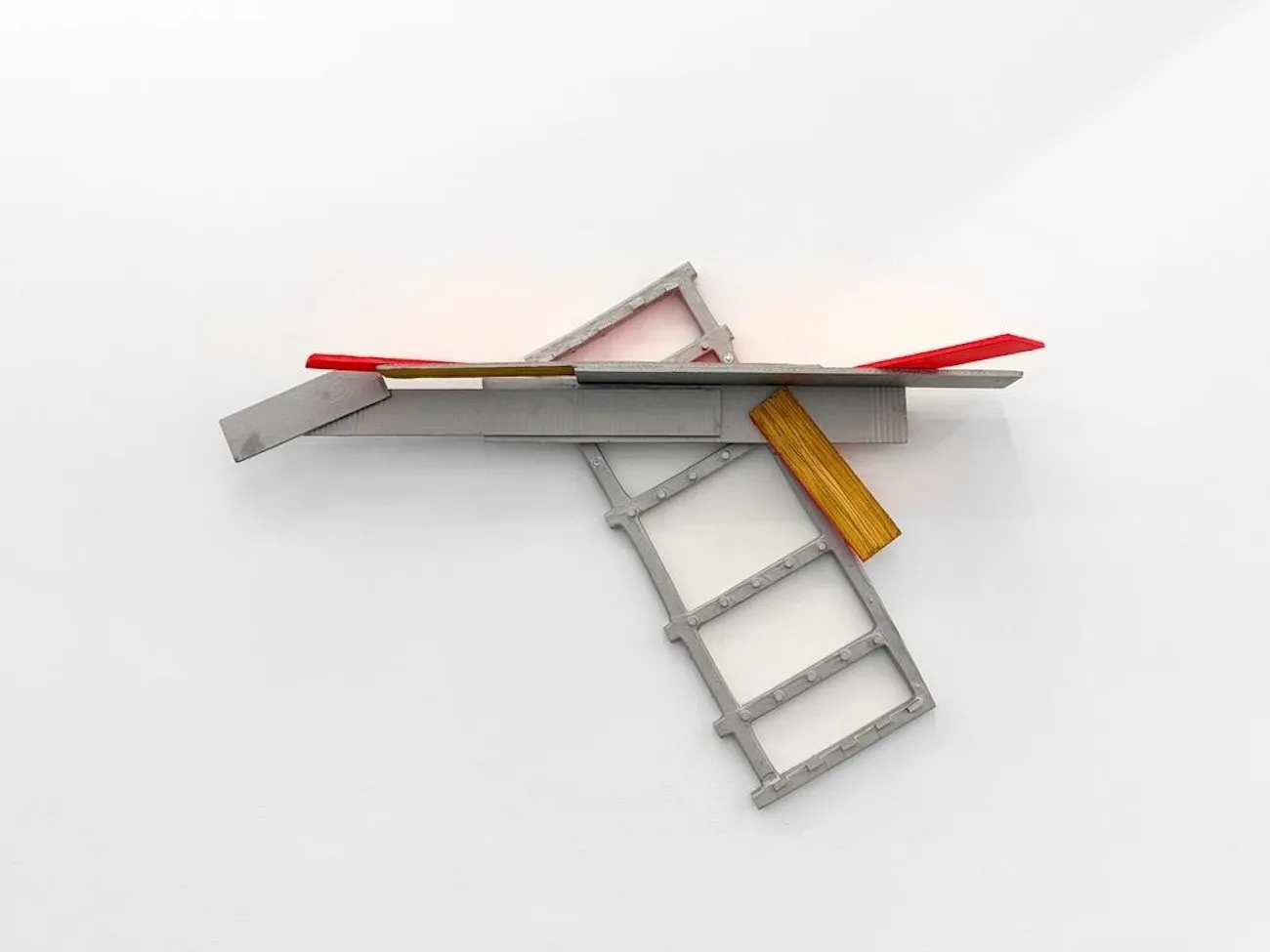
The sculptures in the exhibition push this idea from image to space. In Mimetic Processes 2 (Lay lady lay) (2025), a tilted cast-aluminum structure and colored planes create an unstable balance. The form appears as a supporting frame or an unfinished fragment. As viewers move through the space, the structure changes its front-back relations and visual center, making the work feel less like a finished object and instead a set of spatial relations that are constantly forming.
In The Work of Art in the Age of Mechanical Reproduction, Walter Benjamin wrote that even the most perfect reproduction lacks the unique presence of an artwork in time and space. Matter moves in another direction: it brings this presence back into the relation between image and material. At the same time, Merleau-Ponty’s idea of seeing is not simply observing an object from outside, but a bodily way of entering a network of relations. In Irazu’s work, the image is not just a representation, but it is also not a stable object—it is a structure that forms between surface, material, and space. In Matter, photography, painting, and sculpture are not separate mediums; they move into each other within the same visual field, giving the image a new sense of weight and presence.
— Shuhan Zhang
Rochelle Voyles: Unreliable Narrators
81 Leonard | 81 Leonard St, New York
Mar 12 – Apr 11, 2026
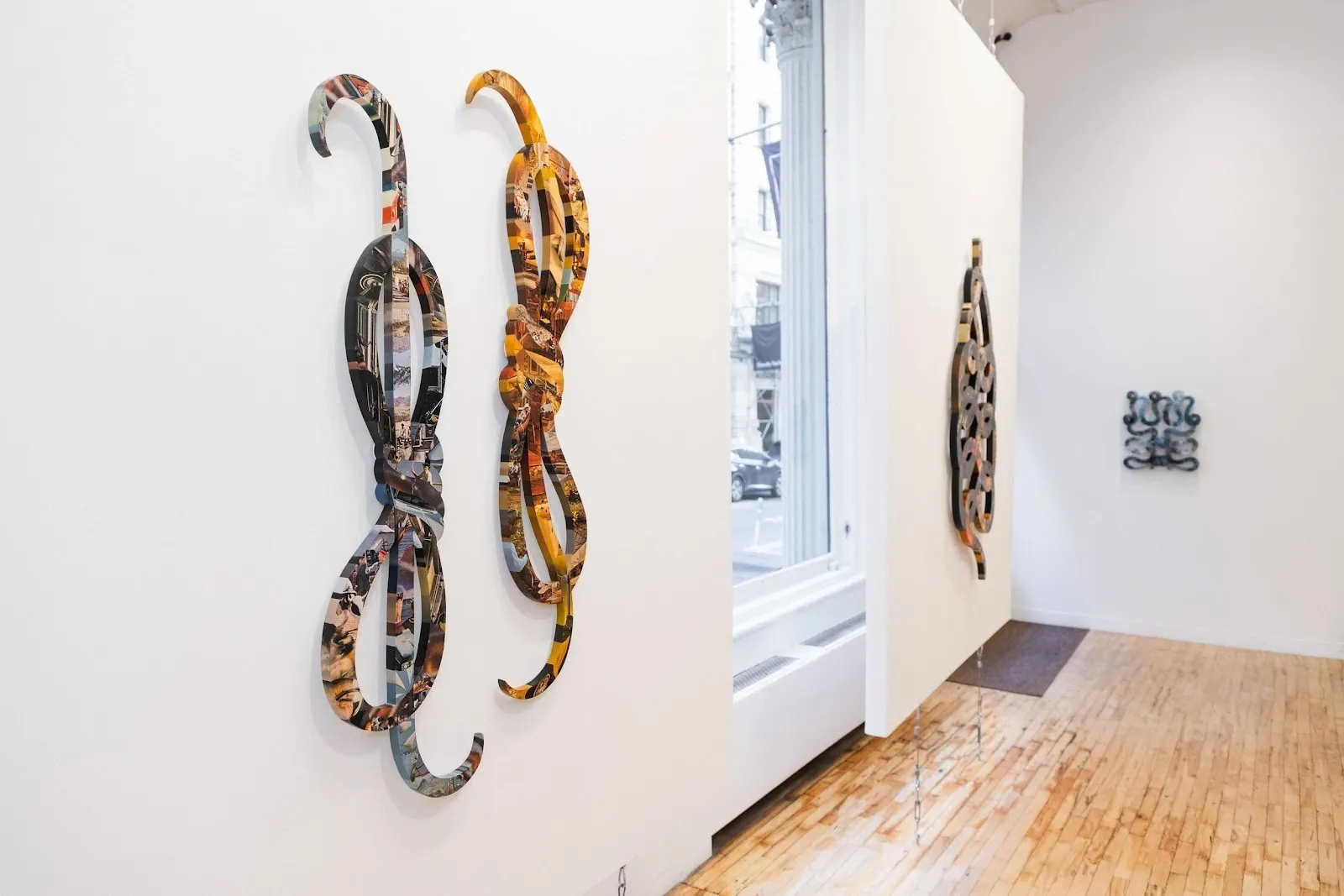
Rochelle Voyles’s Defense and Entrapment (2026) immediately signals an exhibition that refuses to play it safe. Drawing from her background in carpentry and a sustained interest in textiles, artist Rochelle Voyles’s solo exhibition Unreliable Narrators examines the friction within personal memory and collective history. Photographs are estranged from their original context; Voyles reclaims their stories through cutting, assembling, and reconfiguration. Archival images manipulated in this way circulate as deteriorating cultural tropes, revealing systems of oppression and the reconstructed stories left in their wake.
For Voyles, each jigsaw-cut sculpture describes a fragment of reality and the human experience. Hand-cut silhouettes interlock across the surface, painted borders bleed into the photographs, and a thin varnish gives a subtle sheen to the surfaces. As each sculpture takes shape, it informs the collage, and the piece becomes the narrative. Voyles threads these experiences with disorder, cultural erasure, and war, evaluating both inherited conclusions and open-ended desires.
While some interlocking shapes read as ties, linking her thought systems, others manifest as roots that ground the imagery, communicating from one piece to another. Smaller remnant sculptures emerge from their larger counterparts, shaped from scraps that fall after being hand-cut. These smaller forms become lost stories—pieces no longer active in the larger composition, but meaningful in their fragmented, amalgamated state.
Voyles’s objects possess a fluid, malleable quality, appearing to stretch and unravel. Viewers are asked to excavate their own realities from the visual records they inherit. At times, this work feels like a simulation, where colonized worlds and biased histories complicate recognition of the alternate realities we presume to know.
The two-part blue and orange collage analyzes masculine and feminine stereotypes through cowboy Americana imagery—archetypes built on erasing other races from alternative subcultures. Cropped images of cowboys, rodeo gestures, car interiors, and herding cows collide with fragments of domestic imagery, creating tension between rugged masculinity and its constructed counterpart. The edges of the sculptures are painted, elongating the stretch of memory and the act of partial recall. Voyles gives the works a film-like quality through jump cuts, allowing moments to shift rapidly while maintaining the sequence and momentum.
By portioning and repositioning visual records, Voyles shows how images, like the continuum of memory, can become layered and reinterpreted over time. The work asks viewers to confront contradictions embedded in narratives that rarely resolve into coherence. Voyles’s works leave viewers suspended between past and present, memory and perception, revealing the fragility of consciousness.
— Aliya Nimmons
François Durel: Minor Enclosures
Super Dakota | 87 rue Stanley, 1180 Brussels
January 15 – March 13, 2026
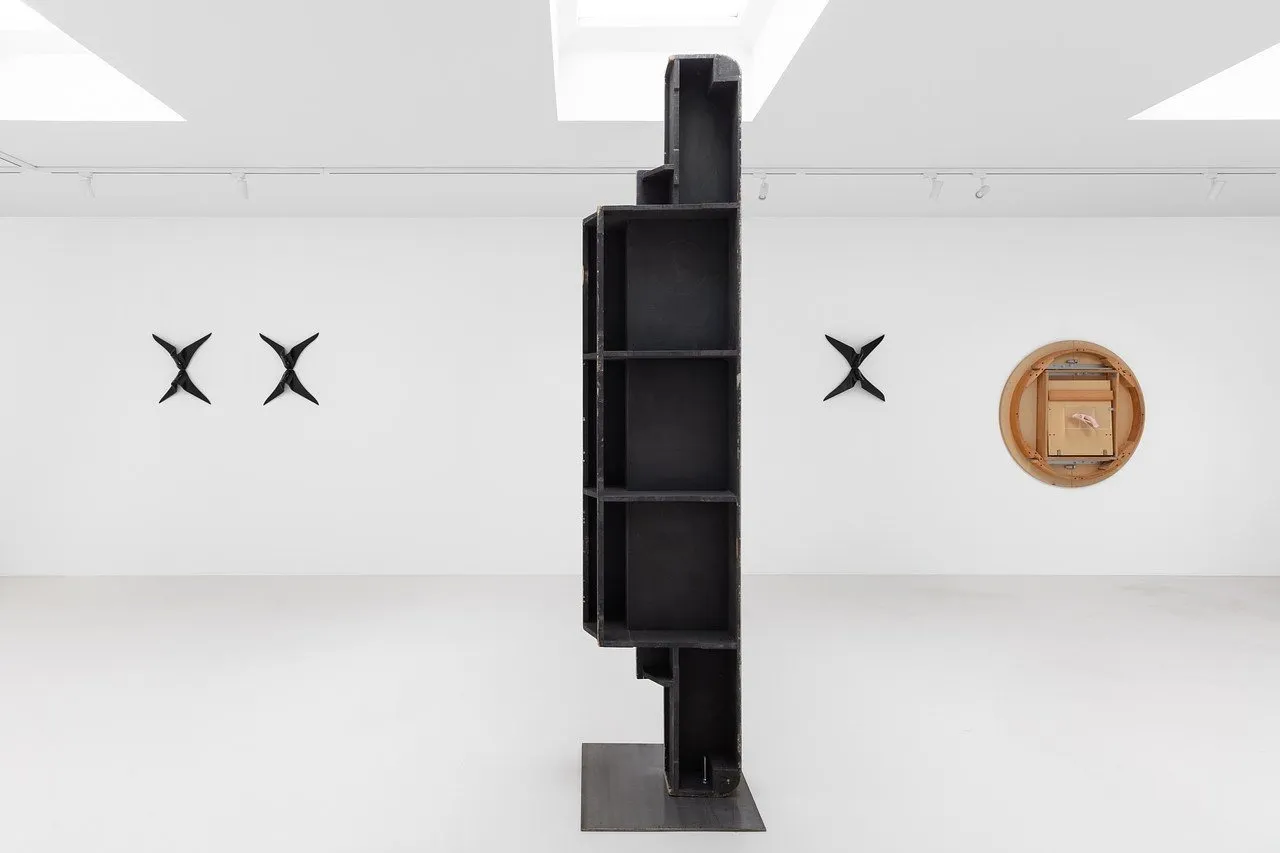
For his first exhibition in Brussels, artist François Durel takes everyday objects and reverses their pre-determined identities, presenting them as indices of their functions and therefore altering the viewer’s relationship with said objects. Consisting of an intimate selection of multidisciplinary works, Minor Enclosures is situated in a singular gallery and examines the social and cultural values of objects. Architectural and sculptural objects are the core of the show, although photography is exhibited as well. Art critic and historian Michael Fried believed in objects as soundly existing in the realm of non-art, arguing that minimalism did not have a place in the modernist era—while that opinion is still very much up for debate, Durel’s works certainly hold up within a Foucauldian sense and this contemporary era.
Within the artist’s works, the subject matter has largely been stripped away, resisting the mystification of art objects by having no illusory composition. In fact, Durel’s works seek to demystify and present plainly the use of objects within apparatuses of labor and control, prompting us not only to see the quotidian, banal manifestations of power but also to consider an object’s latent potential for new uses, meanings, and significance. Several large tine harrows are displayed throughout the show, serving as a formal grounding for the exhibition. Harrows usually serve as tools used by farmers to turn soil; in this case, Durel has painted these arrows with slick car paint, causing them—Index, Pulse, Delay I (2026), in particular—to glow. In taking these tools out of their use case environment, manipulating their surfaces, and situating them within the sterile white cube, Durel renders the object unfamiliar, opening it up to an affective plane in which new symbolic meanings can unfold.
Protocols I–VI (2026) is a series of black-and-white photographs that refer to the gesture of ringing a bell. The photos segment the movement of a bell going up and down as one touches it, which speaks to simple moments that one may overlook. Capitalizing on this sentiment is Tilt (undefeated, it rested on its lover’s arms, unrested but withholding all triumph) (2026), which at a distance appears to be a closed geometric form but is actually a huge set of stairs isolated and turned on its side. Durel plays with the piece’s ratio by changing its stance—instead of placing the stairs in a horizontal position that one would walk up, it is instead a cross-sectioned, vertical sculpture that one must circumambulate, not touch.
Durel’s repurposing of these objects reminds viewers that we don’t often think of these everyday moments, such as climbing the stairs, ringing a bell, or picking up an arrow. There is a choreography to those repetitive moments, which causes one to wonder how would they feel if said moments were to change course, or suddenly slip away.
— Adrianne Ramsey