

.webp)

Sonia Boyce: “Demonstrate” at the Queens Museum
Review
The vastness of the Amazon can create a sense of dissolving within its scale, a sensation not unlike standing in New York’s Financial District, where skyscrapers rise with a different yet equally imposing authority. Occupying the space between these parallel architectures of dominance is Ana González’s solo exhibition at Sean Kelly, RÍO.
Sublimation printed onto tarp, TEQUENDAMA (2025) depicts a river dramatically descending through the titular mist-filled gorge in a dense jungle. Translating to “he who precipitates downward,” TEQUENDAMA is part of González’s Devastations series, in which González unravels the printed fabric thread portraying Amazonian and Andes Mountains rivers by thread from the bottom up. The material tearing undeniably alludes to the demise inflicted on the very landscape the work is embedded in; the destruction of fibers subtly mirrors the eradication of the forest from which they originate. Tarp can be associated with strength and the ability to withstand time; its shredding, then, signals a structural failure of its original intent. What begins as a formal disturbance becomes a metaphorical one; the notion of Amazonian preservation, infinite abundance, and pristine wilderness begins to fray before the viewer’s eyes. González’s composition reminds us of the transformative reality of a landscape dissolving before our own eyes, an avoidable yet impending demise.
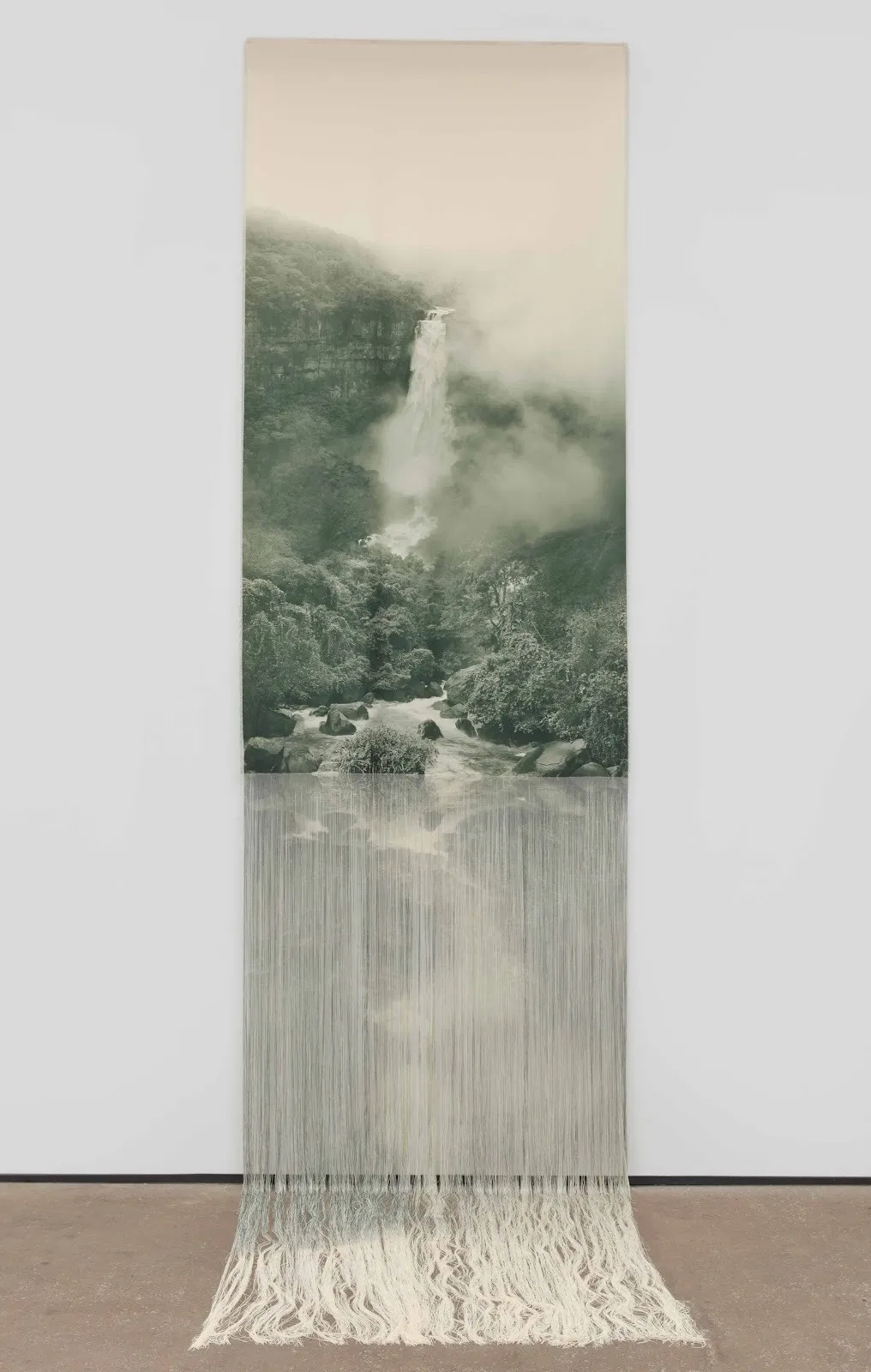
TEQUENDAMA’s shreds of fabric spill onto the floor, collapsing the space between viewer and once-distant landscape. González’s body of work seems to ask, how close are we to environmental collapse, and how are we implicated in its demise? Ecofeminist theory responds to this inquiry by outlining common binaries—man/woman, self/other, nature/culture—as both manifestations and instigators of hegemonic, destructive ways of life. Nature has been divorced from culture, cast as Other; thus, it can be extracted from, and its exploitation no longer triggers moral friction.
This Western construction of dualistic oppositions and hierarchized matter becomes especially relevant to the recent surge of Amazonian gold mining, in which the economic value of this resource outweighs the underlying ecological repercussions. This logic contrasts the way indigenous communities understand nature as a living body—a sentient organism in which rivers, mountains, humans, and animals are interconnected organs.[1] Nature is perceived not as external to humanity, but as a condition of our existence.
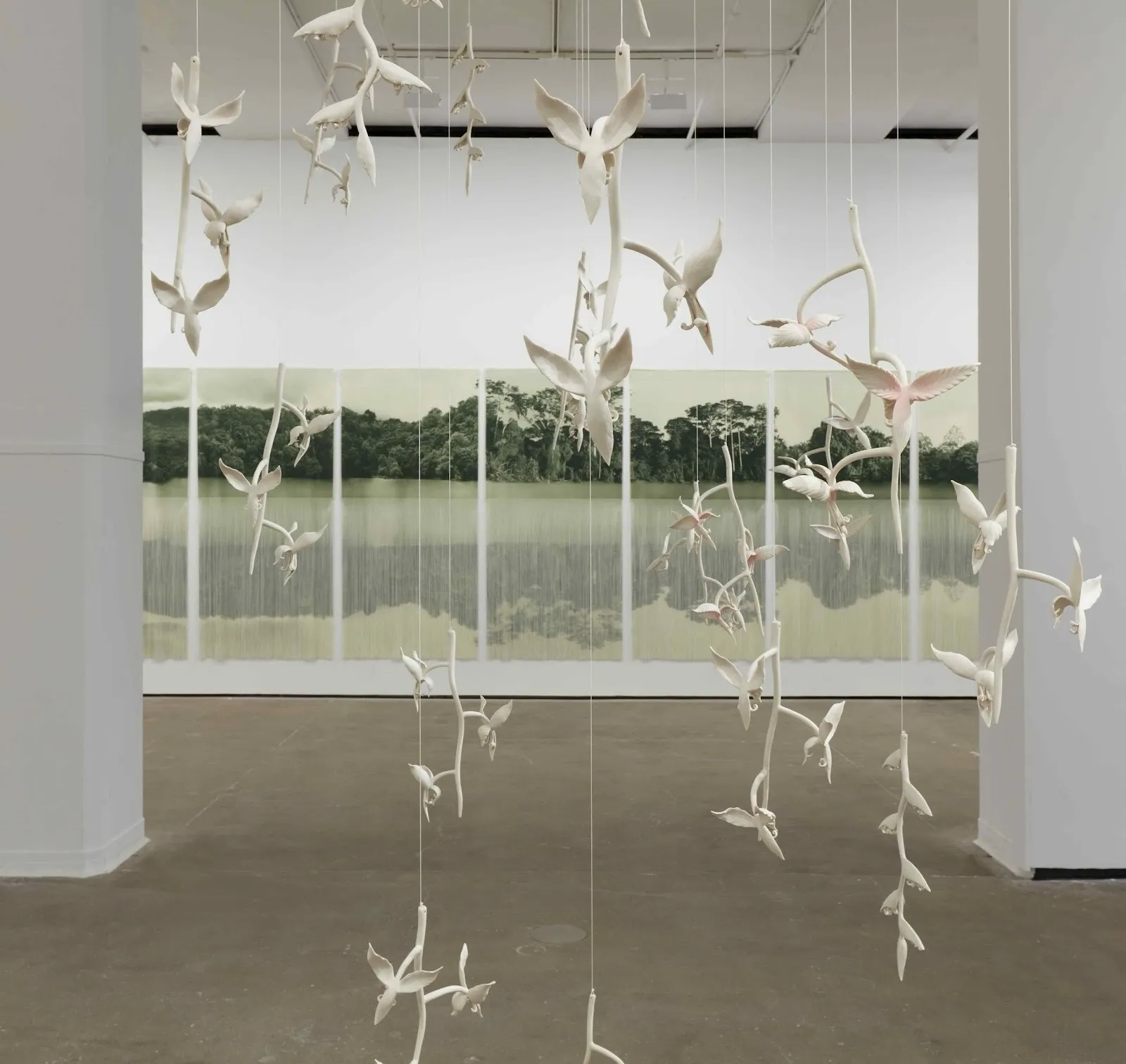
Where TEQUENDAMA reveals a landscape unraveling under hegemonic, extractive logic, Jardin (2026) offers a meditation on the fragile architectures of interdependence endangered by such thinking. Jardin drapes Limoges porcelain Gongora- and Heliconia-like forms along fine vertical wires suspended from a cloud-shaped structure from the ceiling. The form of the Heliconia flower is evolutionarily adapted for hummingbirds, the curvature and depth of the bracts corresponding to hummingbirds’ beaks. This coevolution manifests as nature's structural expression of interdependence. Similarly, the Gongora flower is one of the oldest species in the Amazon, and its evolutionary survival relies on Euglossine bees. In this way, Jardin appears to invoke Indigenous understandings of the world that conceive us as mutually dependent agents within a shared ecosystem. The selection of surviving, evolved plant species elicits a chord of endurance, yet their existence is as fragile as translucent porcelain. What has endured for centuries can dissolve in an instant.
Our obsession with growth in extraction without limit assumes that regeneration is continuously guaranteed, and González's work reminds us of the urgent fragility of this exploitative relationship with nature. Grounded in the ethics of degrowth, González foregrounds fragility and interdependence rather than productivity and accumulation. In doing so, her work questions the capitalist dream of endless expansion and questions the reliance on invisible reproductive and ecological subsidies that sustain it.[2] The works on view instead incentivize us to pay attention to small dependencies that shape our existence, to turn away from grandiose notions of heroic salvation and instead dive into meticulous care. Care, therefore, becomes our hope for a quiet infrastructure of survival.
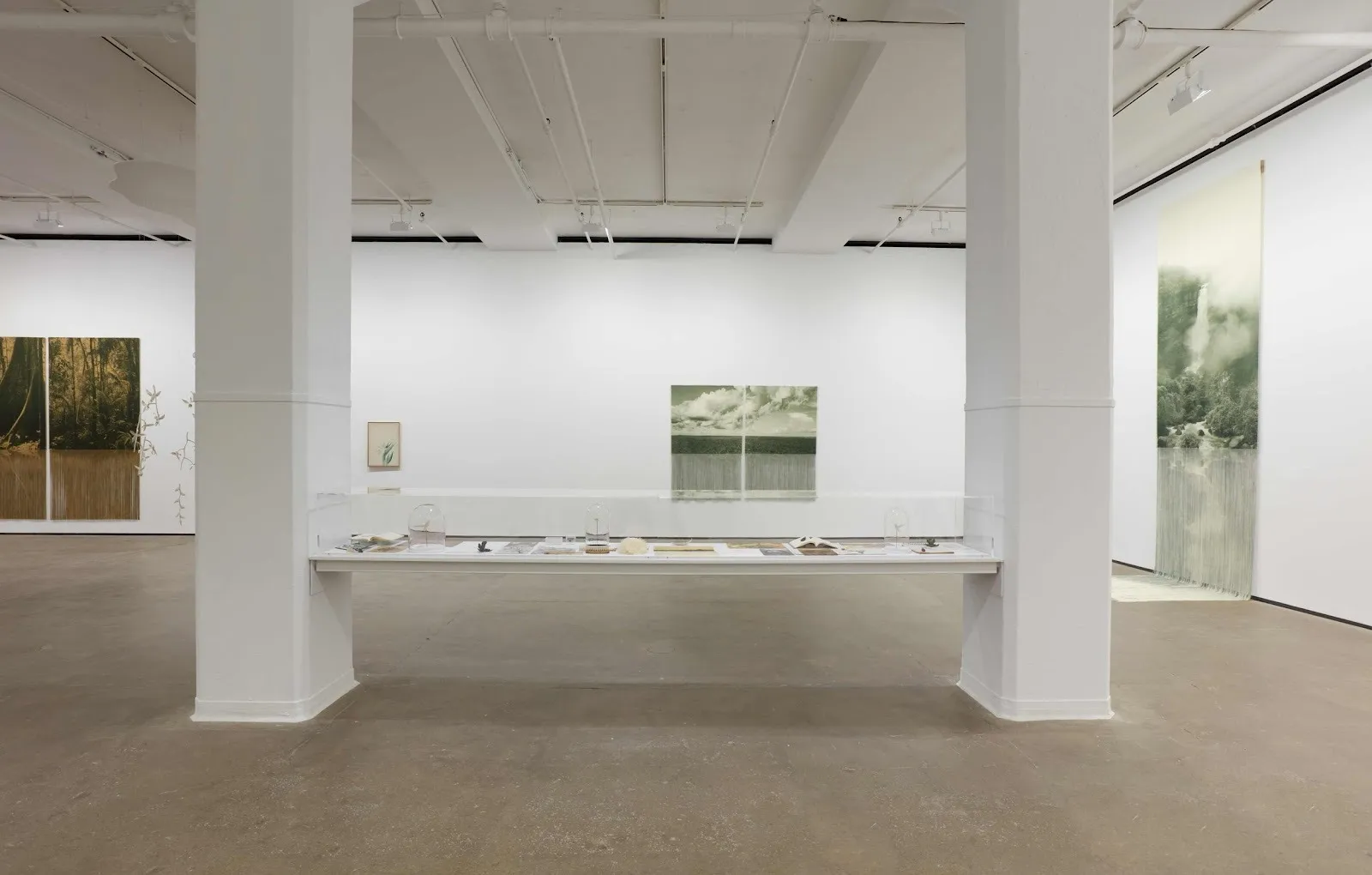
Ana González: RÍO is on view at Sean Kelly Gallery from February 27 through April 11, 2026.
[1] Hannah Elizabeth Parathian, “Understanding Cosmopolitan Communities in Protected Areas: A Case Study from the Colombian Amazon,” Conservation and Society 17, no. 1 (2019): 26–37.
[2] John-Oliver Engler et al., “15 Years of Degrowth Research: A Systematic Review,” Ecological Economics 218 (2024): 108101.